
Why a Piano Maker Wants the Screen: Yamaha's £215m Bet on Disguise and the Concert Visual Arms Race
Updated:
Most people who have stood in a stadium watching a stage-wide LED wall bloom behind Beyoncé, Taylor Swift or Bad Bunny have never heard of the company that kept those pixels in sync. On November 13, 2026, that company got a new owner. Yamaha Corporation — the Hamamatsu group behind pianos, guitars, mixing consoles and PA systems, not the motorcycle maker — announced that it will buy Disguise, the London firm whose media servers and software drive the video on many of the world's biggest tours.
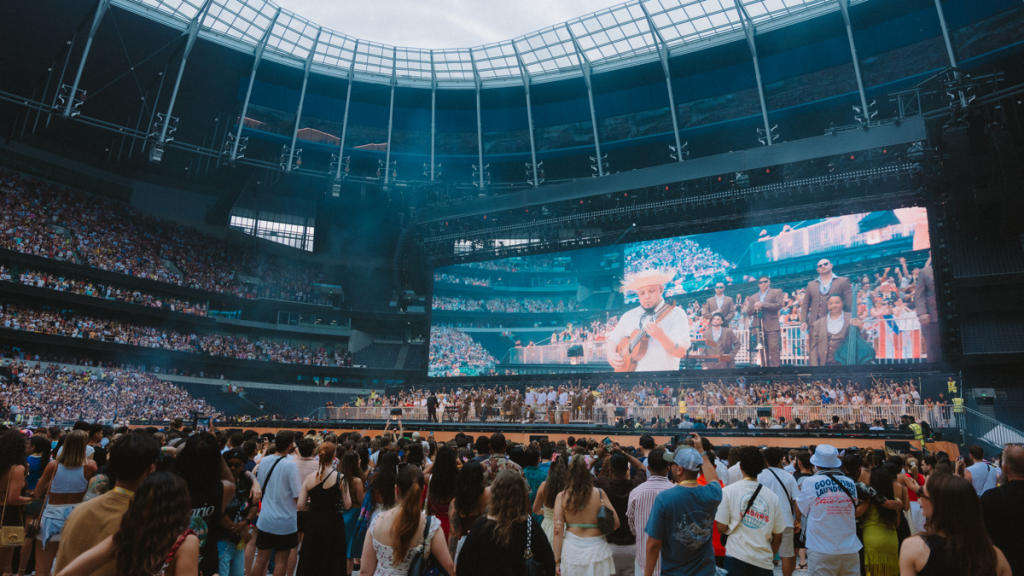
Bad Bunny at Tottenham Hotspur Stadium. Photo: Disguise
On the surface it is an odd pairing: a 139-year-old instrument maker buying a company that sells screens and real-time graphics. Look closer and the deal says something specific about where the money in live music is moving — towards spectacle — and about how a company that has always sold what audiences hear now wants a share of what they see.
The deal, in numbers Yamaha actually filed
The press coverage on announcement day said little about money; Digital Music News noted that no terms had been made public. Yamaha's own disclosure to the Tokyo Stock Exchange, published the same day, fills in most of the gaps:
- What is being bought: all shares of Butterfly Topco Limited, a holding company set up in February 2021 that indirectly owns Disguise Technologies Limited. Disguise becomes a wholly owned subsidiary.
- Price: £215 million for the ordinary shares and shareholder loan notes, about ¥46.1 billion at Yamaha's conversion rate of ¥214 to the pound. Including roughly ¥1.6 billion in estimated advisory fees, the total is about ¥47.7 billion. Yamaha separately expects to pay about ¥3.2 billion to repay bank borrowings tied to the transaction. The final figure will be fixed at closing.
- Sellers: a Carlyle fund vehicle (CETP IV Investment 7) holding 58.16%, Livingbridge with 5.64%, and other shareholders — including management and employees — with the remaining 36.20%.
- Timing: the agreement was signed November 13, and completion is scheduled for December 2026. Until then this is an agreed deal, not a closed one. Yamaha says the effect on its consolidated results is "under review."
Carlyle's ownership dates to March 2021. Disguise's own announcement at the time said Carlyle would take a majority stake, Epic Games (maker of Unreal Engine) a minority stake, and existing backer Livingbridge would reinvest. Founder Ash Nehru remained the largest shareholder among employees. The pitch then was virtual production: in the previous year, more than 150 Disguise xR stages had been built in over 35 countries. The "more than five years of high growth under the ownership of Carlyle" in this week's announcement covers that period.
What Disguise actually does
Disguise is not a screen manufacturer. It makes the layer between the creative team and the LED panels or projectors: Designer software to plan, preview and sequence video content across irregular surfaces, and media servers that play that content back in real time, synchronized with the music, lighting and camera feeds. Yamaha's notice describes it as an "end-to-end workflow from pre-production content design to synchronized playback and real-time control during live events," sold in more than 100 countries through over 400 partners.
It started as a touring media-server specialist and, under CEO Fernando Küfer, widened into broadcast, film and fixed venues. The announcement lists tours by Beyoncé, Taylor Swift and Bad Bunny; venues including the Burj Khalifa, the Stade de France and Tottenham Hotspur Stadium; Top Gun: Maverick and Project Hail Mary on the film side; Netflix House; and Disney's Hercules on Broadway and in the West End. Those credits come from the companies themselves and should be read as such.
The most important credit is Sphere in Las Vegas. Sphere has used Disguise media servers and software since it opened in 2023 to process and play back content for its residencies. In September 2026 the two companies signed a multi-year technology partnership to build next-generation playback technology, with Sphere as the first customer. Sphere's Ryan Dolan said "every artist who has performed at Sphere has benefitted from Disguise's technology." Yamaha is buying Disguise eight weeks after it locked in the most visible showcase in live entertainment.
Why Yamaha needs a new pillar
Yamaha's two main businesses are steady but not growing much. In the fiscal year ended March 31, 2026, group revenue rose 0.7% to ¥465.3 billion, according to its full-year results. Musical instruments, the larger segment, grew 3.0% to ¥304.9 billion, but core operating profit in that segment fell 3.9%. Audio equipment, which includes the professional mixers and speakers found at most concerts, shrank 3.6% to ¥142.4 billion. Its core operating profit fell 25%, which Yamaha attributes partly to the end of a post-pandemic surge in pro-audio demand in Europe.
Yamaha already has a seat at nearly every big show, through the front-of-house console and often the PA. What it does not have is the visual budget, and on a modern stadium tour the visual budget tends to be the one that keeps growing. Yamaha's notice uses an industry shorthand, "AVLM" (audio, video, lighting and media), and argues that the demand for immersive experiences makes integration of all four more valuable than selling any one of them. The plan is to sell Disguise into Japan and wider Asia through Yamaha's channels, cross-sell both product lines, and develop jointly integrated products. The notice also mentions Yamaha's newer bets in sports arenas, concert venues and creator/IP businesses such as VOCALOID.
Put plainly, Yamaha is trying to stop being only a supplier of boxes on a production rider and to become a platform the whole show runs on. The same move from hardware to software runs through other gear stories on this site, from Ableton Live 13 to Akai and Moog embracing vibe-coded mods. The difference here is that Yamaha is buying its way across the stage to the video side rather than building into its own category.
The arms race Yamaha is buying into
The demand side is clear. Live Nation's 2025 results showed record revenue of $25.2 billion, up 9%, and 159 million fans, up 5%, a rise it attributes to "growth in activity at stadiums and across international markets." It said it had invested nearly $15 billion in artists and shows, and that over 80% of 2026 large-venue shows were already booked by early February. CEO Michael Rapino described the company as building "world-class stages designed to elevate the artist's vision."
Stadium-scale shows are exactly where Disguise works, and they keep raising expectations. Each headline tour is expected to look bigger than the last, and Sphere has turned a concert venue into a 360-degree screen. A media server is not glamorous, but every big show needs one, and the more video the show runs, the more it depends on that server working.
The case for caution
The numbers behind the "high growth" story are thin. The same Yamaha filing includes Disguise's financials, and they are less impressive than the client list. Consolidated net sales were £67.2 million in 2023, £67.2 million in 2024 and £60.0 million in 2025, a decline of about 11% over two years. EBITDA fell from £7.6 million to £4.6 million. Adjusted operating profit has hovered around zero, and the company has reported losses attributable to owners of £35–39 million a year, with net assets of about –£160 million at the end of 2025. On those figures, Yamaha is paying roughly 3.6 times last year's revenue and more than 40 times EBITDA (the author's calculation from the filing). Much of the reported loss and negative equity probably reflects buyout-era goodwill amortization and shareholder loan notes rather than day-to-day operations. That is an inference from the deal structure, not something Yamaha's notice spells out. Even so, revenue has been shrinking, not growing, in the years just before the sale.
Hardware groups have stumbled crossing categories before. The best-known music-industry example is Gibson. In May 2018 the guitar maker filed for Chapter 11 with up to $500 million in debt. Its restructuring plan was explicitly designed to "unburden" the instrument business of the consumer-electronics unit Gibson blamed for its financial woes, the business it had built by acquiring Philips' audio and home entertainment division in 2014 for around $135 million (IO+). The situations differ: Yamaha is far larger, buying with cash rather than heavy borrowing, and moving into a professional market adjacent to its own pro-audio business. But the lesson about distraction and culture clash still applies. Disguise's value sits with a small community of video directors and show programmers, and both companies have gone out of their way to promise its brand and teams will be left alone.
A bigger visual arms race does not help everyone in music. The growth Live Nation reports is concentrated at the top. A Chartmetric analysis published by Digital Music News found that among the top 1,000 artists at each career stage, the share of mid-level acts playing at least ten shows a year fell from about 19% in 2022 to 12% in 2024, citing rising travel and accommodation costs, weak ticket sales and visa rules. Production spectacle is not the main cause of that squeeze, but it raises the reference point audiences carry from stadium shows into smaller rooms. A consolidated AVLM platform will be priced for arenas and fixed venues first. Whether any of it reaches independent artists on club tours is an open question (the author's assessment).
Some critics argue the screen is crowding out the song. Writing for CNN when Sphere opened with U2, Holly Thomas admitted that she "hated it." She worried that its 360-degree visuals reflect "a hyper-stimulated world in which the performers and their music alone can no longer be trusted to sate an audience's expectations," and compared the venue to the Roman Colosseum: "not here to entertain us… here to engulf us." Many fans clearly disagree, as Sphere's ticket sales show. But Thomas's point names the trade-off that Yamaha's "sound as the starting point" language does not settle: in an integrated AVLM show, the music is one input among several.
What to watch
The strategic logic is coherent. The fastest-growing part of live music is the big-room spectacle, and Yamaha already supplies its audio. Owning the system that drives the video brings it closer to the center of how those shows are designed. The open questions are practical:
- Closing. The deal is scheduled to complete in December 2026. Until then, the terms remain subject to final determination at closing.
- Accounting impact. Yamaha has not yet said how a loss-making, shrinking-revenue subsidiary bought at a high multiple will affect its consolidated results.
- Independence. The promise that Disguise keeps its brand, teams and partner relationships will be tested when Yamaha starts cross-selling, and especially if Disguise's customers use competing audio brands.
- The 2027 roadmap. Both companies say more news on combined products will follow in 2027. That will show whether "AVLM integration" means new tools for show creators or just a single sales channel.
If it works, the next stadium screen that makes a crowd gasp may be run by a piano company. If it doesn't, the deal will join a long list of hardware companies that paid a high price for an adjacent market.
Sources
- Digital Music News, "Yamaha Acquires Disguise from Carlyle to Grab a Bigger Piece of Live Events" (original article, Nov 13, 2026): https://www.digitalmusicnews.com/2026/11/13/yamaha-corporation-to-acquire-disguise/
- Yamaha Corporation, "Notice Concerning Making Disguise Technologies Limited a Wholly Owned Subsidiary through an Acquisition of Shares of Butterfly Topco Limited" (Nov 13, 2026): deal price, shareholders, Disguise financials, schedule, strategic rationale. https://www.yamaha.com/en/news_release/files/news/26111302/pdf/2611130201.pdf
- Yamaha Corporation, consolidated financial results for FY ended March 31, 2026: segment revenue and profit. https://www.yamaha.com/en/ir/library/flash-report/pdf/frepo-2026-q4.pdf
- Disguise, "Disguise partners with The Carlyle Group as it enters new chapter of growth" (March 2021): Carlyle majority stake, Epic Games minority stake, xR stage figures. https://www.disguise.one/en/insights/news/disguise-the-carlyle-group-investment-2021
- Digital Music News, "Sphere and Disguise Announce Multi-Year Technology Partnership" (Sept 23, 2026): https://www.digitalmusicnews.com/2026/09/23/sphere-disguise-multi-year-partnership/
- Live Nation Entertainment, Full Year and Fourth Quarter 2025 Results (Feb 19, 2026): https://news.livenationentertainment.com/news/live-nation-entertainment-full-year-and-fourth-quarter-2025-results
- Fortune / Bloomberg, "Gibson Guitars Files for Chapter 11 Bankruptcy" (May 1, 2018): https://fortune.com/2018/05/01/gibson-guitars-files-for-bankruptcy/
- IO+, "Uncertain future for Philips Audio after Gibson bankruptcy" (May 2018): Gibson's 2014 purchase of Philips' audio division. https://ioplus.nl/archive/en/uncertain-future-philips-audio-gibson-bankruptcy/
- Digital Music News / Chartmetric, "Why Some Artists Are Rethinking Touring" (June 17, 2025): https://www.digitalmusicnews.com/2025/06/17/why-artists-arent-touring/
- Holly Thomas, "Opinion: The Sphere raises an important question," CNN (Oct 4, 2023): https://www.cnn.com/2023/10/04/opinions/sphere-las-vegas-performance-concert-thomas