
Suno Walks Into the DAW: What Bridge Does, and Why Ableton Isn't Actually Its Partner
Updated:
On November 10, 2026, Ableton announced Live 13, a large update built around step sequencing, a drum synthesizer, a tape looper and ARA 2 audio editing, without a single generative-AI feature. Three days later, on November 13, Suno released the beta of Suno Bridge, a Mac app that writes AI-generated instrument and vocal stems straight onto an Ableton Live timeline (Unite.AI).
The timing practically wrote its own headline. Digital Music News asked whether Ableton was "dancing with the devil," describing the German company as "getting into bed with Suno" and saying it had "announced a partnership" for the launch (Digital Music News). If true, it would be a striking contradiction: the DAW maker that had just bet its flagship release on hands-on music making, signing up as the first host for the most litigated AI music generator on the market.
The available evidence points somewhere less dramatic, and more interesting. Bridge is real and it works with Live, but by Suno's own account Ableton did not build it, co-announce it or endorse it. Bridge is less a story about one partnership than about what happens when a DAW becomes open enough that an AI company can move in without asking.
What Bridge actually does
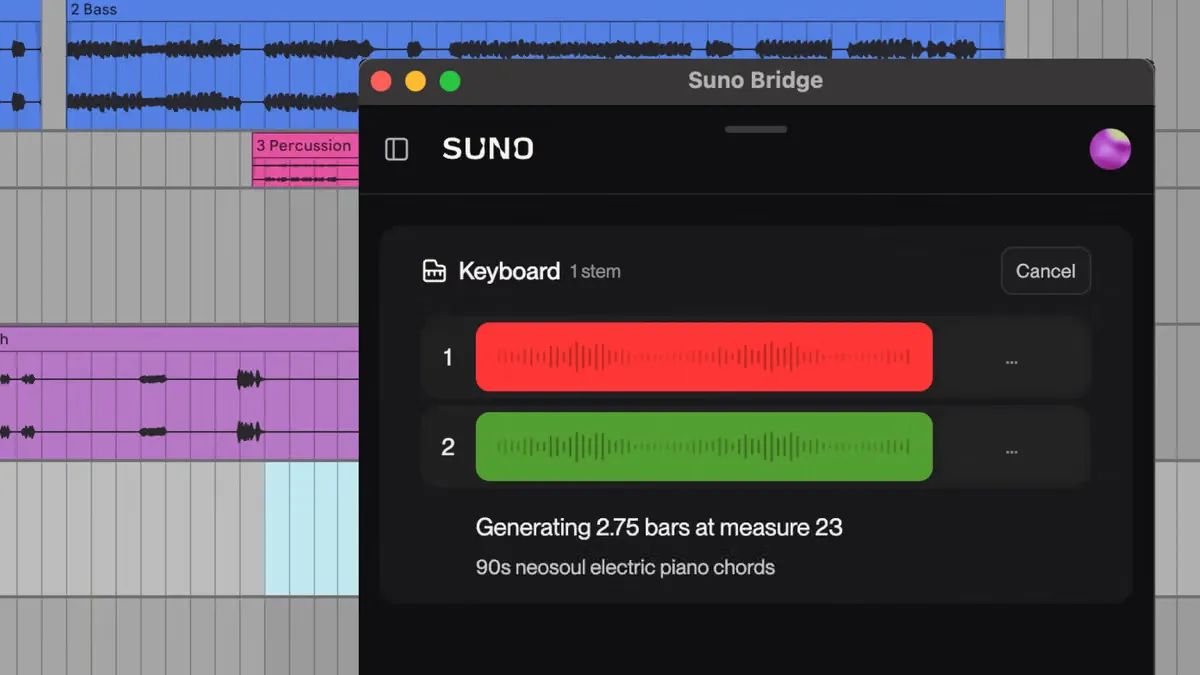
Bridge is not a plugin, despite how it is often described. It is a standalone Mac application that runs next to Ableton Live, and both programs must be open at the same time (Unite.AI; Mubert). The workflow, as described in Suno's launch materials and the outlets that walked through them, runs in four moves:
- Sync. The user opens a Live Set and then Bridge (or launches Live from inside Bridge). Bridge uploads the chosen Live project, including its audio files, to the user's Suno account so the model can "hear" the session. According to Suno's FAQ as quoted by several outlets, Bridge uploads only the project the user selects and asks permission before including audio it cannot reach at first (Unite.AI; Veena Studio).
- Set a window. Live's own loop start and end markers in Arrangement View define the prompting window. Suno's example: a loop from bar 9 to bar 16 yields an eight-bar part that starts on the downbeat of bar 9.
- Prompt. The user picks an instrument type and describes the sound. Suno says the output follows the session's tempo, key, style, harmonic content and groove, which is the main pitch against stock samples, since stock samples know nothing about your chord changes. According to a step-by-step guide from the newsletter The AI Musicpreneur, each prompt returns two takes; that detail comes from a single source.
- Insert. The chosen take lands on the Live timeline already aligned, with no dragging or nudging. Bridge generations are kept out of the user's regular Suno library and appear under Downloads instead.
The entry conditions are narrow. At beta launch Bridge requires a Mac, Ableton Live 12 or later, and a Suno Premier subscription. Free and Pro accounts cannot use it at all. The app is a free download, but every generation spends Suno credits "just as creating in Studio does," in the words Veena Studio and Mubert both quote from Suno's Bridge page. Premier is listed at $30 a month, or $24 a month billed annually ($288), with 10,000 credits a month (Mubert; Veena Studio). Suno says more operating systems and DAWs are planned but has given no dates.
One version detail is easy to get wrong. Bridge targets Live 12 because Live 13 is not out: Ableton's new release is in limited public beta with a ship date of only "early 2027" (Ableton). Nothing in the launch coverage says whether Bridge works with the Live 13 beta.
A sourcing note: Suno's own blog post and Bridge page could not be loaded from where this article was researched. The descriptions above rely on outlets that quote those pages directly. Two of the most detailed, Veena Studio and Mubert, sell competing AI music products and have an interest in the comparison. Their verbatim quotations of Suno's page agree with Unite.AI's and The AI Musicpreneur's accounts, but their commentary should be read with that interest in mind.
Partner, or just compatible?
This is the question the launch headlines got wrong. Digital Music News wrote that Ableton "announced a partnership with Suno," but the link it gave for that claim points to Suno's own blog post, not to anything Ableton published. Suno's Bridge FAQ, quoted verbatim by Veena Studio and paraphrased by Unite.AI, Mubert and The AI Musicpreneur, says the opposite: "Suno Bridge has been developed independently of Ableton" (Veena Studio; Unite.AI; The AI Musicpreneur). In searches of Ableton's site and of launch coverage, we found no Ableton press release, blog post or spokesperson quote about Bridge.
On the evidence available, then, Ableton Live is Bridge's first supported host, not its partner. Suno chose Live; Live did not choose Suno. DMN's framing, and the moral drama in its headline, rests on a partnership that the product's own documentation disclaims. Unless Ableton says otherwise, "Is Ableton dancing with the devil?" has a plain answer: Ableton was not asked to dance.
It helps to compare Bridge with what an Ableton-sanctioned integration looks like:
- Splice in Live 12.3. In late 2025 Ableton built Splice sample browsing directly into Live's browser. That was an Ableton feature in an Ableton release, alongside on-device stem separation (MusicRadar).
- The Extensions SDK. In June 2026 Ableton opened a public beta of a free JavaScript toolkit that lets anyone build tools that read and edit a Live Set and, per Dubspot's summary, "connect Live to outside services and systems." It runs only in Live 12 Suite on the beta program, version 12.4.5 or later (MusicRadar; Dubspot). That is an open door, not a curated partnership.
- The original "Bridge." The name has history. At NAMM in January 2010, Ableton and Serato jointly announced a product called The Bridge, linking Live with Serato Scratch Live (Synthtopia). That was a true co-branded partnership, and it shows what one looks like when Ableton actually signs on.
Suno has not said how Bridge talks to Live, and the coverage does not say whether it uses the Extensions SDK. Bridge's stated requirement of "Live 12 or later," with no Suite-only restriction, suggests it does not depend on the Suite-only SDK beta. That is our inference, not a confirmed detail.
From the wish machine to the session: where Bridge sits in Suno's ladder
Seen from Suno's side, Bridge is the latest rung in a year-long climb toward people who already make music.
- Create (the prompt box). The original product: type a sentence, get a song.
- Suno Studio. The browser-based "generative DAW," whose 2.0 release in August 2026 added MIDI recording and editing, a wavetable synth, automation and a chat bar for Premier subscribers (Digital Music News). Studio asks producers to come to Suno.
- MIDI input in Create. On November 4, Suno let users start a song from their own
.midfile. As our earlier piece Back to the Motif: What Suno's MIDI Input Says About the Next Phase of AI Music Tools argued, that flipped the order of operations so the musician goes first. - Bridge. Nine days later, Suno stopped asking producers to come to it and went to them, into the DAW where they already keep their plugins, routing and muscle memory. Suno's pitch makes this explicit: "stay in the DAW you've invested time and money in."
Studio and Bridge are two answers to the same problem. Studio bets that producers will move into a new environment if it is generative enough. Bridge concedes that most of them will not, and settles for being one more source of parts inside an existing session. The AI Musicpreneur describes Bridge as Suno Studio "flipped around." Both share the Premier gate and the same credit pool, so for Suno they are two front doors to the same subscription.
The trade is also different from MIDI input. MIDI input gives Suno a score and asks for a performance. Bridge gives Suno the entire session, including audio, arrangement and the user's own recordings, and asks for one part that fits. That is a much richer context for the model, and a much bigger thing for the user to hand over.
Ableton's awkward position: the third party arrived
Our earlier piece on Live 13, Ableton Bets on the Hands: What Live 13 Says About How DAWs Are Answering AI, read Ableton's strategy as treating AI as a utility for splitting stems and finding sounds, not as a collaborator that writes parts. Anyone who wanted an AI co-producer in Live would get one from third parties. Bridge is exactly that third party, arriving within days of the announcement.
For Ableton, this cuts both ways (this section is the author's analysis; Ableton has made no public comment on Bridge that we could find).
What Ableton gains. Live becomes the first DAW that Suno's paying users can generate into, which is a small but real reason for AI-curious producers to choose Live over Logic or FL Studio. Ableton gets that without licensing a model, without putting generation in its own release notes, and without joining the lawsuits Suno is fighting. That is the same arms-length arrangement the Live 13 strategy implied.
What Ableton gives up. Control over how its users meet generative AI. With no partnership, there is no Ableton say over what Bridge uploads, how it labels generated clips, or how it presents Live in its marketing. A reader skimming the headlines now associates "Ableton" with "Suno," whether or not Ableton agreed to anything. The DMN story is a live example of that cost.
What its rivals did instead. The other big DAW makers are not waiting for third parties. Apple previewed an agentic assistant for Logic Pro 13. Image-Line turned FL Studio's Gopher into an agent that changes levels and plugin settings. Splice released its own DAW, Splice Create, which exports Ableton Live sessions and whose assistant, Splice says, searches a licensed catalog rather than generating new sounds (MusicRadar; MusicRadar; The Fader). Those companies build the assistant themselves and decide what it may do. Ableton's approach leaves the most aggressive generative feature in Live to the company with the most legal exposure.
The relationship between DAW makers and Suno is starting to fall into three types. Some compete with Suno by building their own assistants (Apple, Image-Line, Splice). Some become venues Suno moves into (Ableton, for now involuntarily). And Suno becomes a DAW maker itself, through Studio. Whether Ableton eventually says something about Bridge, by endorsing it, setting terms through the Extensions SDK, or distancing itself, will show which of those roles it wants.
What it means for producers and session musicians
For producers, the appeal is concrete. Bridge aims at the part of production where sessions stall: the chorus that needs a guitar line, the verse that needs a backing vocal, the folder of half-finished projects Suno's marketing tells users to "dust off." A part that already matches the key, tempo and chord changes saves the hunt through sample packs, and it lands in an environment where the producer still controls mixing, processing and arrangement. Compared with generating a whole song and splitting it apart, adding one part to an existing arrangement is closer to how producers actually work, a point even competitor Mubert concedes.
The price of that convenience is the session itself. To get one new part, the producer uploads the whole Live project, including unreleased vocals and demos, to a hosted service. Mubert's advice, to try Bridge on a throwaway session first and to ask before uploading anything under an NDA, is commercially motivated but sound (Mubert).
For session musicians, the implications are less comfortable (this is the author's assessment). Bridge targets a specific layer of paid work: the overdub. "Add a cello," "give me a funk guitar part," "the vocal your track is missing." Those are requests a producer would traditionally send to a session player or a demo singer. A tool that answers them in the producer's own timeline, in key, for a few credits, competes most directly with the musicians who sell parts, not with the ones who write songs. The same pattern appeared with Suno's MIDI input and orchestral mockups. Generative tools are reaching the people who already make music, and the labor they make cheaper is often other people's.
There is a more hopeful reading too. A sketch-stage part generated in Bridge can be a better brief for a human player than a verbal description, and some producers will use it that way: generate to audition an idea, then hire someone to play it properly. Which use dominates will depend on cost, quality and the legal questions below, not on the tool alone.
The limits: lawsuits, ownership and a narrow beta
The legal cloud has not lifted. Suno is still a defendant in several cases. Universal Music and Sony Music are pursuing their infringement suit and in October 2026 were fighting to subpoena Suno investor Lightspeed over training-data risks (Digital Music News). Reservoir Media filed infringement and DMCA claims against Suno and Anthropic on October 22, seeking nearly $340 million in total, about $200 million of it from Suno (Digital Music News). On November 8, rights holders of Elvis Presley's music and a publisher of Eminem's records sued over voice and style imitation, including a claim under Tennessee's ELVIS Act (The Verge). Suno has also signed licensing deals with Warner Music, BMG and Believe, which Reservoir's complaint cites as evidence that a licensing market exists.
These cases concern how Suno's models were trained, not individual users. But a producer who puts a Bridge-generated vocal on a commercial release is building on a model whose legal status is still being argued in court.
Commercial rights are not the same as copyright. Suno's help center, as quoted by Mubert, says songs made on paid plans carry commercial-use rights and that paid subscribers are treated as owners, but that "copyright qualification and protection is determined by your region/country's copyright office, not by Suno." In a Bridge session, the producer's own bassline and the generated vocal could have very different legal standing. Suno's copyright filters screen the audio that goes into Bridge. Flagged rightsholder material is not ingested, and only that material is blocked if a session mixes it with original work. Nothing in the coverage says Bridge checks what comes out (Unite.AI; Mubert).
The beta is small. Mac only, Live only, Premier only, and every discarded take costs credits. Windows users and anyone on Logic, FL Studio, Bitwig or Pro Tools cannot try it yet. As of November 16, three days after launch, we found no independent hands-on review that measured output quality, and no substantive signed reaction from Ableton users on the r/ableton subreddit or Ableton's forum. The detailed accounts available are launch walkthroughs and posts from competing AI music companies. Claims about how well Bridge's parts "fit" a session are, for now, Suno's claims.
Conclusion: an open door, not a handshake
DMN's question, whether Ableton is dancing with the devil, assumes a choice Ableton does not appear to have made. The more accurate picture, based on Suno's own documentation, is that Suno built an app around Live from the outside and Ableton has said nothing. That makes the story less about one company's ethics and more about the structure of the market. A DAW open enough to host Max for Live, Splice and an Extensions SDK is open enough for Suno to move in without asking.
For Suno, Bridge completes a turn from replacing music making to serving it, and from asking producers to come to its browser to meeting them in their own sessions. For Ableton, it tests the Live 13 bet. The company can keep its own release notes free of generative AI, but it cannot stop its users from generating into Live. Its next decision is whether to say something about the AI that has already arrived in its DAW.
Sources
- Original article: Ashley King, "Is Ableton Dancing With the Devil? Suno's 'Bridge' Promises DAW Integrations, With Ableton Live the Beta Guinea Pig," Digital Music News, November 16, 2026
- Suno — Introducing Bridge (primary announcement; not directly reachable during research, quoted via the outlets below)
- Unite.AI — Suno Launches Bridge Beta for AI Stem Generation in Ableton Live (launch date, requirements, workflow, upload and copyright filtering, "developed independently of Ableton")
- Veena Studio — Suno Bridge for Ableton: $30 a Month, Your Session Uploaded (verbatim quotations of Suno's Bridge page and FAQ, pricing; competitor publication)
- Mubert — Suno Bridge Ableton Beta: What We Know (standalone-app detail, pricing, ownership terms from Suno's help center, privacy advice; competitor publication)
- The AI Musicpreneur — How to Use Suno Bridge in Ableton Live 12 (step-by-step workflow, two takes per prompt, comparison with Suno Studio)
- Ableton — Live 13 shop page and FAQ (Live 13 release window)
- MusicRadar — Ableton's Extensions SDK (June 2026 public beta)
- Dubspot — Ableton Extensions SDK: What It Is and Why It Matters (SDK scope and requirements)
- MusicRadar — Live 12.3: Ableton is playing catch-up (Splice integration in Live)
- Synthtopia — NAMM: Ableton And Serato Announce The Bridge (2010 joint product)
- Digital Music News — Suno Studio 2.0
- MusicRadar — Apple goes all in on AI with Logic Pro 13
- MusicRadar — FL Studio's agentic Gopher
- The Fader — Splice launches its own DAW, Splice Create
- Digital Music News — UMG and Sony press Suno investor Lightspeed
- Digital Music News — Reservoir sues Suno and Anthropic
- The Verge — Elvis and Eminem rights holders are suing Suno