
"Another Color on the Palette": Nile Rodgers, AI, and the Logic of Music's Pro-AI Camp
Updated:
In the first week of November 2026, Nile Rodgers posted a short clip of himself sitting inside a photogrammetry rig, cameras recording his face from every angle. The scan was the raw material for a digital double — "an AI me," as he described it — that will appear in a new video for "The Christmas Song," the charity single he first recorded with British soul singer Rebecca Ferguson in 2020. Rodgers called the project "next level." Many of his followers called it something else, and within days the man behind "Le Freak," "Good Times," "Let's Dance" and "Get Lucky" was arguing with strangers in his own Instagram comments.
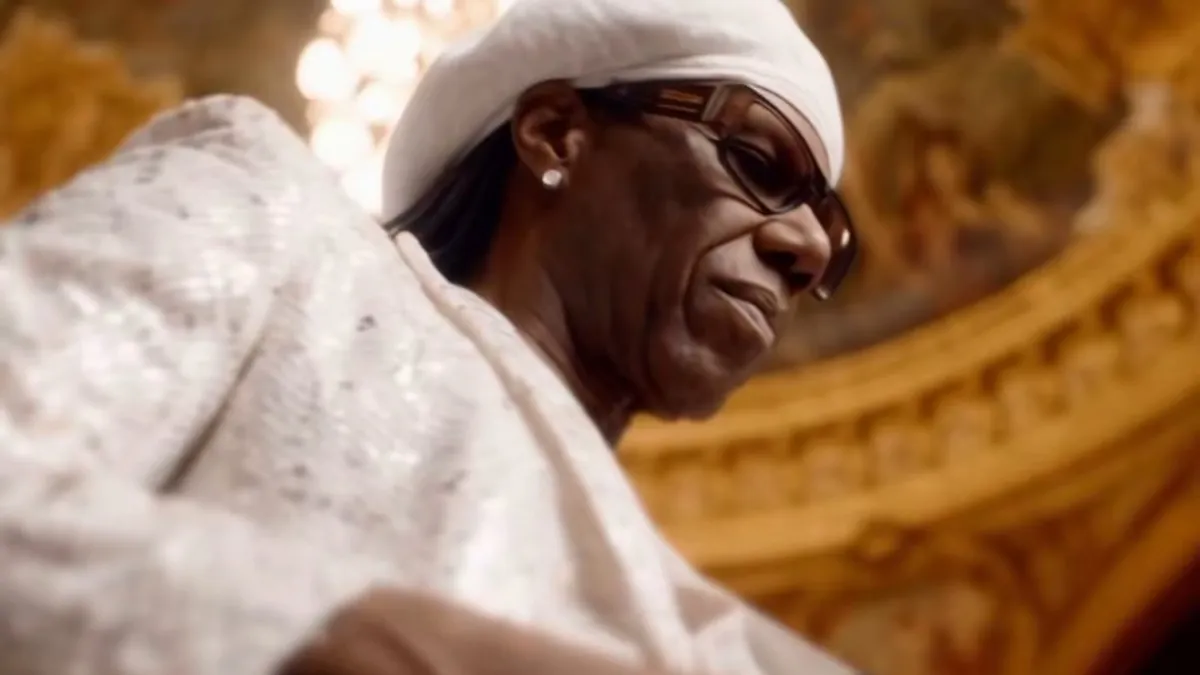
Photo: Nile Rodgers / Instagram
Digital Music News framed the episode as Rodgers becoming "the latest" high-profile musician to publicly back AI. That framing is accurate, but it skips the more interesting question. Rodgers is not a tech evangelist who discovered music; he is one of the most sampled, most borrowed-from producers in pop history, and a man who has spent years as an advocate for songwriters' pay. When someone with that résumé says AI is just another tool, it is worth looking closely at what exactly he is endorsing — and what he has left unsaid.
What Rodgers actually said, and where
The quotes come from three places, and keeping them apart matters.
The Instagram posts (November 2026). The first post, according to Rolling Stone, described the scan as "the start of the process" and said the "AI capture was very thorough." Rodgers added that seeing the Eagles at the Sphere in Las Vegas had made him imagine "stories with incredible environments & music." A follow-up post with stills explained the motive: during his first bout of cancer, he wrote, a child had coached him through it, and he produced the song for children who are "bedridden and ill" over the holidays. The video is due on November 20, so at the time of writing nobody outside the production has seen the finished work.
The comment threads. Here Rodgers made two distinct arguments. The first was about process: "We created everything. Mood boards, storyboards," he wrote, adding that "the AI did what we told it to do," that his director came from television and worked "setup by setup," and that a traditional shoot would have cost roughly $100,000 (Guitar Player). The second was an accusation of hypocrisy: critics, he said, use AI every day through search and navigation apps, so objecting to his use of it was inconsistent. "I used to work with Microsoft and Apple," he told one commenter, "I'm very aware of the things they do" when consumers adopt new tech (Rolling Stone). Earlier, replying to a commenter who had dismissed the scan as "slop," he asked, "Do you have a problem with CGI?" and urged critics to wait until they had seen the work (MusicRadar).
Earlier interviews (2023–2024). None of this is a sudden conversion. In mid-2023, speaking to the Daily Star's Wired column, Rodgers dismissed talk of "fake" music as noise he had heard "all our lives," and called the drum machine and sequencer "wonderful tools" without which some bands "could never have had a record" (MusicRadar). In January 2024 at Davos he told Euronews that he wanted to treat AI as "just another color on your palette" — a quote also reproduced by Rolling Stone and MusicRadar in their November coverage.
One detail is easy to miss in the noise: in every account available so far, the AI is used for the video, not for the music. MusicRadar notes this explicitly. Whatever one thinks of the visuals, Rodgers has not said he used generative tools to write, play or sing anything.
A career built on new machines — and on being borrowed from
Rodgers' "it's just a tool" argument makes more sense once you look at his career, because almost every chapter of it involved a new machine that was accused of killing real music.
Chic's records were made by a live band at the peak of disco, a genre that was itself attacked as mechanical. In the 1980s Rodgers became one of the defining producers of the era of drum machines and synthesizers, on records such as David Bowie's "Let's Dance" and Madonna's "Like a Virgin." Decades later, his collaborations with Daft Punk (Random Access Memories) and Beyoncé (Renaissance) won Grammys, according to the Songwriters Hall of Fame. His 2023 anecdote about Avicii, who he said "didn't understand tertiary harmony" but wrote beautiful songs because "his gear allowed him to do that" (MusicRadar), is the core of his position in one story: technology lowers the bar to expression, and the ear does the rest.
His relationship with borrowing is more complicated, and more relevant. In 1979 the Sugarhill Gang's "Rapper's Delight," the first rap single to become a mainstream hit, was built on a studio band's replay of the "Good Times" groove. When Rodgers first heard it in a Manhattan club, he and Chic bassist Bernard Edwards threatened legal action; the dispute was settled with the two credited as songwriters (GRAMMY.com; Stereogum). Rodgers later embraced the record so fully that he now raps a few bars of it whenever Chic plays "Good Times" live, and introduces the song as the one "that started hip-hop."
That arc — initial objection, a negotiated credit, then celebration — is a useful lens on his AI stance. Rodgers did not oppose reuse of his work as such. He opposed reuse without his name on it. Once attribution and payment were sorted, the borrowing became part of his legacy rather than a theft from it.
He has applied the same instinct to streaming. As chairman of the Songwriters Hall of Fame — first elected in 2018 and unanimously re-elected to a third, five-year term in October 2024 (SHOF) — he signed the 2019 songwriters' letter rebuking Spotify for appealing a royalty-rate increase. "Songwriters are not treated fairly!" he told NPR at the time, while also insisting that streaming would eventually become equitable. Embrace the technology, fight over the split: that is the pattern.
The line he draws — and the one he hasn't addressed
Read carefully, Rodgers' 2024 Euronews remarks contain a real distinction. Using AI-generated vocals "to copy another person's sound," he said, is "horrible"; using AI to express yourself and make better music is "fantastic" (Rolling Stone, quoting Euronews). His own video fits squarely on the permitted side of that line: the likeness being modeled is his, captured with his participation, for a project he controls.
That is a consent-and-identity line. It answers the question "whose face and voice is this?" It does not answer the question that sits at the center of most artist opposition to generative AI: what was the model trained on, and was anyone asked?
That second question is what the organized opposition is actually about. The April 2024 open letter from the Artist Rights Alliance, signed by more than 200 musicians including Billie Eilish, Stevie Wonder, Nicki Minaj and Pearl Jam, did not call for banning AI and conceded that, used responsibly, it can advance human creativity. Its target was companies training models on artists' work without permission, in efforts the letter said were "directly aimed at replacing the work of human artists" and that would dilute the royalty pools paid to working musicians (MusicRadar). The Statement on AI Training, whose signatories include Kate Bush, Roger Daltrey and Billy Bragg, compresses the argument into one sentence: the unlicensed use of creative works for training is "a major, unjust threat to the livelihoods" of the people behind them.
In the public record reviewed for this article — the November 2026 Instagram exchanges, the 2024 Euronews interview and the 2023 Daily Star comments as reported — Rodgers does not address training data or licensing at all. Nor has he said which tools or vendors produced the "AI me." That is not evidence that he disagrees with the letter writers; it means his support is, so far, support for a use, not for any particular supply chain. Given his history of fighting for credit on "Good Times" and for songwriter royalties on streaming, it would be surprising if he endorsed unlicensed training. But that is an inference, and only he can settle it.
His hypocrisy argument has a similar gap. Pointing out that critics use Google Maps treats "AI" as one undifferentiated thing. Most of his commenters were not objecting to machine learning in general; they were objecting to generative imagery in art, to its environmental footprint, and to the signal it sends when a legend endorses it. As Digital Music News put it, many AI critics "are precisely the people who pointedly do not use it."
Who else is in the "supporters' camp"
Digital Music News lists Rodgers alongside Dr. Dre, Diplo, Kid Rock, will.i.am, Timbaland, David Guetta, Grimes and Paul McCartney. The list is useful as a roll call, but the people on it are supporting quite different things.
The "new instrument" argument. Dr. Dre is the closest match to Rodgers. In an August 2026 interview with The New York Times alongside Jimmy Iovine, he compared AI skeptics to people who would have opposed the drum machine or the synthesizer and said only those "who have trouble creating" see it as a threat (Digital Music News). On the debut episode of Ice Cube and Mike Epps' podcast Listen & Laugh, Dre went further, comparing AI to sampling and saying he would "love" it if someone remade "Nuthin' but a 'G' Thang" and outdid the original. Cube pushed back: working a sample into a new track, he argued, is a different act of creativity from typing prompts (MusicRadar). The sampling analogy is the strongest card the pro-AI camp holds, and it is notable that the two producers who play it hardest — Dre and Rodgers — are the ones whose careers were built at the intersection of new machines and borrowed grooves.
The "license my voice" model. Grimes represents a different position altogether. In 2023 she launched Elf.tech, letting anyone transform their vocals into a "GrimesAI-1" voiceprint in exchange for a 50% split of master-recording royalties (Digital Music News). That is support for AI with a consent-and-payment structure attached — arguably closer to the letter writers' demands than to Dre's "get used to it."
The restoration case. Paul McCartney's place on the list rests on the Beatles' final song, for which Peter Jackson's team used AI to separate John Lennon's voice from a piano on an old cassette demo; McCartney stressed at the time that "nothing has been artificially or synthetically created" (Digital Music News). Yet in November 2025 the same McCartney contributed a near-silent track to Is This What We Want?, the protest album against UK plans to let AI firms train on copyrighted work without permission (Rolling Stone Australia). He is the clearest proof that "supporting AI" and "opposing unlicensed training" can be held by the same person at the same time.
Same Sphere, opposite conclusions
The sharpest counterpoint to Rodgers comes from an unexpected direction. In September 2026, Brian May told Absolute Radio that he had "changed his mind" about AI. He once saw it as inevitable, "just like the Industrial Revolution"; now, he said, "we have to resist" and control it "very, very seriously and very quickly" (MusicRadar).
What makes May's account so pointed is where he started. He, too, had been inspired by the Eagles at the Sphere, and spent time planning a Queen avatar show. He has "backed off," he said, because such a show cannot be made "without massive use of AI, with all the consequences of that" — from data centers he wants kept out of the British countryside to the discomfort of building on other people's work. Two veteran guitarists watched the same Las Vegas spectacle; one came away wanting to scan himself, the other decided he could not.
Nick Cave, who most recently cast Suno as a threat to creation itself in The Red Hand Files, stands further out still. His argument is not mainly about licensing or energy; it is that songwriting draws its meaning from human struggle, and that "data doesn't suffer" (The Red Hand Files, Issue #218). Rodgers' position answers a different question. He is not claiming a machine can feel; he is claiming that an artist who feels can use a machine. The two men are less in direct disagreement than talking past each other — one about the source of meaning, the other about the means of production.
Whose risk, whose reward
There is one more fault line the roll call obscures: age and position. Stereogum's Tom Breihan observed that it is "striking how many of the artists embracing generative AI are established elders" (Stereogum). Several of Rodgers' commenters made the same point less politely; one asked what was "happening with old artists using AI" (Guitar Player). Dre, in his podcast exchange with Cube, framed it the opposite way — that it is people "our age" who don't want to learn new technology.
Both readings can be true, because the costs and benefits do not fall evenly. For a 74-year-old producer with a catalog that has, by the Songwriters Hall of Fame's count, sold more than 500 million albums, an AI double is an extension of an existing brand: his likeness, his approval, his song, a lower budget. For a newcomer, the same technology arrives in a market where the competition is not one legend's avatar but an unlimited supply of generated tracks — the scenario the Artist Rights Alliance letter described when it warned of diluted royalty pools. A veteran's "it's just a tool" is made from a position where his own work is already scarce and recognized; a newer artist's worry is that their work will become training material or background noise before it is either (this is the author's inference, not a claim made by Rodgers or his critics).
That does not make Rodgers wrong about his own project. It means his experience does not generalize automatically. The drum machine did not ingest the life's work of every session drummer to learn how to play; the debate over AI is sharper precisely because the analogy he relies on breaks down at the point of training.
What the supporters' logic needs to hold
Strip away the comment-section heat and the pro-AI case Rodgers is making is coherent: creativity resides in the artist; tools have always been feared before they were accepted; using your own likeness, with your own consent, for a cause you care about is your business. On those terms his Christmas video is an easy case.
The harder cases are the ones he hasn't addressed — models trained on other people's work without permission, and markets flooded by output no one authored. His own history suggests where he might land: a man who demanded credit on "Rapper's Delight" and told NPR that "songwriters are not treated fairly" is not an obvious defender of unlicensed training. If the supporters' camp wants to be more than a list of famous names, that is the distinction it will have to make out loud — and Rodgers, of all people, is well placed to make it.
The finished video arrives on November 20. It will settle the aesthetic argument one way or another. The ethical one will take longer.
Sources
- Digital Music News — Nile Rodgers Becomes the Latest High-Profile Musician to Publicly Support AI (Ashley King), November 6, 2026 — original article
- Rolling Stone — report on Nile Rodgers defending AI use in his "The Christmas Song" video (Althea Legaspi), November 5, 2026 — Instagram captions and comment replies; Euronews quote
- Guitar Player — Nile Rodgers hits back at fans who criticize his use of AI (Christopher Scapelliti), November 2026 — "AI me," TV director, "setup by setup," November 20 release
- MusicRadar — "Drop the slop dude! Not very Chic!" (Beth Simpson), November 2026 — AI used in the video, not the song; CGI reply
- Stereogum — Nile Rodgers Defends New AI Music Video (Tom Breihan), November 5, 2026 — "established elders" observation; Rodgers' age; 2023 comments
- Euronews — Nile Rodgers on his proudest moment and the fantastic potential of AI in music, January 19, 2024 — "another color on your palette" (quoted via Rolling Stone and MusicRadar)
- MusicRadar — Nile Rodgers on AI and Avicii (Ben Rogerson), 2023 — Daily Star interview; drum machines, sequencers, Avicii
- Songwriters Hall of Fame — Nile Rodgers Re-Elected Chairman, November 1, 2024 — chairmanship terms; career credits
- NPR — 'Songwriters Are Not Treated Fairly': Nile Rodgers On Streaming's Present And Future, April 12, 2019
- GRAMMY.com — 10 Most Controversial Hip-Hop Samples — "Rapper's Delight" settlement and co-writer credit
- Stereogum — The Number Ones: Chic's "Good Times" (Tom Breihan), February 14, 2020
- MusicRadar — report on the Artist Rights Alliance open letter, April 2024 — "stop devaluing music"; training without permission; royalty dilution
- Statement on AI Training
- Digital Music News — And Dr. Dre Said, 'Only People Who Have Trouble Creating View AI as a Threat', August 23, 2026
- MusicRadar — Dr Dre and Ice Cube clash over the use of AI (Beth Simpson), November 2026
- Digital Music News — Grimes AI Project Officially Launches in Beta, May 1, 2023
- Digital Music News — Paul McCartney Clarifies AI Use on The Beatles 'Final Album', June 22, 2023
- Rolling Stone Australia — Paul McCartney Protests AI with Silent Track, November 18, 2025
- MusicRadar — Brian May on why he's changed his mind on AI (Beth Simpson), September 16, 2026
- The Red Hand Files, Issue #381, November 2026 — Nick Cave on Suno
- The Red Hand Files, Issue #218, January 2023 — "Data doesn't suffer"