
1.9% of the Fans, 42% of the Revenue: What Does Force-Ripened T-Pop Still Lack?
Updated:
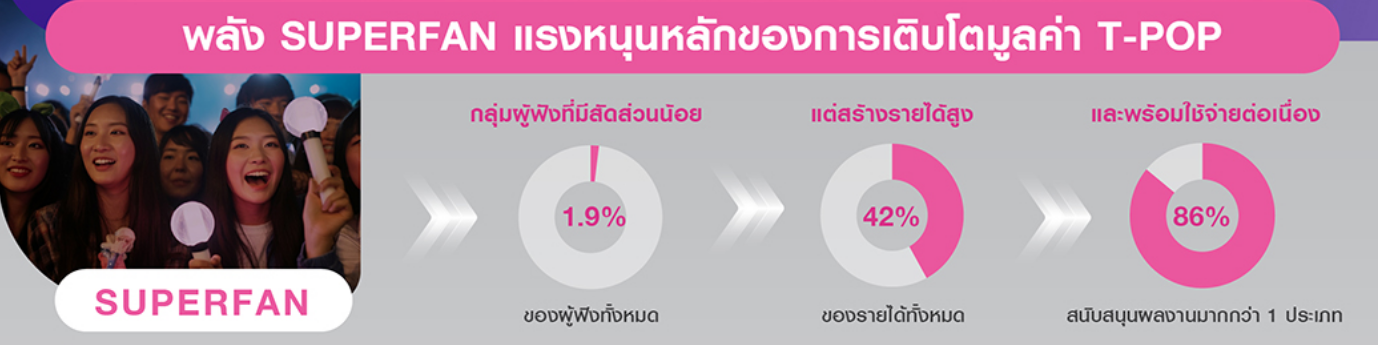
In mid-2026, SCB EIC, the research arm of Thailand's Siam Commercial Bank, published a report with a grand title — "The New Era of T-Pop: Growth Beyond Thailand" (report page). Among all its growth figures, the most striking is this: "superfans," who account for just 1.9% of all T-Pop listeners, generate 42% of the industry's revenue.

The figure comes from MIDiA Research, cited in the SCB EIC report (as covered by The Nation). It sketches a classic "economy of the few": a broad base of streaming volume, with profits underwritten by a small cohort of highly committed spenders. The concert market confirms the paying heat — according to SCB EIC, the number of large-scale T-Pop concerts rose from 37 in 2024 to 51 in 2025, with more than 30 already held in the first half of 2026 (Bandwagon).
The money is real. But is what earns that money a mature music industry? This article examines how genuine the T-Pop boom is, across three layers: where the money comes from, how big the market is, and what the system still lacks. (Throughout, phrases such as "according to / reports say / data show" introduce factual statements; "in this author's view / by this author's estimate" introduce opinion or inference.)
A Set of Inverted Numbers: Where the Money Comes From
Start with the spending structure. SCB EIC's survey found that 86% of superfans keep paying for more than one category of music-related consumption; in its 2025 survey, 71% of respondents said they now listen to more T-Pop, rising to 81% among Gen Z (The Nation). Even more direct evidence is endorsements: 84% of fans buy products endorsed by their idols (SCB EIC survey, reported by Bandwagon).
In other words, T-Pop's commercial center of gravity has long ceased to be "selling music" itself; it now spans a full spectrum of person-centered spending: concerts, fan meetings, albums and photo books, random photocards, merchandise, VIP perks, brand endorsements, and limited events.
The most vivid sample of this structure is BKPP. Billkin and PP Krit built a highly stable CP ("couple") fanbase through the "I Told Sunset About You" series; in 2024 the two staged their DOUBLE TROUBLE concert at the Queen Sirikit National Convention Center in Bangkok, drawing nearly 40,000 attendees over two nights (per Thai outlet The People, "nearly 40,000 people" — translated from Thai; the original Chinese article said "more than 40,000," a slight discrepancy). What sold out was not just tickets — venues, security, merchandise, food and beverage, and transport were pulled along with it. Into 2026, the duo's CP commercial value continues.

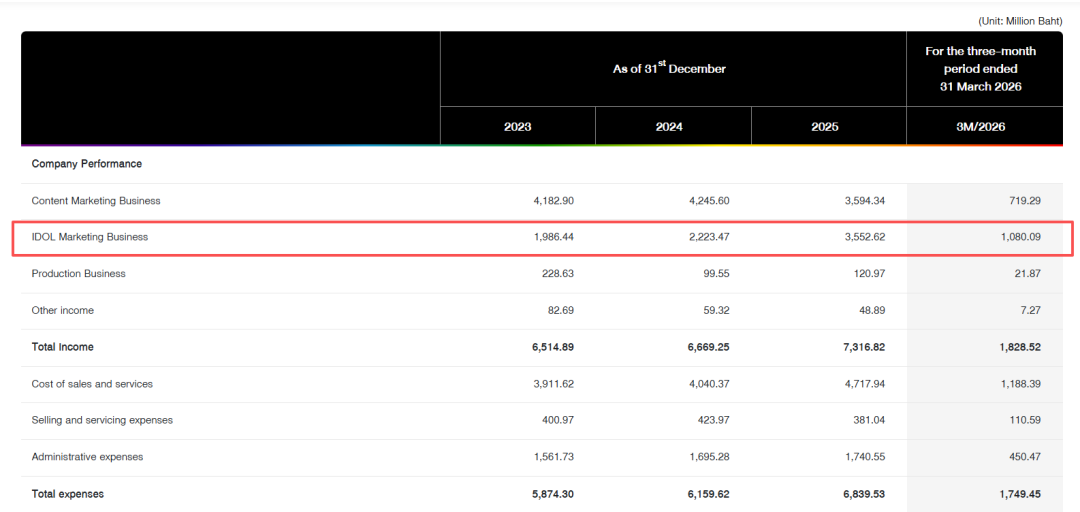
A listed company's financials nail the trend down even harder. In Q1 2026, The One Enterprise (ONEE) — the parent of GMMTV — posted revenue of about THB 1.83 billion, up 24.86% year on year; within that, its "Artist and Idol Marketing" segment earned THB 1.08 billion, roughly 59% of the total, while net profit reached THB 48.22 million, up 315.11% (ONEE investor relations; company announcement). Idol marketing has clearly overtaken drama content as the top revenue source of Thailand's leading entertainment group. Earlier, in the first nine months of 2025, ONEE logged revenue of THB 5.27 billion (+39.19%), with Q3 idol-marketing revenue of THB 997 million (+66.59%). The original article additionally stated that idol marketing accounted for 48.88% of full-year 2025 revenue and that the content-marketing segment earned THB 719 million in the latest quarter — these two figures appear only in that article's retelling and could not be independently verified against ONEE's public filings; readers should defer to company disclosures.
Heat First: BL Dramas and the Lightweight Path of Content Feeding Music
Why did superfan money happen to flow here? The answer starts around 2020.
The wave of Thai BL (Boys' Love) dramas was the key precondition for T-Pop's global break. "2gether: The Series" is widely seen as the turning point: during the pandemic, it reached overseas audiences via LINE TV, YouTube, and Netflix, assembling a cross-border distribution machine of actors, OSTs, fan meetings, CP appearances, and fan translators. Spotify's own newsroom report from November 2023 attributed Thai pop's global growth directly to "fans and Boys' Love" — global T-Pop listening doubled within a year, and streams of the official T-Pop Now playlist grew about 3.5x (Spotify Newsroom).

This produced a path entirely different from K-Pop's: artists are first seen by overseas audiences through drama roles, CP pairings, variety clips, and short-video edits, and only then is that attention converted back into music, concerts, and brand deals. Jeff Satur is the archetype — he entered overseas fans' field of view through "KinnPorsche" and its OST, then absorbed that traffic as a singer and producer, becoming a multi-hyphenate transnational artist.
But the flip side of "content feeding music" is music's weak bargaining power. SCB EIC estimates per-stream payouts on Thai streaming platforms at roughly THB 0.01–0.36 (Bandwagon) — even a trophy-tier hit cannot feed an industrial pipeline on streaming volume alone. Since the royalty sheet is thin, monetization must concentrate in concerts, merchandise, and endorsements. That is the industrial logic of "shifting from hit-driven to superfan-driven": not a matter of taste, but of arithmetic.
How Real Is It? Another Set of Coordinates for Market Size
Hype narratives distort scale, so it is worth checking against calmer numbers.
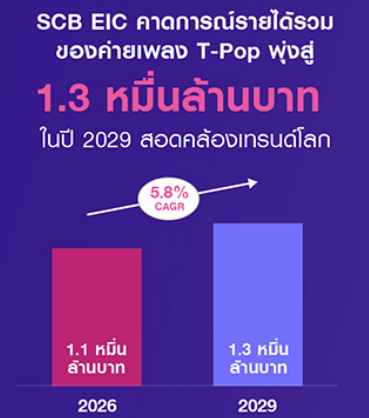
First, a definitional correction. The original Chinese article reported SCB EIC's forecast that the "Thai music industry market" would reach THB 11 billion in 2026 and THB 13 billion in 2029, a compound annual growth rate of about 5.8%. But according to Bandwagon's coverage of the report, those figures refer to the combined revenue of T-Pop labels, not the size of the entire Thai music industry — the two scopes differ greatly, and using the latter to describe "industry scale" would significantly overstate it. Readers should defer to the report's original wording.
Second, IFPI's global coordinates. Thailand's recorded-music market ranked 24th worldwide in 2022 with revenue of about US$105.4 million, over 90% of it from streaming (Believe, "5 things to know on Thai digital music market," January 2024); 26th in 2023 with about US$107.7 million, streaming at 92.3% (Music Ally, February 2025); and 29th in 2024 with about US$100.9 million, up 12.92% year on year (Music Business Worldwide, May 6, 2026). Note that these three figures come from different annual editions of IFPI's Global Music Report, whose definitions and revisions do not align — in particular, the 2024 "12.92% growth" rests on the revised base of IFPI's latest edition and cannot be joined to the prior year's US$107.7 million as a trend line. But two conclusions are solid: Thailand is a market of roughly US$100 million, oscillating between 24th and 29th place globally; it is not a rapidly inflating giant emerging market.

Third, the home field. Thai songs' share of domestic streaming rose from 35% in 2021 to 50% in 2024 (Bandwagon). Local content has won the home market — that is the precondition of every going-global narrative, not its result.
In this author's view, put together, these numbers locate T-Pop as "home field newly won, away field riding on CP": the domestic base is solid, while overseas revenue depends heavily on the narrow circles of drama and fandom economics rather than the universal spread of the music itself. That is fundamentally different from K-Pop, which built an export machine on the back of a limited home market.
Going Global and Capital: From Cultural Spillover to Mechanism-Building
With the boundaries acknowledged, this wave of expansion becomes easier to read: which parts are mechanisms, and which are merely heat.
On policy, the Creative Economy Agency's (CEA) Music Exchange program has pushed Thai music exports from one-off shows toward systematic international festivals and industry matchmaking: in 2024 it funded 48 Thai artists and bands to appear at 44 international festivals across 12 markets; cumulatively over 2024–2025, it supported 95 artists at 64 international festivals covering 17 markets, generating about 54.7 million global exposures (figures as cited in the original article from CEA project materials; single source, not independently verified against official documents). Industry reports say the 2025 Music Exchange, themed "PUSH & PULL," gathered 48 artists, matched them with 46 international festivals, and reached about 34.9 million exposures (single source).

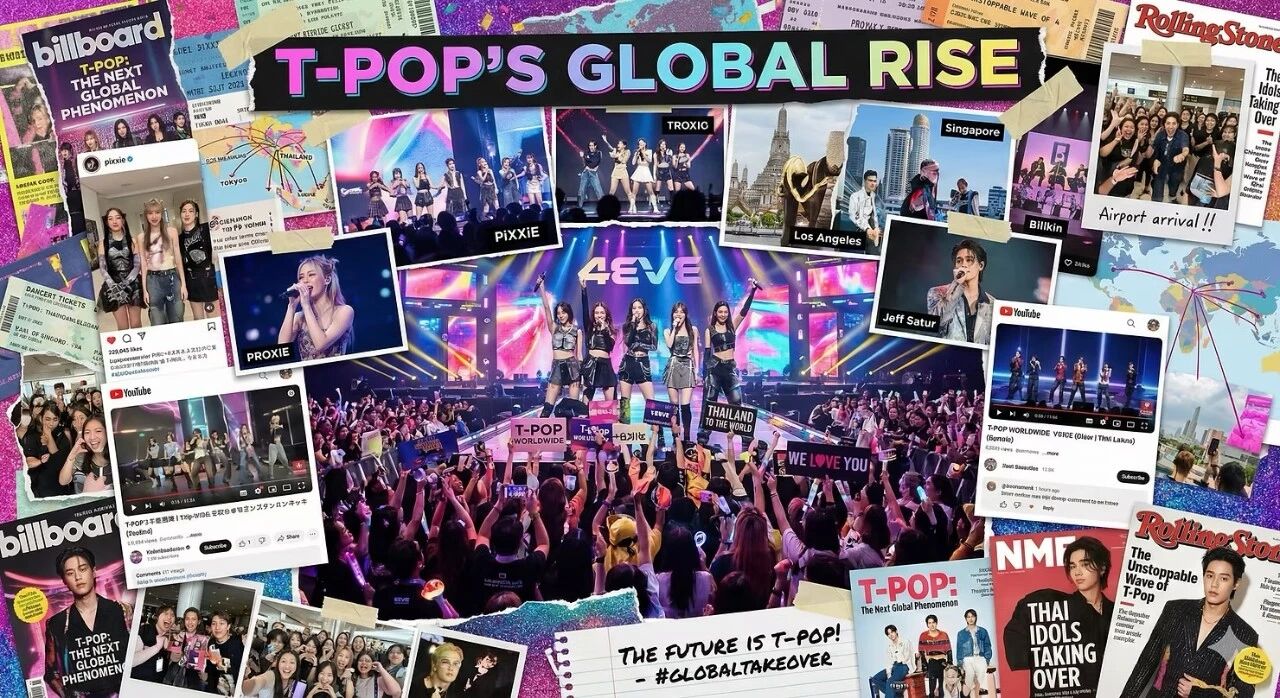
On the artist side, MILLI, Jeff Satur, 4EVE, BUS, PiXXiE and others increasingly appear at international stages such as Coachella and Summer Sonic (as listed by Chinese music-industry outlet 音乐先声); boy band BUS became the first Thai act to tour fan meetings across multiple Asian cities (Bandwagon). The listener map has expanded from Southeast Asia to the US, Indonesia, the Philippines, Malaysia, Singapore, and Australia, and streams under Spotify's RADAR Thailand program doubled from 2023 to 2024 (same source). Overseas consumption of Thai music on the platforms is real.
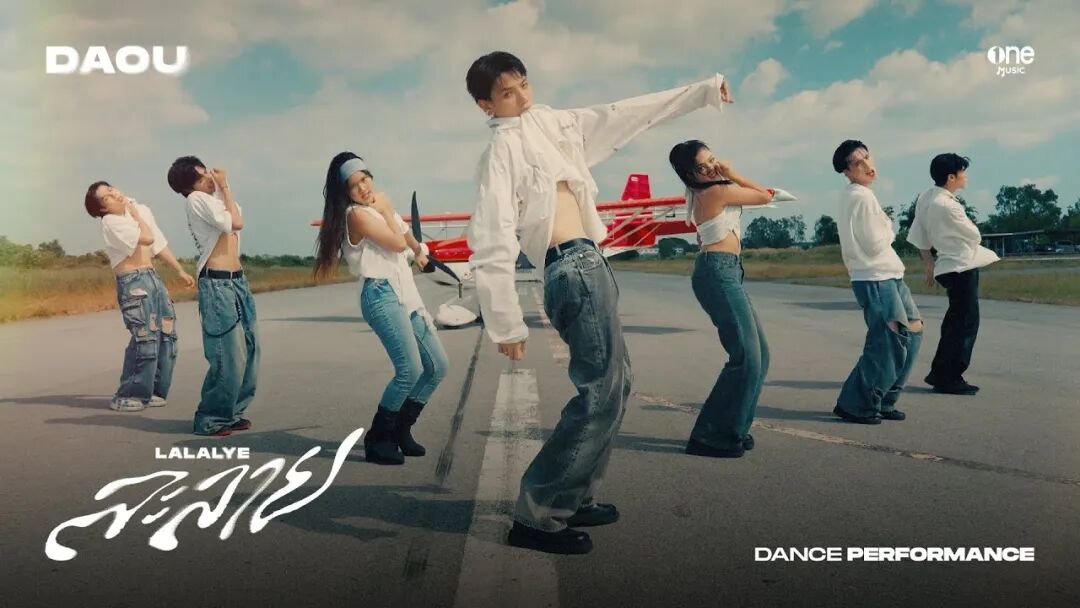
China is a special chapter. PiXXiE and 4EVE appeared on Mango TV's "Bai Fen Bai Chu Pin"; Davika Hoorne and Jeff Satur joined "Sisters Who Make Waves" and "Call Me by Fire" respectively; KT Kratae's "BANGKOK CITY" and 蔡有福's "LALALYE" kept feeding Douyin's duet-and-tutorial loops (all as listed by 音乐先声). But a limiting view deserves mention: Chinese media cautioned as early as November 2023 that T-Pop's influence in China remained largely confined to BL fandom circles, with limited spillover beyond them (Sina Finance, November 2023). In other words, China currently offers a "vertical dividend," not mass-market penetration.
The landmark capital event is the marriage of GMM Music and Tencent Music Entertainment Group (TME). On June 3, 2024, the two announced a strategic partnership under which TME and Tencent Holdings acquired a 10% stake in GMM Music through cash plus a minority stake in JOOX Thailand, valuing the company at about US$700 million (PR Newswire release; the original article said "May 2024," which differs slightly from the release date — this article follows the release). By this author's estimate, the 10% stake implies a consideration of roughly US$70 million. In 2026, the joint venture label GX10 ASIA was unveiled, with JAYLERR announced as its first signing (as reported by 音乐先声; single source).

Notably, the cultural flow is not one-way: in recent years many Chinese performers who struggle to stage shows on the mainland have flocked to Thailand for concerts, and Tencent Video's overseas arm WeTV produced two seasons of "CHUANG ASIA" in Thailand (as listed by 音乐先声). Thailand is both exporter and receiver — a two-wayness that reminds us the so-called "T-Pop going global" is embedded in a larger current of regional entertainment capital.
The Counterargument: Is an Industrial System a Requirement, or a Detour?
The SCB EIC report is not all optimism. It unusually lists a string of risks: K-Pop's far larger fanbases, capital, and artist-management capabilities; foreign artists and shows diverting Thai consumers' entertainment spending; and intensifying competition from new domestic labels, independent artists, and influencer crossovers (The Nation). The report also names four shortcomings to fix: a clear national strategy, financial and tax support, ecosystem connectivity, and stronger copyright and IP management; it states plainly that the industry needs internationally experienced professionals in A&R, music business, and copyright, while music copyrights remain of limited use as collateral within Thailand's financial system (The Nation; Bandwagon).
Copyright deserves a separate word. In an interview published by WIPO in August 2025, Thai musician Notapol Srichomkwan said outright that copyright protection has long been neglected by Thai artists (WIPO). On one side, 42% of revenue rests on fans' willingness to pay; on the other, weak copyright infrastructure keeps those earnings from settling into long-term assets — precisely the fault line between "fast money" and "building an industry."
But here a genuinely contrary view must be brought in: treating the K-Pop industrial system as the standard answer is itself open to doubt.
First, the K-Pop model carries heavily criticized costs. Critiques from outlets such as Initium Media of K-Pop idols' "dehumanized" labor, punishing training regimes, and image control suggest that a highly organized, capital-intensive, standardized system pairs efficiency with costs as two sides of one coin. Second, international coverage from outlets such as i-D notes that a generation of young Thai musicians is jolting the country's conservative pop culture with more experimental expression — the most moving part of T-Pop right now is precisely the not-yet-fully-disciplined ease, wild beauty, and ever-transgressing gender and romantic imagination, qualities inherently in tension with a standardized industry. Third, "superfan monetization" is not a Thai phenomenon: from Goldman Sachs' "Music in the Air" report (2024) to Vevo's fandom research, the global music business is tilting toward high-commitment spenders. Thailand did not invent a new model; it is simply the market where this global wave finds its most ready-made material and script (this author's synthesis).
Conclusion: Fix the Shortcomings Before Talking About "the Next"
Having pulled all this apart, we can return to the title's question: what exactly does force-ripened T-Pop still lack?
This author believes the original article's core judgment still holds: the idol-industry shell has taken shape, while the industrial system that should support it has not. Styling, choreography, and MVs can be copied quickly; production management, copyright operations, international distribution, and global commercial capacity cannot. With drama IPs and CP heat overwhelming the music itself, T-Pop risks degrading into an appendage of the drama industry over time — superfans accelerate monetization, but if industrial capability stays fractured, artist relations, fan loyalty, and commercial activity will usurp the core operating logic, and the music itself will be marginalized.
T-Pop was force-ripened by dramas, the CP economy, and superfans: commercial heat inflated first, while the music's own subjectivity and industrial support have yet to catch up. Fixing copyright, talent, and distribution is the precondition for discussing any vision. But fixing shortcomings does not mean copying K-Pop wholesale — its real opportunity may lie precisely in holding on to those undisciplined qualities while fitting them with an industrial chassis. Only then will the world hear "pop music that belongs only to Thailand," rather than another assembly line of idols.
Sources
- 音乐先声 (Yinyue Xiansheng), "被'催熟'的T-Pop,还成不了下一个K-Pop?" (2026-07-02, original article): https://mp.weixin.qq.com/s/Cj4tKtiTpKWtVG02jpnCHg
- SCB EIC report page, "The New Era of T-Pop: Growth Beyond Thailand": https://www.scbeic.com/product
- The Nation, "Superfans turn T-pop into Thailand's next big export" (May 2026): https://www.nationthailand.com/life/entertainment/40066756
- Bandwagon, "Inside the fandom economy powering T-Pop's global rise" (May 2026): https://www.bandwagon.asia/articles/inside-the-fandom-economy-powering-t-pop-s-global-rise
- Spotify Newsroom, "How fans are inspiring the new global growth of Thai pop and boys love" (2023-11-20): https://newsroom.spotify.com/2023-11-20/how-fans-are-inspiring-the-new-global-growth-of-thai-pop-and-boys-love/
- The One Enterprise investor relations: https://investor.theoneenterprise.com/press-releases; company news: https://www.theoneenterprise.com/en/news-15052569
- WIPO interview with Notapol Srichomkwan (August 2025): https://www.wipo.int/notapol-srichomkwan-thai-music
- PR Newswire release, "GMM Music Announces Strategic Partnership with Tencent Music Entertainment Group and Tencent, with a Strategic Investment Valuing GMM Music at $700 Million" (2024-06-03; original link could not be verified, cited via Bandwagon/The Nation)
- Music Business Worldwide report on Thailand's 2024 recorded-music market (2026-05-06; original link could not be verified)
- Believe, "5 things to know on Thai digital music market" (2024-01-23; original link could not be verified)
- Music Ally report on Thailand's 2023 IFPI figures (February 2025; original link could not be verified)
- Goldman Sachs, "Music in the Air" (2024), and Vevo's fandom research (2025): global context for superfan monetization
- Initium Media and i-D coverage of the K-Pop machine and young Thai musicians; Sina Finance's assessment of T-Pop's reach in China (November 2023); Thai outlet The People's coverage of the BKPP concert