
A New Trophy, Two Boycotts: How the Grammys' "Asian Seat" Offended the Very People It Meant to Court
Updated:
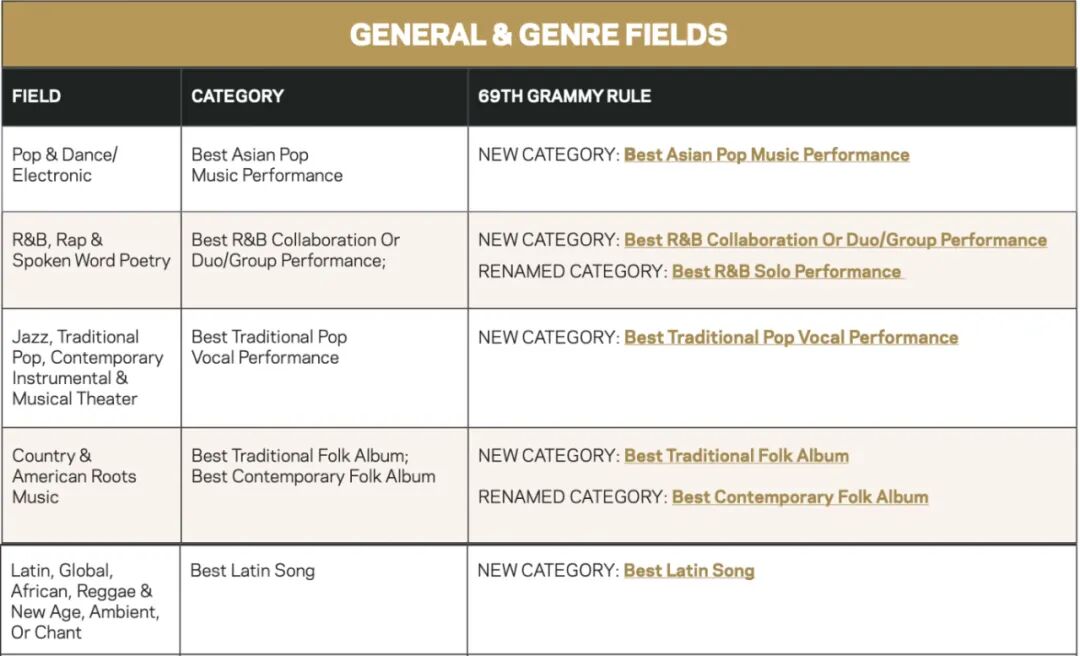
In June 2026, the Recording Academy announced five new categories for the 69th Grammy Awards (ceremony on February 7, 2027). Among them, Best Asian Pop Music Performance gave Asian pop its own dedicated category—entry into the world's most influential music awards system—for the first time, and brought the total number of Grammy categories to 100.
By all rights, this should have been a milestone for Asian music. Instead, the story took a turn nobody predicted over the following three months: in late July, BTS announced it would no longer submit music to the Grammys; in October, hours after Academy CEO Harvey Mason Jr. confirmed the new category would go ahead as planned, Stray Kids announced it was joining the refusal. An institution that built a chair specifically for Asian music had that chair flipped over by the very guests it hoped to attract.
To understand this rare head-on collision, start with the rule text itself.
Reading the Rules: The Award Is for "Asian Pop Music," Not for "Asian Artists"
Per the official Grammy announcement, the category recognizes "artistic excellence in Asian pop music performances originating from or widely recognized within Asian markets," covering K-pop, J-pop, C-pop and beyond, with the requirement of meaningful use of one or more Asian languages—songs performed entirely in English are ineligible for this award, though they may compete elsewhere.

Two details deserve a closer look. First, the criteria emphasize genre and market attributes rather than the artist's nationality or ethnicity: it defines "Asian pop music," not "Asian artists." Second, the "meaningful use of Asian languages" eligibility threshold effectively locks out some of the most successful Asian acts in history—BTS's "Dynamite" and "Butter" are all-English recordings, and under the current rules they wouldn't even qualify for the award ostensibly built with them in mind.
The controversy starts precisely with the definition. Read closely, the Grammy's description of "Asian pop music" carries unmistakable K-pop features: it asks for an "integrated system of music creation, stage performance and visual presentation" that works "for both audio playback and live stage performance." Korean culture critic Jung Min-jae pointed out in an interview that Asian countries' pop musics are wildly different and share little common ground, and lumping them together invites criticism (as relayed in the original report). On Korean broadcaster Arirang's dedicated panel discussion, Keimyung University professor David Kim put it more bluntly: by confining K-pop to a single category, the Grammys had effectively built a "glass ceiling" in specific terminology.
Why Now: A Market Too Big to Ignore, an Audience It Can't Keep
The commercial logic behind the Grammys extending a hand to Asia isn't hard to find.
On the market side, Asia has become the main growth engine of the global recording industry. Per the IFPI Global Music Report 2026 (released March 2026, covering 2025 data), Asian market revenues grew 10.9% year over year (after just 1.3% in 2024), remaining the world's largest physical-music region at roughly 45.1% of global physical revenues; Japan grew 8.9%, holding at #2 globally; China grew 20.1%, overtaking Germany for the first time to become the world's fourth-largest market and the fastest-growing among the top 20. (The original report attributed these figures to the "2025 report"; they in fact come from the 2026 report—corrected here.)

K-pop's physical exports are even more striking. Per Korea Customs Service data, K-pop album exports hit $120 million in Q1 2026, up 159% year over year—the first quarter ever to break $100 million, nearly half of the entire previous year's exports. The United States was the largest export market at 28% of the total, with North American sales up 449.2% and exports to the European Union up 397.7%. First-half exports reached $257 million, with the US overtaking both China and Japan on a half-year basis for the first time.
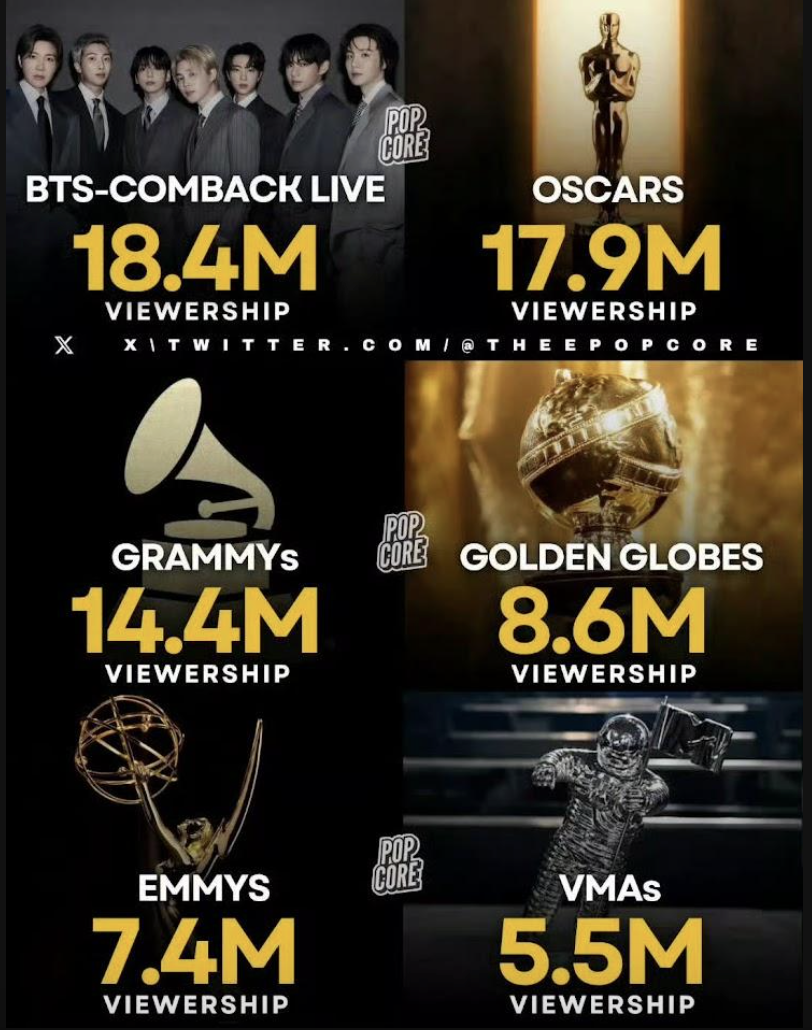
On the awards side, the Grammys are in an anxious stretch of their own. The 68th ceremony (February 1, 2026) drew 14.4 million viewers across platforms, down about 6%—a second consecutive decline (16.9M in 2024, 15.4M in 2025, 14.4M in 2026)—and it was the show's final year on CBS. A legacy award in search of new growth, facing the world's most active, youngest and highest-spending fandom—the audience of Asian music—extending an olive branch is not hard to understand.
In other words, it wasn't the Grammys choosing Asia; it was Asian music growing past the point of being ignorable. What the Grammys need now is to be chosen by Asia again.
A History of Cold Shoulders: Five Nominations, Zero Wins—and the Only "K-Pop Grammy" Went to a Fictional Group
Asian artists have long come away empty-handed in the Grammys' general field (Album, Record and Song of the Year, plus Best New Artist).
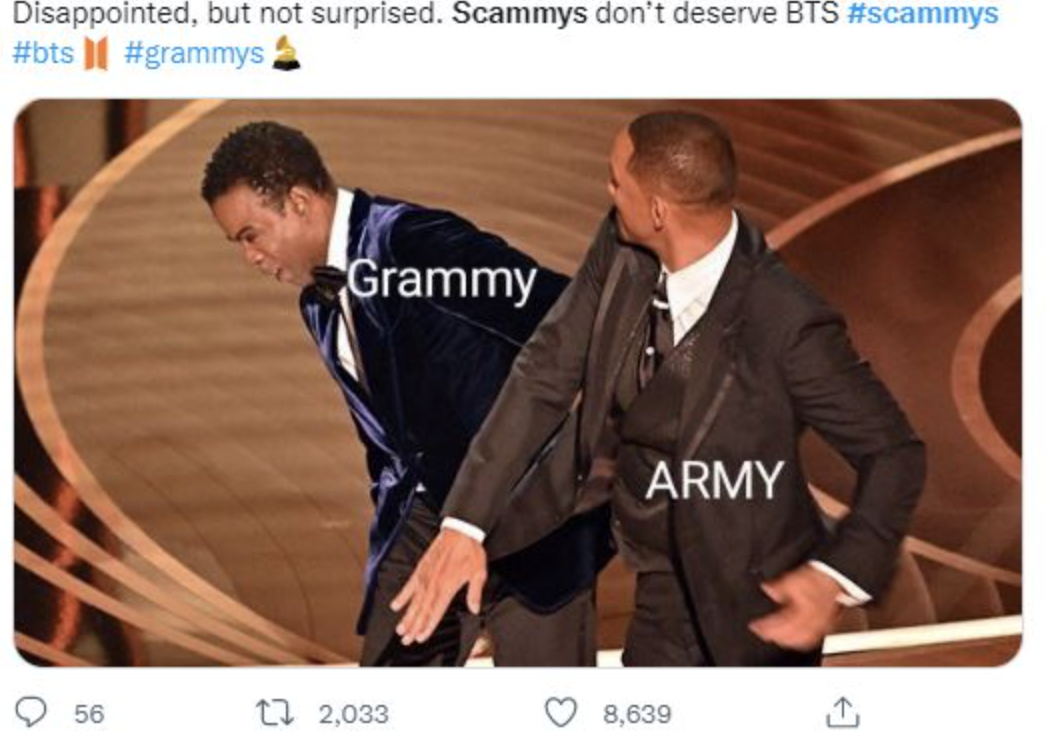
Take BTS: the official Grammy artist page shows five nominations, zero wins—and not one of them in the Big Four, spanning the 61st Grammys' Best Recording Package (2019) to three consecutive Best Pop Duo/Group Performance nods for "Dynamite," "Butter" and "My Universe," all stopping at the genre categories. After "Dynamite" lost in 2021, fans worldwide flooded social media with the "scammys" hashtag; the grievance has deep roots. (The original report called all five "general-field nominations," which is inaccurate—corrected here.)
By the 68th Grammys in February 2026, the picture shifted subtly—though in a telling way. The US-Korea global girl group KATSEYE earned nominations for Best New Artist and Best Pop Duo/Group Performance, winning neither; BLACKPINK's ROSÉ picked up three nominations for "APT.", including Song of the Year, and opened the ceremony—the first K-pop soloist ever to do so—also going home empty-handed. And the historic K-pop breakthrough that night belonged to HUNTR/X, the fictional group from Netflix's animated film KPop Demon Hunters: "Golden" won Best Song Written for Visual Media, becoming K-pop's first Grammy.
The real-life superstars went five-for-nothing; the first "K-pop group" to win a Grammy came from an animated film. No op-ed could put Asian artists' position in this system more sharply than that bit of black comedy.
Yet the same night left behind contrary evidence: Bad Bunny, with Debí Tirar Más Fotos, became the first artist in the Grammys' 68-year history to win Album of the Year with a Spanish-language album. The general field's door isn't welded shut—it has simply never been opened for Asian music.
Precedents: Urban, Latin, African—Three Outcomes of a "Separate Seat"
K-pop's resistance to the new category isn't about refusing recognition. It's that this kind of "reserved seat" has a clearly traceable history at the Grammys.
Outcome one: renaming. In January 2020, after winning Best Rap Album for IGOR, Tyler, The Creator complained backstage that his genre-crossing work was always filed under rap, and left behind the quote still cited today: "I don't like that 'urban' word—it's just a politically correct way to say the n-word to me. Why can't we just be in pop?" (per Okayplayer and other outlets, translated). Five months later, the Recording Academy removed the word "urban" from all its categories.

Outcome two: a general-field breakthrough—with a new fence built alongside. After decades of being confined to genre categories, Latin music saw Bad Bunny seize Album of the Year in 2026—yet in the very same reform batch, the Grammys added a new "Best Latin Song" category, read by US media as "traffic diversion" for unstoppable Latin momentum. The breakthrough arrived and the new fence went up simultaneously; the two things are not contradictory.
Outcome three: a fight over the power to define. When the Grammys created Best African Music Performance in 2023, it too was hailed as historic. Within a few years, controversy shadowed it: South Africa's Tyla won twice—with "Water" (2024) and "PUSH 2 START" (2026)—becoming the category's first two-time winner, and twice drew fire for sounding "too Westernized," "not African enough"—in 2026 beating heavyweight Nigerian names including Burna Boy, Davido and Tems. A Forbes opinion piece framed it as a question: "Is Tyla Afrobeats?" (The original report misstated the song title as "RUN 2 START"—corrected here.)

A Guardian commentary from October 2026 made the problem explicit: the West has a "blinkered view" of African music, and African music isn't defined by whether it sounds ancient but by its creators, its origins, and how it reflects Africa's past, present and future. When the rules of an award effectively sift for "local works that match Western taste," categorization becomes the power to define—who gets to represent a continent's music. The original report, borrowing a critique from the African outlet OkayAfrica, called it "symbolic inclusion with a colonial logic": you get an award, and along with it, someone else decides what you are.
There are voices in the other direction, too: some commentators argue that "PUSH 2 START," grafting South Africa's homegrown amapiano onto global pop, is precisely what contemporary African music looks like—"as African as it gets." The definitional dispute has no referee—and that is exactly the problem.
The Boycotts and the Response: A Negotiation Over a Seat
Which brings us back to the summer of 2026.
On July 29, BTS announced it would submit nothing to the 69th Grammys—including the new release "Arirang." Their statement said (translated): "We have decided not to enter the Grammys this year. I hope that music can be heard and loved for what it is, rather than being divided by region." HYBE later clarified that this was the members' own decision, not a company-wide boycott, and that its other artists would submit as usual—reportedly, to "protect the standing the work deserves."
The Academy's response held the line. In October, Harvey Mason Jr. confirmed the Asian pop category would make its debut at the 69th ceremony as planned, reiterating the rule's key point: submitting to the Asian pop category does not prevent an artist from also being nominated in the general categories. Hours later, Stray Kids announced it was joining the boycott. Reports say K-pop's three biggest companies initially leaned toward not submitting, though a subsequently leaked submission list suggested some artists broke ranks.
Mason's point holds up on paper: the categories run in parallel and can, in theory, both be won—Bad Bunny's general-field victory the same year is living proof. But the gap between "permitted by the rules" and "never in the statistics" is exactly why K-pop doesn't believe it. To a group with five nominations and zero wins, watching its all-English releases fail even the threshold of an award built for them, "you're always welcome to compete in the general field" sounds more like politeness than a promise.
Conclusion: To Categorize Is to Wield Power
Line up all the facts, and the essence of this conflict is not "should there be an Asian award"—it is the power structure behind the categorization system.
The Grammys need the Asian market: with ratings down three years running, the CBS contract expiring and streaming carving up the audience, a $120-million export quarter, a Chinese market growing 20.1% and the world's most fervent fandoms add up to a growth story it cannot afford to lose. But needing a market is not the same as embracing its artists: the new award's language threshold screens out the most successful Asian works, its K-pop-flavored definition absorbs all of Asian pop, and its procedural fairness—"categories run in parallel"—answers every objection.
Nearly every "reserved seat" in history was set with good intentions mixed in; how it ended depended on whether the general field's door ever actually opened. Urban got renamed. Latin waited long enough for Bad Bunny. The African award is still fighting over "what counts as African music." Asian pop's answer sheet won't be graded until February 7, 2027: that night, will any Asian artist appear in the general-field nominations? Or have they already submitted their own answer through two boycotts—
The chair can be declined. The seat must be equal.
Sources
- 音乐先声 (Music First Sound): 《格莱美为何惹K-Pop众怒?》 (original article, in Chinese)
- Grammy.com: Five New Categories And Rule Updates Take Effect For 2027 Grammys
- The Guardian: BTS withdraw from Grammys over Asian pop category
- The Korea Times: After Asian pop category launch, BTS says it won't submit music to Grammys
- BBC: K-pop giants Stray Kids join BTS in boycotting the Grammys
- Rolling Stone: Grammys CEO confirms Best Asian Pop category will debut in 2027
- Music Business Worldwide: Grammys will keep Asian Pop category for 2027 as Stray Kids follow BTS
- Forbes: The Grammys Created An Asian Pop Category. BTS Said No.
- Grammy.com: BTS artist page (5 nominations, 0 wins)
- Grammy.com: KATSEYE artist page (68th Grammys Best New Artist and Best Pop Duo/Group Performance nominee)
- Billboard: 'Golden' from KPop Demon Hunters becomes first K-pop Grammy win
- NPR: Bad Bunny wins Grammy for album of the year
- IFPI: Global Music Report 2026
- The Korea Times: K-pop album exports top $100 mil. for first time in Q1
- The Korea Times: K-pop album exports hit record high of $257.48 mil. in H1
- The Hollywood Reporter: 2026 Grammy Awards TV Ratings Fall by 6 Percent
- Okayplayer: Tyler the Creator Calls Grammys Rap, Urban Categories 'A Politically Correct Way to Say the N-Word'
- Forbes: Is Tyla Afrobeats? Grammy Win Sparks Debate
- The Guardian: The west has a blinkered view of African music