
A Gate on the Artist Page: Spotify Hands Profile Approval Back to Artists, With Limits
Updated:
In July 2025, the British folk singer Emily Portman got a message from a fan congratulating her on a new album. She hadn't released one since 2022. The record, titled Orca, sat on her own streaming profiles, credited to her, with song titles she says resembled something she might have written and vocals she recognized almost immediately as AI-generated, AFP reported. Getting it removed meant contacting platform after platform; across the cases AFP documented, takedowns took anywhere from 24 hours to eight weeks.
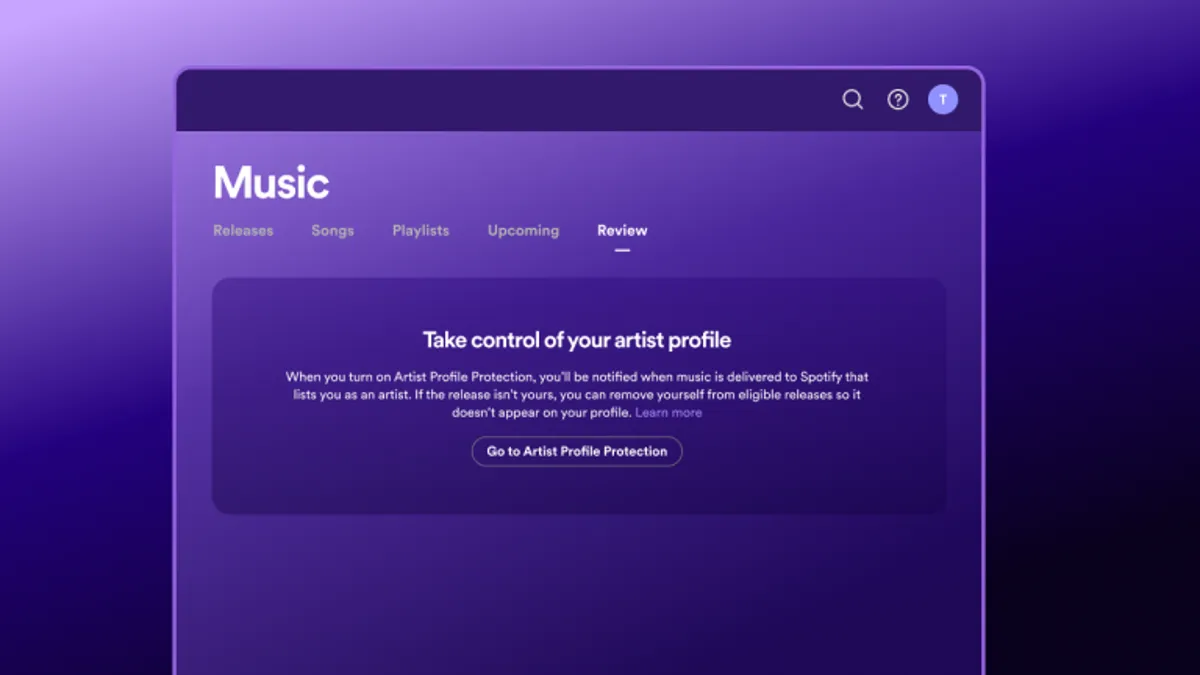
Photo credit: Spotify
Sixteen months later, Spotify has shipped its answer to that specific failure. On November 17, 2026, the company updated its Spotify for Artists announcement to say that Artist Profile Protection is "now available for all artists on Spotify." Headlines framed it as artists being able to "fully block" any release under their name that they haven't approved, which is how Digital Music News put it. That is true for some artists. For most, the version they get is lighter: an alert, a review queue, and a remove button.
This piece looks at that mechanism, the question of who gets to decide what appears under an artist's name, rather than the takedown war itself. Our earlier piece, Behind the Takedown of 260,000 Fake Tracks, followed Sony Music's removal campaign and the legal gaps around voice cloning. The Human Premium, Stress-Tested covered Spotify's choice to disclose AI involvement rather than rank against it. Profile approval sits between the two. It doesn't judge whether a track is AI, and it doesn't take anything off the platform. It decides whose page a track appears on.
Two Modes: Review by Default, Block for a Few
Spotify's help center describes two settings, and the difference between them is the whole story.
Review releases is the default when an artist team admin or editor switches the feature on. Spotify sends a notification when a release arrives with the artist's name attached. The artist can remove themselves from it before it goes live or for up to 28 days afterward. If nobody acts, "it goes live as scheduled with you listed as an artist." In other words, Review is an alarm, not a lock: a fake can still reach the profile and collect plays until someone notices it.
Block releases reverses the default. Releases need the artist's approval before they can list that artist. Spotify's own documents describe access to this setting in two ways. The help center says Spotify is "testing Block releases with a limited group of artists," so many people won't see it yet. The blog post describes it as an advanced setting artists "can also opt-in to." The DMN report sides with the narrower reading, saying the advanced setting is open to "a select group of artists." Until Spotify clarifies, the safest summary is that blocking exists but isn't yet universal.
Spotify says who Block is meant for: artists "prone to misattributed releases — such as having a common artist name or frequently experiencing mismatch — and are comfortable actively managing their catalog." It also states the cost plainly: because approval comes first, Block "may delay or block legitimate releases from going live if no action is taken."
What Changes for Labels, Distributors, and Collaborators
Approval isn't only between the artist and Spotify. It reaches into the delivery pipeline, and Spotify's provider documentation shows how.
- Artist keys. An artist using Block gets a unique key from Spotify for Artists and can share it with distributors they trust. A release delivered with a valid key arrives marked "pre-approved" and goes live without manual review. Without the key, the release waits in the artist's Approvals queue. If an artist refreshes the key, the old one "becomes invalid immediately," so a label holding a stale key will see its deliveries stall. Spotify also warns that keys "may not work with every provider."
- A new status trail for distributors. Spotify's provider portal now has an Artist Profile Protection tab. It shows each release's status (Approved, Declined, Needs Approval, Partially Approved, Expired) and whether each artist has the feature switched on and at which tier. Under Block, a release still marked "Needs Approval" when it goes live won't list that artist.
- Collaborations. The feature covers more than the headline credit. A release can flag someone as main artist, featured artist, remixer, actor, or composer, orchestra, or conductor on classical releases. A featured artist or remixer who doesn't approve is simply left off, and the release can still go live without them. The bigger lever belongs to the main artist: if they use Block, they must approve the release "before it can go live on Spotify for any artists listed."
- Switching distributors. To avoid flooding artists with approvals when a catalog moves, Spotify runs "transitive approvals." Re-delivered releases containing tracks already live on the profile go through automatically if they pass Spotify's matching checks.
- Mistakes are hard to undo. Approvals can take up to 24 hours to process. Reversing an approval or a rejection means contacting Spotify, and the provider documentation says artists "cannot undo a removal" on their own.
Taken together, the design shifts power one specific way. A small number of artists with Block switched on, and their trusted distributors, become a checkpoint that every other contributor's release has to clear.
From Limited Beta to a Softer General Release
The current version reverses the approach of the beta. When Spotify first announced the feature in March 2026, enrolled artists could "review and approve or decline releases delivered to Spotify from most providers," and "only the releases you approve" would appear on the profile. Every enrolled artist got a key. According to Digital Music News at the time, a release that got no timely response wouldn't list the artist at all. In effect, the beta was Block for everyone who joined.
The general release makes Review the default and keeps hold-until-approved as an advanced option. Spotify hasn't publicly explained why. Its blog does name the trade-off: legitimate releases can stall when no one acts. The company also says it "worked with thousands of artists" during testing, including Samia, Diplo, Searows and Dave East, to protect profiles "without affecting release schedules." Music Week adds The Army, The Navy to the list of beta users. Our reading, which is an inference rather than a stated Spotify rationale, is that the beta showed a universal approval gate would cost more in delayed real releases than it saved in blocked fake ones.
The feature also has a longer backstory. In September 2025, Spotify said it was testing "new prevention tactics with leading artist distributors" and promised artists the ability to report "mismatch" even before release, alongside a claim of more than 75 million spammy tracks removed in a year. Its October 20, 2026 progress report said more than 50 million slop and spam tracks had been pulled from recommendations this year, and it promised profile protection for all artists by year-end. Spotify delivered six weeks early. That timing came shortly after Sony Music said its takedown requests had climbed to more than 260,000 tracks by the end of September, up from 135,000 at the end of March.
What It Fixes
Spotify names three ways music ends up on the wrong page: "a metadata mix-up, another artist with the same name, or someone maliciously attaching their music to your profile." Profile approval handles each one a little differently.
- Deliberate impersonation of the Orca kind is the main target. Portman told AFP that scammers posing as artists approach distributors, which then upload "without any identity checks." Artist keys tackle that weakness directly for Block users, because a stranger's delivery without the key can't attach to the profile.
- Same-name collisions are the reason Spotify recommends Block at all. An artist called something common can now decline releases by a namesake rather than file mismatch reports after the fact.
- Metadata errors that put a real release on the wrong page can be caught in the review queue before they distort an artist's stats, Release Radar and recommendations, the downstream effects Spotify lists in its announcement.
Then there's the symbolic shift. Spotify's Sam Duboff, quoted by Music Week, put it this way: "Artists should never have to find someone else's music under their name." For years, the burden ran the other way, with artists discovering fakes through fans and petitioning platforms afterward. Australian musician Paul Bender, whose band found AI tracks on its profiles, gathered roughly 24,000 signatures on a petition asking platforms to tighten security, AFP reported. Approval in advance is the first mainstream answer to that request.
What It Doesn't Fix
The feature's limits are mostly written into Spotify's own documentation.
It is Spotify only. The blog post itself warns that a declined release "may still appear under your name on other streaming services besides Spotify." Portman had to chase her fake across several services. A fraudster blocked on one service still collects from the rest. The DMN report notes that rivals have taken other routes, such as labeling AI music (Qobuz, Deezer, Apple Music, Tidal) or banning it outright (Bandcamp), but none of those amounts to an artist-controlled approval gate.
Review mode is only as good as the attention behind it. Under the default, a fake goes live unless someone removes it. That makes protection depend on an artist team that reads its email and checks the queue regularly. Eric Alper, a publicist who wrote about the beta, cautioned that the feature "requires active management" and that a missed notification could delay an artist's own releases. Big acts have managers and label staff to handle this. A part-time independent artist, the kind most often targeted precisely because nobody is watching, may not. Spotify also hasn't said whether accounts that never claimed a Spotify for Artists profile, including deceased artists' catalogs, which AFP said were a frequent target, have anyone to act for them.
Blocking can catch real collaborations. Under Block, a main artist who is slow to approve holds up the release for every collaborator on it. A featured artist who misses the window just gets dropped from the credit. Spotify says Block "may delay or block legitimate releases." For same-name artists the trade is clear: fewer wrong releases, but more chances to stall a right one.
It governs attribution, not existence. Declining a release removes your name from it. It doesn't remove the track from Spotify. Removal still runs through separate channels: Spotify's mismatch reports, illegal-content reports, and its impersonation policy for voice clones. And nothing in the mechanism stops an impersonator from uploading the same AI album under a slightly altered name that never triggers your queue. That gap is our inference from how the feature is described, not something Spotify has addressed. Spam filters, AI Persona labels and takedowns have to cover it, and those are the systems our earlier Sony piece found struggling to keep pace.
The Gate and the Gatekeepers
What Spotify built is less an anti-AI tool than a consent layer for identity. It doesn't decide whether a track is real, good or synthetic. It decides who gets to say "this is mine." That's a sensible division of labor, because the artist is the one party who can always tell, and a platform judging authenticity at the scale of today's upload volumes would make its own mistakes.
The cost is that the work lands on artists. The default mode protects people who are paying attention, and the strongest mode is reserved for a limited group and carries a real risk of delaying legitimate music. On one platform, the most important question for an artist's identity is now answered by the artist. On every other platform, and for artists who aren't watching, it still isn't. Whether rivals copy this, and whether Spotify opens Block to everyone, will decide whether the November launch becomes the industry standard Duboff hopes for or stays a good fix on one service.
Sources
- Digital Music News: Spotify Is Now Allowing Artists to Fully Block All Releases Under Their Name Without Their Approval (original article, Nov 17, 2026)
- Spotify Support: Protecting your Spotify artist profile (Review and Block modes, 28-day window, roles covered, artist keys, transitive approvals)
- Spotify for Artists: Introducing Artist Profile Protection (updated Nov 17, 2026) (general availability, beta artists, cross-platform caveat, Block trade-off)
- Spotify Provider Support: Artist Profile Protection (distributor statuses, key refresh, removals can't be undone)
- Spotify Newsroom: One Year In: Putting Human Artistry First on Spotify (Oct 20, 2026) (spam figures, year-end commitment)
- Music Week: Spotify rolls out Artist Profile Protection tool to all artists (Duboff quote, beta artists, Sony's 260,000 figure)
- Music Week: Amid concerns about AI fakes, Spotify trials Artist Profile Protection feature (March 2026) (beta design)
- Digital Music News: Spotify Artist Profile Protection beta (March 24, 2026) (beta defaults)
- Digital Music News: Spotify AI protections announcement (Sept 25, 2025) (75 million spam tracks, distributor prevention tests, pre-release mismatch reports)
- AFP via eNCA: 'Easiest scam in the world': Musicians sound alarm over AI impersonators (Emily Portman and Paul Bender cases)
- That Eric Alper: Spotify Just Gave Artists a Powerful New Tool (April 22, 2026) (active-management caveat)