
Buying the Idol Machine: Why HYBE Wants Control of Japan's KeyHolder
Updated:
HYBE has spent five years trying to build a Japanese pop business from scratch. On November 18, 2026, it decided to buy one instead. Its Tokyo subsidiary, HYBE JAPAN, launched a tender offer for KeyHolder (TSE: 4712), a listed entertainment group that half-owns the company behind Nogizaka46 and runs SKE48. The price is ¥1,200 a share. If the offer is fully taken up, HYBE JAPAN will end up with a little over half of KeyHolder for roughly ¥10.6 billion. HYBE says the deal will strengthen its competitiveness in the global music market.
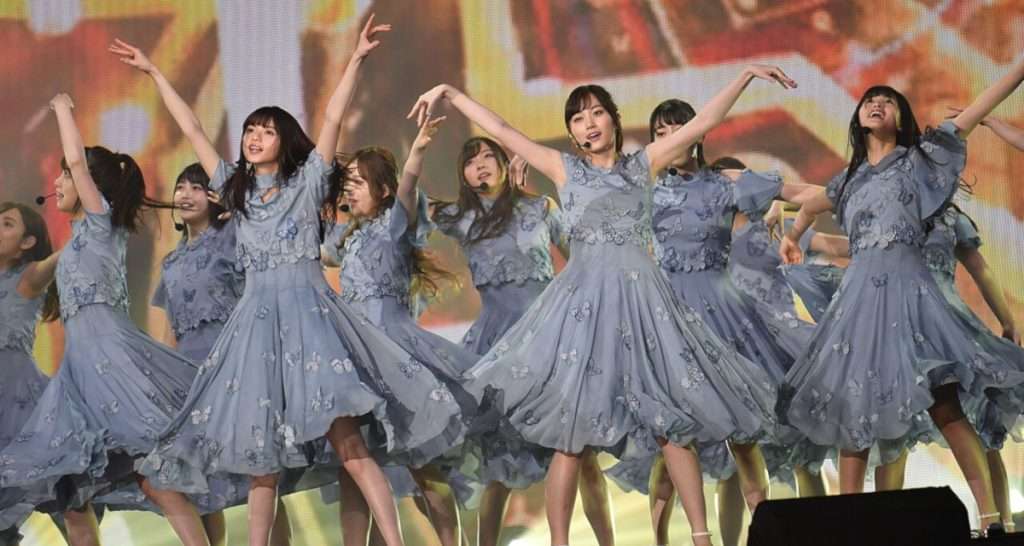
Nogizaka46 performing live. KeyHolder's subsidiary North River owns half of the company that operates the group. Photo: Li Chengru, via Digital Music News
Digital Music News broke the story in English, with HYBE's announcement and executive quotes. The detail in this article comes mostly from KeyHolder's own filing to the Tokyo Stock Exchange, a 46-page statement of the board's opinion on the offer. It sets out the terms, how the two companies came to the deal, and what KeyHolder's board thinks could go wrong.
The terms: control, not ownership
This is not a full takeover. HYBE JAPAN is buying enough to steer KeyHolder and consolidate it, while leaving the company listed on the TSE Standard Market. According to the filing:
| Item | Detail |
|---|---|
| Buyer | HYBE JAPAN Inc., founded March 2019, 100% owned by HYBE Co., Ltd. |
| Tender period | November 19, 2026 to January 6, 2027 (30 business days) |
| Settlement | January 14, 2027 |
| Price | ¥1,200 per common share; ¥1 per unit of KeyHolder's 2nd-series stock warrants |
| Minimum | 8,751,630 shares, about 43.05% of voting rights after the offer |
| Maximum | 10,453,092 shares, about 51.42% of voting rights (about 50.10% fully diluted) |
| Premium | 11.32% over the November 17 close of ¥1,078; 46.70% over the six-month average of ¥818 |
| Listing | Maintained; delisting is not the aim |
Most of the minimum is already promised. KeyHolder's largest shareholder, the financial group J Trust (27.11%), has signed an agreement to tender all its shares. So have Omotesando Capital (6.58%) and KeyHolder chairman Nobuyoshi Fujisawa (0.58%). Together that is 7,148,690 shares, exactly the floor for common stock.
The other piece involves the producer Yasushi Akimoto, who created both Nogizaka46 and SKE48. Akimoto is KeyHolder's second-largest shareholder, with 6.90% of the common stock. Under his tender agreement he is selling HYBE his stock warrants, which convert into 1,066,660 shares, for ¥1 per warrant. His common shares are not part of that agreement. Two other warrant holders, Shinsuke Akimoto and Yoshihiro Akatsuka, have made the same commitment. The filing does not explain the warrant price or why Akimoto is keeping his shares.
The committed stakes add up to 41.95% on a fully diluted basis. That is the figure behind the "42% already secured" in early English-language coverage. One correction to that coverage: DMN said in passing that HYBE already owned "plenty of KeyHolder shares" and so qualified for shareholder perks, including meal vouchers for a Roppongi steakhouse a KeyHolder unit operates. The filing says that as of November 18, neither HYBE nor HYBE JAPAN owned any KeyHolder shares or warrants.
KeyHolder's board supports the offer but is neutral on whether shareholders should sell. Because the company will stay listed, the board says keeping the shares is also a reasonable choice. The timing makes that choice real. When HYBE JAPAN chairman Kim Young-min first raised a price of ¥1,200 to ¥1,250 with KeyHolder president Yushi Ode on August 19, 2026, the stock closed at ¥787 the day before, so the price meant a premium of about 52%. By November 17 the stock had risen to ¥1,078, and the premium had shrunk to 11%. HYBE has capped the offer, so if more shares are tendered than it wants to buy, it will purchase them pro rata.
What HYBE is buying
KeyHolder has not always been an entertainment company. It was founded in December 1967 as Sigma Co., took the name KeyHolder in April 2018 and then rebuilt itself around entertainment. The group now has 17 consolidated subsidiaries and four equity-method affiliates. In 2025 it had revenue of ¥35.63 billion, up 14.6%, across four main segments:
| Segment (FY2025) | Revenue |
|---|---|
| Integrated entertainment | ¥14.55 billion |
| Advertising agency | ¥6.55 billion |
| Video production | ¥6.45 billion |
| Logistics | ¥5.61 billion |
| Other | ¥2.48 billion |
As of January 1, 2026, the group had 166 artists under contract, including 13 music groups. The assets HYBE emphasises are these:
- Nogizaka46. KeyHolder's subsidiary North River owns 50% of Nogizaka46 LLC, which operates the group. North River handles merchandise and the fan club. Nogizaka46 LLC reported 2025 revenue of ¥13.95 billion and profit of ¥1.59 billion, of which ¥794 million was attributable to KeyHolder. The group, which debuted in 2012, has sold more than 30 million records and won the Japan Record Award in 2017 and 2018, according to The Korea Times.
- SKE48. The Nagoya group, formed in 2008, is run by KeyHolder's SKE Co. and held auditions for its 14th generation of members in 2026. Its latest single sold about 335,000 copies in its first week, The Korea Times reports.
- Bands, actors and personalities. Management units Zest, FA Project and AOI Corporation represent the rock band Novelbright, the actor Hiroshi Tamaki and a long list of former idol-group members who now work in television and film.
- Businesses outside music. United Productions has made 14 regular programmes for Tokyo's key broadcasters. FA Project runs an advertising agency. 10ANTZ operates the official mobile games for Nogizaka46, Hinatazaka46 and Sakurazaka46.
The filing points to one structural feature more than any other. Nogizaka46 and SKE48 bring in new members and graduate old ones while the brand carries on. HYBE JAPAN calls this a "circulating artist brand" and treats it as evidence of KeyHolder's ability to develop and manage talent. That is a different business from K-pop, where a fixed lineup is promoted for a contract term that Korea's standard contract caps at seven years. A group that renews itself does not face the same contract cliff (this is the author's comparison; the filing does not frame it this way).
Why Japan
HYBE's answer, in its filing and in CEO Jason Jaesang Lee's statement, is about market size. According to the IFPI's Global Music Report 2026, Japan's recorded-music revenue grew 8.9% in 2025. Japan remains the world's second-largest market after the United States and its largest physical market. The filing also cites Pia Research Institute, which put Japan's 2025 live-entertainment market at a record ¥856.4 billion, up 12.6% for a third straight record year. Pia attributes the growth to bigger venues and higher ticket prices more than to a larger number of shows.
Our earlier piece, CD Sales Continue to Trickle Upward—Is a DVD Revival Next?, covered the physical side in detail: in 2025, CDs brought in more money in Japan than subscription streaming did. What matters here is what Japanese fans pay for. Albums, fan-club memberships, handshake events and dome tours make up a revenue stack, and a group like Nogizaka46 can fill every part of it. HYBE's filing describes Japan as a market where streaming, physical sales and live shows sit side by side, built on "continuing relationships between artists and fans."
That is also how HYBE makes its money at home. In the third quarter of 2026, HYBE had record revenue of ₩1.53 trillion, and physical sales made up roughly 70% of its recorded-music revenue, according to DMN. Kang Min-ju, a senior analyst at Sanford C. Bernstein, told the writer Tomoko Kanno in Toyo Keizai that K-pop is an "engagement industry" and a "love business" in which music is only one layer. On that view, KeyHolder is not mainly a catalogue purchase. It brings large, proven fan bases that HYBE can sell albums, memberships and live shows to.
Why buy instead of build
HYBE has been building in Japan for years. HYBE JAPAN was set up in March 2019 and now has about 330 employees. It runs two Japanese labels. YX LABELS manages &TEAM, a group that debuted in 2022. According to the filing, &TEAM has had four straight million-selling releases since "Go In Blind" in 2025, appeared on NHK's year-end Kōhaku Uta Gassen that year, played Belluna Dome in 2026 and reached No. 20 on the Billboard 200, the highest position for a Japan-based boy group. JCONIC's group aoen debuted in 2025. In August 2024, HYBE announced its "HYBE 2.0" plan, which made locally produced acts and the J-pop market a priority in Japan. In July 2026 it ran its largest Japanese audition yet.
The filing is unusually frank about the limits of that approach. HYBE JAPAN lists three things it still lacks:
- J-pop artists with large fan bases. HYBE has had big Japanese fandoms for its K-pop acts for years. In J-pop it is still at the stage of developing artists through its own labels. Relationships between artists and fans take a long time to form, and HYBE says it cannot shorten that much even if it does the development itself.
- People and networks. Scouting, running live events and working with broadcasters, advertisers and production companies depend on relationships that take a long time to build.
- Businesses outside music. HYBE says its video production and advertising sales in Japan still have room to grow.
The filing says HYBE JAPAN began seriously looking for a Japanese partner with artist IP and business infrastructure around August 2024, the same month HYBE 2.0 was announced.
HYBE has used acquisitions this way before. The filing describes a "Multi-home, Multi-genre" strategy in which HYBE expands by buying strong local labels and also by exporting its training system through new local companies. In the US it bought Ithaca Holdings in 2021 and QC Media Holdings, owner of the hip-hop label Quality Control, in 2023. It also formed HYBE x Geffen Records with Universal Music Group's Geffen in 2022; that venture produced KATSEYE. In Latin America it bought Exile Music in 2023. The KeyHolder deal is different in one respect. HYBE bought those US companies outright. Here it is taking just over half of a listed company and leaving the other shareholders in place.
What HYBE says it will do with it
Both companies' statements list three areas of cooperation:
- New Japanese artists, created by combining HYBE's audition and training system with KeyHolder's scouting and management.
- Fan data. HYBE plans to analyse fan behaviour through Weverse and use it to improve how KeyHolder sells live shows, merchandise and digital content. The filing adds that any use of the platform will be discussed with KeyHolder after weighing the convenience of existing fans and the effect on the business.
- Taking KeyHolder acts overseas through HYBE's international offices, partners and promotion.
The overseas route got wider two days before the announcement. On November 16, HYBE signed a strategic partnership with the agency CAA covering brand partnerships, content, licensing, merchandise and live events. According to DMN, the partnership covers Japan along with Korea, China, India and the Americas. Neither company has said whether KeyHolder's acts will fall under it.
The filing's own caution is that HYBE says new artists take substantial investment and time, and that it cannot commit to results now. The share valuations in the filing also leave out synergy value, because it is "difficult to estimate specifically at this point." The only figure fixed so far is the price.
The limits: what the deal does not settle
The strategic case is clear. Several things could still stop it from working.
HYBE only gets half of Nogizaka46, indirectly. Nogizaka46 LLC is an equity-method affiliate of KeyHolder, not a subsidiary, and it has other investors. The filing says that any plan involving the group requires discussion with those investors, and that "whether, when and how" such plans are carried out depends on the outcome. The filing does not name them. HYBE will control a company that owns half of the operator of KeyHolder's most valuable group. That is a long way from controlling Nogizaka46.
Autonomy and control pull against each other. HYBE says KeyHolder will keep its listing, its management and its "operational autonomy." It also says KeyHolder's value lies in long relationships with artists, fans, broadcasters and advertisers that "do not lend themselves to direct outside control." The filing also says there is no business-alliance agreement attached to the offer, and that HYBE's interests may conflict with those of KeyHolder's minority shareholders. Transactions between HYBE companies and KeyHolder will have to be on arm's-length terms. KeyHolder's board looked at the possible downsides: effects on its independence, on its partners and on its artists and staff. It concluded that the benefits outweigh them but that "some operational adjustments" may be needed. Leaving the company listed protects relationships, and it also makes it harder to move quickly.
Being localized is not the same as being local. K-pop companies have tried to build Japanese acts for years, with mixed results. In 2024 The Korea Herald's Kim Jae-heun wrote that &TEAM had "just about managed to stay active," and that the wider impact of JYP's NiziU was modest. &TEAM's million-sellers since then show that view needs updating. A 2025 analysis by Shin Joo-young of The Kyunghyang Shinmun quoted the critic Lim Hee-yoon: "There's a big difference between being 'local' and being 'localized.'" That question now cuts the other way. Japan's idol business is built on its own fan practices, a cycle of graduations, and close ties with television. If HYBE tries to reshape it around K-pop production methods and Weverse, it could damage what made KeyHolder worth buying (this is the author's inference from the critics' argument, applied to this deal).
HYBE's problems at home. HYBE is making the bid while dealing with several disputes and investigations of its own:
- Min Hee-jin. In February 2026 the Seoul Central District Court dismissed HYBE's suit against the former ADOR CEO and ordered HYBE to pay her about ₩25.5 billion for her shares under a put option (Sports Kyunghyang). HYBE said it would appeal. On November 13, a court dismissed damages claims by the HYBE labels Belift Lab and Source Music against Min, and Source Music said it would appeal (Sports Kyunghyang). The NewJeans contract dispute covered in our earlier piece, NewJeans' record label contract reportedly lacked protections for minors, also continues: ADOR's damages suit is still in court.
- Founder investigation. In September 2026, Seoul police referred chairman Bang Si-hyuk and four others to prosecutors, without detention, over allegations that existing investors were misled before HYBE's 2020 IPO. Police put the alleged illicit gains at ₩263.1 billion (Sports Kyunghyang). Bang denies wrongdoing, and no indictment decision had been reported at the time of writing.
- Data security. In October HYBE disclosed that hackers had got into its electronic approval and expense systems through outside vendor software. The breach exposed employees' and business partners' resident registration numbers, passport numbers, card details and medical records. HYBE reported it to Korea's Personal Information Protection Commission (The Korea Times). Weverse separately confirmed in September that data from 422,584 accounts had leaked, including payment and refund details (MBW).
Investors have priced this kind of risk before. When the IPO investigation was first reported in May 2025, HYBE shares fell 2.51% on a day the KOSPI rose, a drop The Korea Times' Jun Ji-hye attributed to "owner-related risk." For KeyHolder's shareholders, the remaining minority after the deal included, the issue is concrete. They will own a stake in a company controlled by a parent that is under investigation and in court. One of HYBE's main selling points is Weverse fan data, and that pitch arrives during a year of leaks (this is the author's assessment).
What to watch
- January 6, 2027. The offer closes. With the stock at ¥1,078 the day before the announcement, how many retail shareholders tender will show how much the market believes in the synergies.
- The other Nogizaka46 investors. Any public statement from them, or any change to Nogizaka46 LLC's ownership, will matter more than anything HYBE says.
- Weverse in Japan. Whether Nogizaka46 or SKE48 fan clubs move onto Weverse, and how fans react, will test the fan-data plan.
- The first jointly built act. HYBE's own filing says new artists take years. Until KeyHolder and HYBE launch one, the deal will be judged on HYBE's stake in fan bases that already exist.
HYBE started out trying to export a training system to Japan. With this deal it is buying a share of an idol business that has run on its own model for more than a decade. Whether that model survives under HYBE's control will decide if the deal pays off.
Sources
- Dylan Smith, "Hybe Moves to Take a Majority Stake in Japan's KeyHolder," Digital Music News, November 18, 2026 — original article.
- KeyHolder Inc., "株式会社HYBE JAPANによる当社株式に対する公開買付けに関する意見表明のお知らせ" (Statement of opinion on the tender offer by HYBE JAPAN), TSE/TDnet filing, November 18, 2026 — deal terms, tender agreements, shareholdings, premiums, KeyHolder financials, Nogizaka46 LLC figures, HYBE JAPAN background, stated synergies and dis-synergies.
- The Korea Times, "HYBE targets controlling stake in Japanese agency behind Nogizaka46, SKE48," November 19, 2026 — won-denominated deal size, artist sales figures.
- Bae Moon-gyu, "Hybe to acquire Japanese entertainment firm 'KeyHolder'," The Kyunghyang Shinmun, November 18, 2026 — deal summary and stated purpose.
- IFPI, "Global Music Report 2026" — Japan's 2025 growth and market rank.
- Dylan Smith, "Hybe Q3 2026 revenue," Digital Music News, November 3, 2026 — HYBE Q3 revenue and physical share.
- Ashley King, "CAA bags global deal with Hybe," Digital Music News, November 16, 2026 — CAA partnership scope, including Japan.
- Tomoko Kanno, "〈ポストBTSは誰だ〉韓国アナリストが斬る「K-POPはラブビジネス」," Toyo Keizai Online, June 19, 2026 — Bernstein analyst Kang Min-ju on K-pop as an engagement business (paywalled; only the public portion was used).
- Kim Jae-heun, "Can K-pop thrive beyond its Korean identity?," The Korea Herald, June 24, 2024 — skepticism about localization groups.
- Shin Joo-young, "Japan-based K-pop groups &TEAM and NEXZ now take the stage in Korea," The Kyunghyang Shinmun, November 6, 2025 — "local" versus "localized."
- Sports Kyunghyang, "Min Hee-jin wins against Hybe… 'Pay 25.5 billion won'," February 12, 2026 — put-option ruling.
- Sports Kyunghyang, "Source Music says … 'we regret the first-trial ruling'," November 13, 2026 — Belift Lab and Source Music damages rulings.
- Sports Kyunghyang, "Police refer HYBE Chairman Bang Si-hyuk to prosecutors," September 3, 2026 — IPO investigation referral.
- The Korea Times, "HYBE data breach exposes employee medical records, financial details," November 2026 — internal systems breach.
- Music Business Worldwide, "HYBE's Weverse confirms data leak affecting 422,584 accounts," September 2026 — Weverse leak.
- Jun Ji-hye, "Will the man behind BTS go to jail?," The Korea Times, May 29, 2025 — share reaction and "owner-related risk."
- YTN, "Entertainer exclusive contracts may not exceed seven years," July 8, 2009 — Korea's standard contract term.