
A Record Year and a Rescue Plea: Why Britain's £8.4 Billion Music Industry Is Still Lobbying for Help
Updated:
On November 17, 2026, UK Music, the umbrella body for ten British music trade organizations, published its annual economic report, This Is Music 2026. Its headline was the kind ministers like to quote: in 2025 the core UK music industry generated a record £8.4 billion in gross value added (GVA), up 5.7% on the previous year. In the same document's foreword, chief executive Tom Kiehl laid out four demands for government and warned that "today's success does not guarantee tomorrow's."
A record result and a request for help in one report is less contradictory than it looks. The report's own numbers show an industry growing at the top, flat or shrinking further down, and facing threats such as unlicensed AI training and post-Brexit trade friction that no single year's revenue can solve. They also show something every trade-body report shows: the headline is a negotiating position as well as a statistic.
What £8.4 Billion Measures, and What It Doesn't
GVA is not revenue. UK Music's methodology defines it as the surplus value an industry creates after intermediate costs, which is roughly wages plus profits. The organization builds a bespoke estimate, prepared with the consultancy Oxford Economics, because the government's Standard Industrial Classification codes do not map cleanly onto music. In the report's words, if UK Music "did not do this work, no GVA figure would exist for the music industry."
The core numbers for 2025, according to the report:
- GVA: £8.4bn, up 5.7% from £8.0bn in 2024
- Exports: £5.0bn, up 3.6% from £4.8bn
- Employment: 220,500 full-time equivalents, up 0.3% from 219,770
- Music tourism spending: £11.2bn, up 11.3%, counted separately and not added to GVA
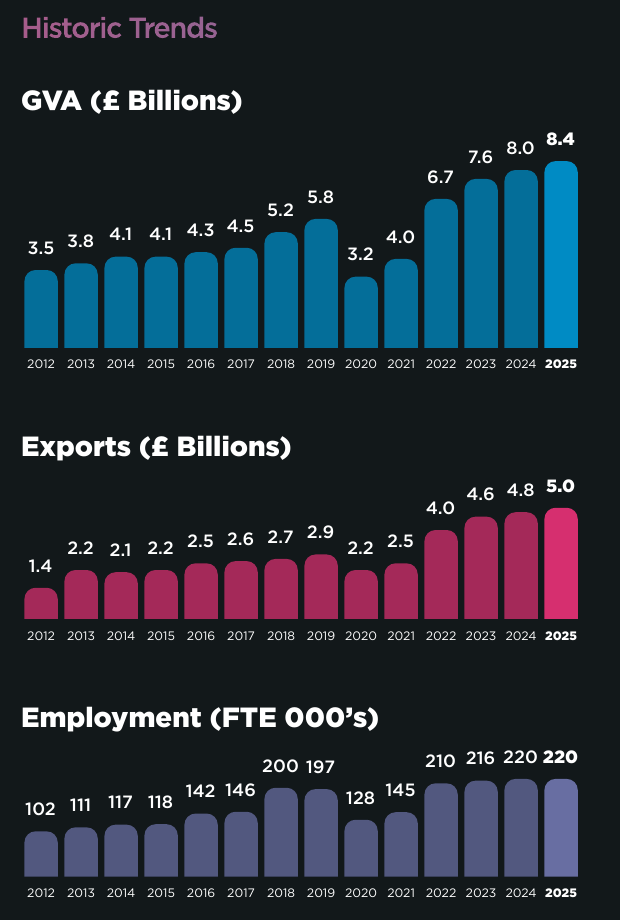
The longer series puts the record in context. GVA collapsed from £5.8bn in 2019 to £3.2bn in the first pandemic year, then rebounded through 2022 and 2023. The previous edition, This Is Music 2025, had already flagged the slowdown: Music Week reported that 2024 growth fell to 5% after several double-digit recovery years, with Kiehl saying growth had "now halved." The 2025 figure of 5.7% is a modest uptick on that, not a return to the boom.
Two qualifications matter. First, the methodology notes that all figures are nominal, so year-on-year changes ignore inflation. The report itself cites a 3.6% rise in consumer prices in 2025, which implies real GVA growth of only about 2% (this is the author's calculation from the report's own numbers). Second, employment has barely moved since 2022: 210,000, 216,000, 220,000, 220,500. The industry is producing more value with roughly the same headcount, and as the next section shows, that value is not spread evenly.
A Two-Speed Industry
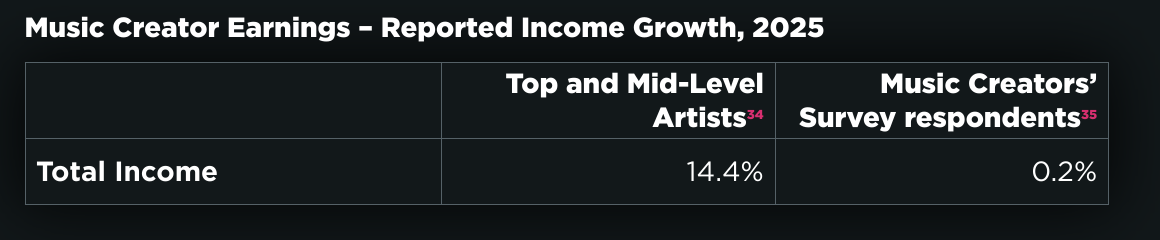
The clearest evidence is the report's comparison of two income datasets. A survey of accountants and business managers covering top and mid-level artists, whose earnings range from £200,000 to over £1 million a year, found 14.4% income growth in 2025. UK Music's own Music Creators' Survey, where average earnings are about £30,000, found growth of 0.2%, well below inflation. The report cautions that the two datasets use different populations and methods and are not a like-for-like comparison. Even so, a gap that wide is hard to explain away.
The live sector shows the same split. Stadium tours by Oasis, Coldplay, Beyoncé, Kendrick Lamar and Dua Lipa drove the record live and export figures. Below arena level, the report describes rising costs that "reduced net incomes," and it cites singer-songwriter Kate Nash telling a parliamentary select committee that she lost £26,000 on her previous European tour and £13,000 on her previous UK tour. Independent festivals report suppliers increasingly demanding full payment upfront.
Recording studios, the pipeline the report most explicitly worries about, are under pressure from property costs. In UK Music's studio survey, revenues rose only 2%, and 74% of studios reported flat or declining revenue. Business rates averaged 11% of turnover and exceeded 20% for some. A Music Producers Guild survey cited in the report found rateable values up an average 34.5% between 2020 and 2026. One studio owner is quoted as saying their business rates were "higher than the rent on my lease."
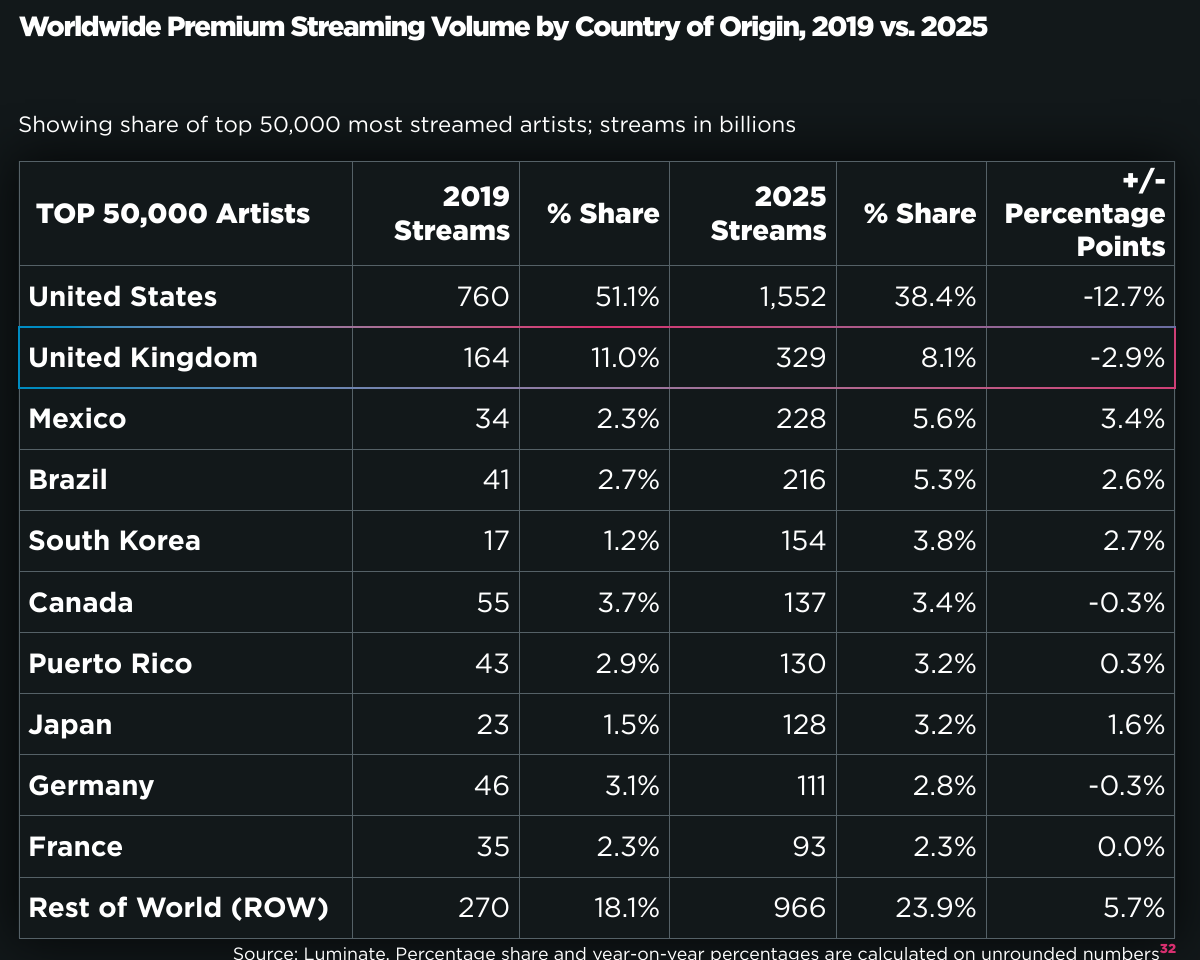
The longer-term worry is international. Luminate data reproduced in the report shows the UK's share of premium streams among the world's top 50,000 artists fell from 11.0% in 2019 to 8.1% in 2025. Mexico, Brazil and South Korea gained, and so did the long tail of smaller markets. The US lost even more share, so this is less a British collapse than a global market getting more crowded. At home, UK artists' share of album consumption rose only slightly in 2025, from 33.6% to 33.9%, after five years of decline.
Taken together, these figures show what the report means by "an uneven picture." The record is real, but it was made mostly by stadium tours, catalog and rights income, and artists who have already broken through. The part of the industry that is supposed to produce the next generation is barely keeping pace.
Ask One: "Don't Give AI a Free Pass"
The first of the four recommendations asks the government to "rule out any new exception that would allow AI developers to use copyright-protected music without permission," to make sure any AI regulation meets creators' needs, and to bring forward a promised consultation on digital replicas.
The demand looks odd at first, because the government has already stepped back. Its 2024–25 consultation proposed a text-and-data-mining exception that would let AI firms train on copyrighted work unless rights holders opted out. That was the government's stated preferred option. The response was overwhelmingly hostile. In a December 2025 progress statement, the government reported that among roughly 10,100 online responses, 88% backed requiring licences in all cases and only 3% supported the opt-out model. Creative-sector respondents mostly opposed it; tech respondents, including AI developers, mostly favored it or a broader exception.
On March 18, 2026, the government published its statutory report on copyright and AI and impact assessment. According to DLA Piper's analysis, it dropped the opt-out exception as its preferred route but also declined to back any alternative. It concluded there was "currently insufficient evidence to justify immediate reform," deferred binding transparency rules in favor of developing best practice with industry, and promised further consultation on digital replicas. The law firm Simmons & Simmons called the approach "a masterclass in can-kicking."
That explains UK Music's wording. Under current UK law, commercial AI training on protected works still requires a licence, so the industry won the first round. But "not now" is not "never," and the report's demand to "rule out" an exception asks the government to close a door it has deliberately left open. The digital-replicas consultation that UK Music wants accelerated still had not appeared by the time the report was published.
The report gives two signs of why the industry feels urgency. A Berklee College of Music survey it cites found that when clients insisted on a popular song they could not afford to license, AI was used to generate a soundalike in 18.5% of cases. Separately, citing Music Ally, it notes that Sony Music alone had filed more than 260,000 takedown notices for AI-generated deepfake recordings by October 2026, up from 75,000 in March 2025.
The technology sector sees the same stalemate as a cost. In March 2026, the trade body techUK argued that UK AI growth relies on "a stable copyright regime that allows access to training data through a TDM exception," framing the decision as whether "the UK chooses to be an AI maker or an AI taker." After the government's report, the Computer & Communications Industry Association said the government "keeps the worst copyright regime for AI training of any major economy." Their argument is that models will be trained elsewhere on the same global data regardless, so Britain loses the investment without protecting the creators. Music's counterargument is that a market for licensed training data is now emerging and an exception would undercut it before it matures. Which side is right depends partly on evidence the government itself says it does not yet have.
Ask Two: The EU Border
The second demand is the most concrete, and for once the industry has the government's own numbers behind it. On August 27, 2026, the Department for Culture, Media and Sport published The economic benefits of touring and impact of EU exit, prepared by Ipsos and Nordicity. Its main findings:
- Reduced EU touring cost the UK an estimated £208 million in GVA between 2022 and 2024, along with about 2,490 full-time-equivalent jobs. Live music accounted for £180.2 million of that.
- UK artists' performances in the EU in 2024 were still 21% below 2019 levels.
- The split was stark. Stadium and arena dates were 56% above 2019, while small-venue dates remained 22% down.
- EU host countries lost an estimated £1.04 billion in GVA, with Germany hit hardest.
The barriers it identifies are cumulative rather than any single rule: country-by-country work permit regimes that the Schengen 90/180-day allowance does not cover, ATA carnets for equipment costing roughly £270–£444 plus security deposits, cabotage rules limiting UK-registered trucks to a few moves inside the EU, import VAT and paperwork on merchandise, and withholding tax refunds that can take nearly two years. One interviewee told the researchers that "merch can be the difference between a tour losing money or breaking even for smaller artists." The report treats its estimates as indicative: they rely on a US-based counterfactual and only 13 stakeholder interviews.
This Is Music 2026 adds a new problem. Under EU customs reforms taking effect in 2026, the report says, each item (not each package) shipped to EU consumers faces a €3 customs duty plus a €2 handling fee regardless of value. That hits independent labels selling vinyl and CDs direct to fans, a channel where, according to the report's BPI data, independents hold 33.4% of physical album sales against 28.9% of streaming equivalents.
UK Music's asks are a structured EU-UK dialogue on cultural exchange, interim help with carnet and customs costs, and membership of Agora EU, the successor to the Creative Europe program. The government has delivered some of the operational fixes. Turn It Up reports that the EU, UK, Norway and Switzerland have begun processing digital ATA carnets, with about 70% of UK carnets expected to go digital. The core issue, a cultural work exemption in visa rules, needs Brussels as well as London to agree.
Asks Three and Four: Every Postcode, and the BBC
The third recommendation, "economic growth for music in every postcode," is a cluster of local and fiscal measures. Culture has become a formal area of competence for England's new strategic authorities, and UK Music wants mayors and councils to write music into their growth plans. Its specific asks are to ringfence part of any overnight visitor levy for culture, introduce temporary business rates relief for recording studios modeled on the relief for film studios, use planning and licensing rules (including the "Agent of Change" principle, which makes new developments near existing venues responsible for noise mitigation) to protect music activity, and invest in music education, new qualifications and apprenticeships.
The fourth asks for sustainable long-term BBC funding. This is the most indirect of the four, but the report makes a specific case. It cites Musicians' Union figures describing the BBC as the UK's largest civilian employer and engager of musicians, issuing more than 19,500 musician and composer contracts a year. It also argues that BBC Introducing, specialist stations such as 1Xtra, and the Proms offer a route to audiences that algorithm-driven platforms do not. The timing is deliberate. The government opened its Charter review consultation in December 2025, and the current Charter expires at the end of 2027, so how the BBC is funded after that is being decided now.
What Turn It Up Already Delivered, and Where the Gaps Are
Four months before this report, on July 13, 2026, the government published Turn It Up: Our Plan for Music, its first national music strategy. (This site has previously covered the plan's class-access dimension, including Culture Secretary Lisa Nandy's warning that "pop is getting posher"; this article focuses on the economic report and the policy asks.) Comparing the plan with UK Music's four demands shows where the gaps are.
Funding and grassroots. The Music Growth Package was increased from £30 million to £45 million over three years, with an extra £15 million from Arts Council England. It aims to reach more than 2,000 projects and at least 40,000 artists and professionals, and for the first time mid-career artists, managers, labels and publishers are eligible. Live music venues received 15% business rates relief. Recording studios did not, which is why the studio relief appears again in UK Music's list.
Education. The plan includes more than £12.5 million for a Music in Libraries program co-designed with the Ed Sheeran Foundation, more than £10 million for creative mentoring of care-experienced young people, a new National Centre for arts education backed by up to £13 million, and the £132.5 million Every Child Can enrichment program, which Creative Industries Minister Ian Murray highlights in his foreword to This Is Music 2026.
Exports. Digital carnets, a nearly 50% increase in trade-mission funding, and a £4.8 million Music Export Growth Scheme run by the BPI address costs at the margins. They do not change visa or cabotage rules.
AI. According to the government's own summary, the plan contains no AI measure. The AI and copyright debate is being handled separately, through the process described above.
BBC. Also outside the plan, inside Charter review.
The scale is worth stating plainly. £45 million over three years is about £15 million a year, against an industry the government's own minister now describes as worth £8.4 billion. That is roughly 0.2% of annual GVA (the author's calculation). It can make a real difference to grassroots organizations at a few thousand pounds per project, but it cannot offset structural costs such as business rates, employer National Insurance increases (which the report says many small music businesses cited as affecting hiring in 2025), or the cost of the EU border. Kiehl's foreword calls Turn It Up "welcome recognition of music's value," then adds that "there is more work for Government to do." Both are accurate.
Reading a Lobby Document Critically
None of this makes the report neutral, and several points should temper how its headline is read.
It is an advocacy document by design. UK Music describes itself as the "collective voice" of the industry, and its stated purpose is to "collaborate, campaign and champion music." The report was written by its own research director, with modeling by consultants it retains. That does not make the numbers wrong, and there is no independent official GVA figure to check them against, because the official statistics do not isolate music. But it means the framing (a record to show music deserves investment, a squeeze to show it needs help) serves the negotiating position.
The record mostly reflects the top of the market. By the report's own account, 2025 growth was driven by stadium tours, rights income collected by societies such as PRS for Music and PPL, and artists already earning six or seven figures. Employment growth was 0.3%. An industry can set a GVA record while most of the people in it see no real income growth, and that is roughly what the data describes. This is a problem the industry also has to address internally (for example through label and publisher deal terms and the streaming royalty principles referred to in Turn It Up), not only one for government to fix.
The Treasury has other claimants. Business rates relief for studios, ringfenced visitor-levy money and education funding all compete with every other sector in a tight fiscal environment, and the government has classed music as one part of the creative industries, which is one of eight priority sectors in its Industrial Strategy. Music asking for targeted relief is reasonable; it is not obvious that it is more deserving than theatre, hospitality, or high-street retail facing the same rates and National Insurance pressures (this is the author's assessment).
On AI, the other side has a real argument. techUK and CCIA's position, that Britain risks losing AI investment without gaining any protection because models are trained elsewhere, is not frivolous, and the government's own report admits the evidence on economic impact is limited. The music industry's case is strongest on transparency and consent for commercial use, and weakest when it assumes a licensing market will appear fast enough to make an exception unnecessary.
Not every ask is in the government's gift. A cultural work exemption from EU visa rules, or the €3 per-item customs charge, depends on EU decisions. London can negotiate and soften costs; it cannot unilaterally fix them.
Conclusion: A Record That Hides a Bottleneck
Read alongside the government's touring study, its AI copyright report, and Turn It Up, This Is Music 2026 makes a narrower argument than its headline suggests. The British music industry is not in crisis. Its economic output is at an all-time high, it remains the world's second-largest exporter of recorded music, and it has won the first round of the AI copyright fight. What the report documents is a bottleneck. Value is concentrating among stadium acts and rights holders, while the studios, small venues, mid-level touring and income for ordinary creators, which together form the pipeline to the next generation, are flat or shrinking.
That is why a record year comes with a request for help. Whether the request succeeds will depend less on the £8.4 billion figure than on three decisions largely outside the music industry's control: whether the government's AI copyright pause becomes a lasting policy, whether Brussels agrees to a touring deal, and how the BBC is funded after 2027.
Sources
- Original article: Rebecca Auburn, "UK Music Urges Government Action on AI, Brexit and Funding Even as Industry Generates Record £8.4 Billion In 'Gross Value Added'", Digital Music News, November 17, 2026
- UK Music, This Is Music 2026 (GVA, exports, employment, creator earnings, studio survey, streaming share, methodology, four recommendations)
- Music Week, "UK Music report values industry's economic contribution at £8 billion – but growth slows in 2024" (2024 baseline and previous year's policy asks)
- GOV.UK, Copyright and artificial intelligence: statement of progress under section 137 Data (Use and Access) Act (consultation response figures)
- GOV.UK, Report on copyright and artificial intelligence, March 18, 2026
- DLA Piper, "TDM and training AI models: UK government publishes report and impact assessment" (analysis of the March 2026 report)
- Simmons & Simmons, "A masterclass in can-kicking: UK Government views on AI and copyright"
- techUK, "techUK response to the Lords Communications and Digital Committee report: AI, Copyright and the Creative Industries", March 11, 2026 (tech-sector view)
- CCIA, response to the UK ministerial report on AI and copyright and economic impact study, March 18, 2026 (tech-sector view)
- Music Ally, "Sony Music has now filed 260k takedowns of AI deepfake tracks", October 5, 2026
- Berklee College of Music, In Sync: Music and Video 2026 (AI soundalike figure, as cited by UK Music)
- DCMS / Ipsos / Nordicity, The economic benefits of touring and impact of EU exit, August 27, 2026
- GOV.UK, "Government launches bold plan to turn up the music industry", July 13, 2026 (Turn It Up measures)
- Broadband TV News, "UK government launches BBC Charter Review consultation", December 16, 2025