
Back to the Motif: What Suno's MIDI Input Says About the Next Phase of AI Music Tools
Updated:
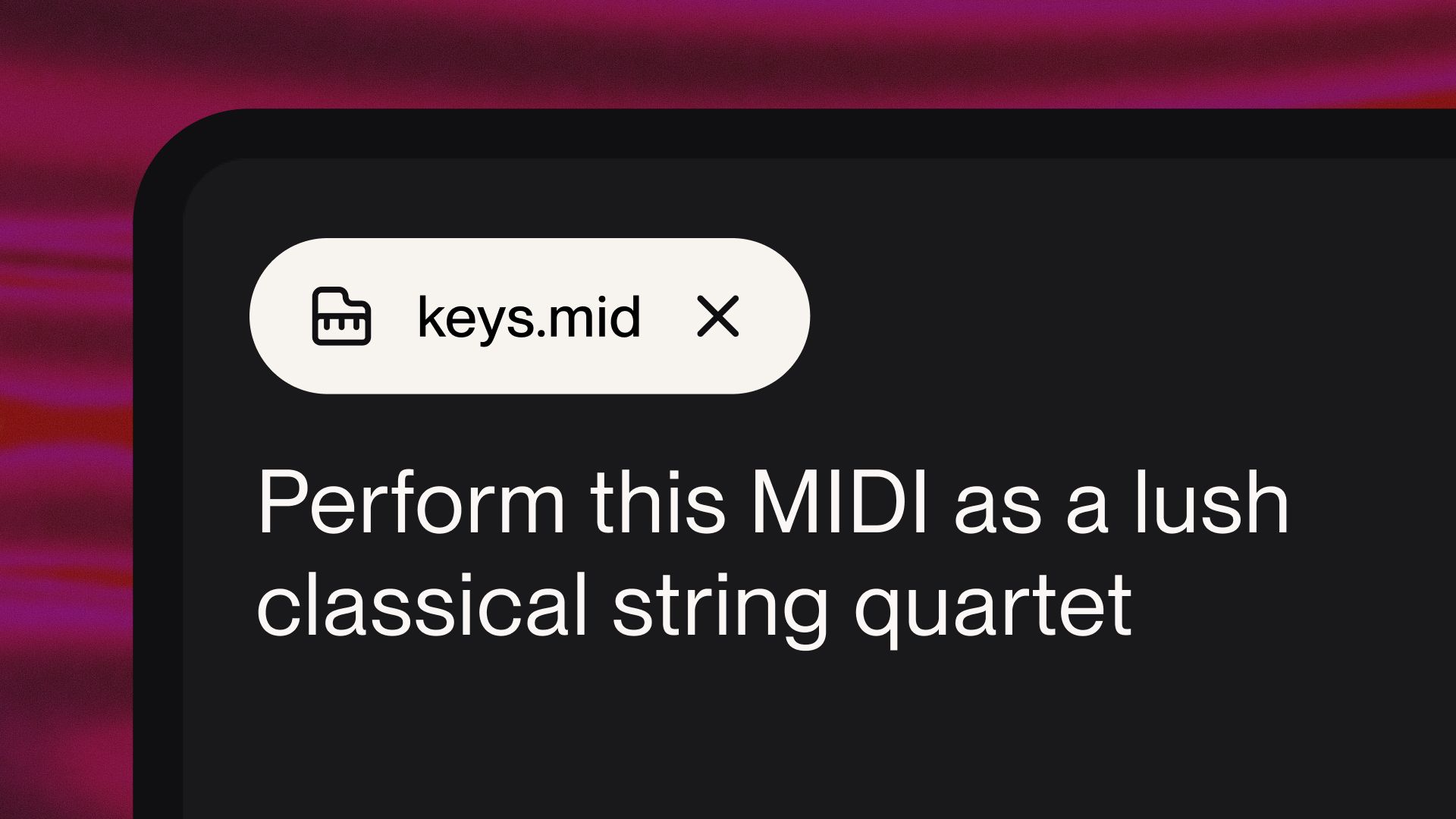
On November 4, 2026, Suno announced that its Create page now accepts MIDI files: drag a .mid or .midi file onto the prompt bar, or pick MIDI from the "+" menu, and the song starts from your notes rather than from a text description. It reads like a small product note. It is arguably the clearest signal yet of where AI music tools are heading — because it reverses the direction of travel that defined the first wave of generative music.
For two years, the defining gesture of tools like Suno and Udio was the wish: type a sentence, receive a song. The user was a requester; the model was the musician. With MIDI input, the musician goes first. You hand the machine a motif, a chord track, a bass line — something you wrote or at least chose — and the machine's job becomes realizing, developing, or re-voicing it. The tool stops replacing the act of composition and starts serving it.
What Actually Launched
The facts first. Per Suno's own blog post, MIDI input accepts any .mid or .midi file and works through Simple Create mode running the v6-wild model. You control how strictly the model follows the file with natural language: ask it to play your notes exactly as written, take the top-line motif and develop it into something new, or keep the notes and swap the instrumentation — the post's own examples range from "arrange this MIDI for a full orchestra" to "transform this MIDI into a string quartet."
The feature sits alongside, and deliberately apart from, Suno's existing upload paths. Remix and Cover start from recorded audio (WAV or MP3), where the model imitates and extends a sound. MIDI input starts from notation — pitch and timing with no sound attached — which Suno positions as "a much more precise starting point than any other way of creating on Suno." At launch it is available to Pro and Premier subscribers — $10/month and $30/month respectively, per Suno's pricing page.
There is also a technical footnote that matters: this is not Suno's first MIDI move. In August 2026, MusicRadar reported that Suno Studio 2.0 — the company's browser DAW — added MIDI import, recording and timeline editing, audio-to-MIDI conversion, and a MIDI-to-audio generator that "covers" MIDI clips while "preserving the pitch, rhythm and dynamics from the original MIDI part." MusicRadar noted Suno called MIDI integration the most requested Studio feature from its user base. The new Create-page input extends that capability from the DAW product into the prompt-first flow — and notably, Studio 2.0 requires the $30 Premier tier, while MIDI-in-Create reaches down to the $10 Pro tier.
Why MIDI? Because a 43-Year-Old Protocol Is the Cleanest Interface Between Human and Machine
The strangest part of the announcement is the oldest: the file format at the center of it dates to 1983. MIDI — the Musical Instrument Digital Interface — grew out of a proposal Dave Smith of Sequential Circuits (with Chet Wood) presented at the 1981 AES convention, developed in collaboration with Roland's Ikutaro Kakehashi and other manufacturers, and first demonstrated publicly at the 1983 NAMM show, as documented by The MIDI Association's history collection. Smith and Kakehashi received a Technical Grammy for it in 2013 (Matrixsynth). Four decades on, it remains the lingua franca of production: the 5-pin DIN cable has been joined by USB and Bluetooth, but the data model — and the .mid file that packages it, up to 16 channels of pitch and timing data with up to 120 controller lanes each — still runs inside essentially every DAW session on earth.
MIDI's durability comes from exactly the property Suno's blog spends a section explaining: it contains no sound. A MIDI file is a description of a performance — which notes, when, how hard, with what sustain — and nothing else. In 1983 that was a limitation (the sounds came from whatever synthesizer received the data). In 2026 it is the point. Audio uploads carry a sonic fingerprint: tempo, timbre, room noise, a specific recording of a specific instrument. MIDI carries intent without any of that. It is the one widely-supported music file format that specifies what was meant rather than how it sounded — which makes it, structurally, an ideal input for a generative model. You give the machine the plan; the machine supplies the performance.
That, at least, is the theory. Whether the execution matches it is a live question — see below.
Three Audiences, Three Different Meanings
The same feature lands very differently on the three groups Suno now serves. (This breakdown is the author's analysis, not Suno's framing.)
For the non-instrumentalist prompt user, MIDI input mostly doesn't apply directly — most people who arrived at Suno through text prompts don't keep .mid files. But it lowers a psychological wall: the platform is signaling that bringing musical material, not just adjectives, is now a first-class way to work. MIDI is also trivially obtainable — exported from any notation app, downloaded from chord-track generators, pulled out of old files — so the barrier is knowing the format exists, not affording tools.
For producers and hobbyist composers, this is the core audience. Suno's blog pitches it at exactly their pain: MIDI sketching is easy, but rendering MIDI into a full-sounding arrangement has always been the expensive part — sample libraries from the likes of Spitfire Audio or EastWest cost thousands of dollars and hundreds of gigabytes, and programming them convincingly is a craft in itself. A model that turns a thin piano sketch into a full orchestra in one generation, if it works, removes the single most capital-intensive step between idea and demo.
For working media composers and educators, the stakes are different again. The "make your sheet music come alive" and school-project use cases in Suno's post are effectively a mockup engine — hear a score with real instrumentation before (or instead of) hiring players. Whether that's a sketching tool or a replacement for the mockup labor that currently pays some composers' bills is the uncomfortable version of the same question.
The Competitive Picture: Everyone Is Courting the Person Who Already Makes Music
Suno is not alone in discovering that its future power users already own studios. Udio, its closest rival, has spent two years building its own upload path: audio-to-audio remix uploads arrived with v1.5 in 2024, and the Styles update in March 2025 let users upload their own audio as a stylistic reference directly from the homepage — with the explicit requirement that users hold rights to whatever they upload. Stable Audio 2.0 added audio-to-audio transfer in 2024, transforming uploaded samples via natural language. The pattern across all of them: the prompt box alone proved too thin an instrument, and every serious tool has been retrofitting ways for users to bring their own material.
Suno's MIDI route is the most radical of these because it is the only one that skips audio entirely. Uploading audio asks a model to imitate a sound; uploading MIDI asks it to read a score. Imitation is statistically safer for a generative model; notation-following demands the model actually honor pitch and timing data it didn't infer from waveforms. If Suno's "play it exactly as written" mode works reliably, it is a genuinely different capability class from anything Udio or Stable Audio ships. If it doesn't, MIDI input is just a new door into the same generative slot machine.
The Fine Print: Early Users Report a Gap Between Promise and Output
That is where the first week of community testing lands, and it is more mixed than the announcement. On r/SunoAI, the feature's launch threads document real problems alongside real enthusiasm.
The most detailed early test came from a user going by u/deadsoulinside, who ran a known MIDI file (from Online Sequencer) through the new input and reported three concrete limitations: the feature is locked to v6-wild with no access to the advanced-mode sliders; it ignored their saved Suno voice — "at times it was a female singer" — and, most damning, in one generation they could not hear the input MIDI in the output at all: "I am not even sure if the midi is in this track." Their conclusion: "Not even remotely close to mine."
The same threads surfaced an even stranger failure mode. A user named Riquende reported that a MIDI file "24 years old and has never been rendered into an actual sound file or uploaded anywhere" was rejected as "matching an existing recording" — a content-identification fingerprint apparently misfiring on pure note data. Their workaround tells its own story about the feature's current ergonomics: "Probably easier to just use my planned workflow of MIDI import > FL Studio 'instruments' > MP3 export > Suno cover."
The positive signals are real but narrower. The original poster of the second thread, u/lumina_si_intuneric, got "the best adherence I've seen in v6 so far" on short instrumental stems — though notably they had avoided vocals, which is precisely where u/deadsoulinside's test broke down. Experienced users like u/JasonP27 recommend treating MIDI input as an intermediate step — generate with v6-wild, then run a second Cover pass for polish and voice control — a sensible workflow that is also an admission that the one-shot "exactly as you wrote them" promise isn't quite there yet.
Two structural criticisms sit outside individual bug reports. First, the subscription gate: MIDI input requires a paid tier, which means the feature most useful to people who already compose is invisible to the free users who might otherwise discover they want it. Second — and this is the author's framing rather than a sourced position — every hour a generative model spends rendering an arrangement is an hour of arrangement labor that once went to a human. The mockup-and-demo layer of the composer economy is exactly the layer most exposed to a tool like this. Empowering for the composer who owns the workflow; deflationary for the ones currently selling that layer.
None of this arrives in a vacuum. Suno announced the feature the same season it was defeated in GEMA's landmark lawsuit and inked a licensing deal with BMG — a company simultaneously fighting over what its models may learn and building tools that ask musicians to teach them directly.
Conclusion: The Wish Machine Learns to Take Requests
The generous reading of MIDI input is that it is the beginning of a settlement between AI music tools and working musicians: instead of asking "what if everyone could skip making music," it asks "what if the expensive parts of realizing music got cheap." The skeptical reading is that "empowering" and "replacing" describe the same trajectory from different altitudes, and that a feature which can't yet reliably follow the notes it was given is a promise of that trajectory rather than its arrival.
Both can be true for now. What is already certain is the direction: the prompt box is no longer the front door. Suno's most telling design decision in this launch is not the MIDI parsing — it is that the model can be instructed, in plain language, how much freedom to take with material the user brought. The next phase of AI music tools will be measured less by how well they generate from nothing and more by how faithfully they elaborate on something. On the evidence of week one, that measurement is now underway, and the scoreboard is not yet in Suno's favor — but the game being played has finally changed.
Sources
- Suno — Start Songs with MIDI (original announcement, Nov 4, 2026)
- MusicRadar — Suno's Studio 2.0 adds an AI chatbot that can control your project (Matt Mullen, Aug 14, 2026)
- The MIDI Association — The History of MIDI Collection
- Matrixsynth — Dave Smith Awarded Grammy for Technical Achievement (2013)
- r/SunoAI — New Feature: MIDI Uploads (Nov 5, 2026)
- r/SunoAI — Has anyone tried out the .mid upload option yet? (Nov 7, 2026)
- Suno — Pricing
- Udio — Introducing Styles (audio upload as style reference, Mar 31, 2025)
- Udio — Introducing v1.5 (audio-to-audio remix uploads, 2024)
- Stability AI — Introducing Stable Audio 2.0 (audio-to-audio transfer, 2024)