
After the Blue Wave: Who Now Holds the Pen on Music AI Law
Updated:
On November 3, 2026, Democrats did something few forecasters had fully priced in. According to CNBC's tally of Associated Press data, they flipped seven Republican-held Senate seats, at least two dozen House districts and five governorships, while Republicans failed to flip a single Democratic-held congressional seat, governorship or legislative chamber. Kansas elected its first Democratic senator since 1932; Texas voters turned out Governor Greg Abbott.
Two days later, Wall Street delivered its own verdict. The Nasdaq Composite fell about 5.5% on November 5 (UPI; Fox Business put it at 5.52%), with coverage attributing the selloff to fears of tougher rules on AI and data centers.
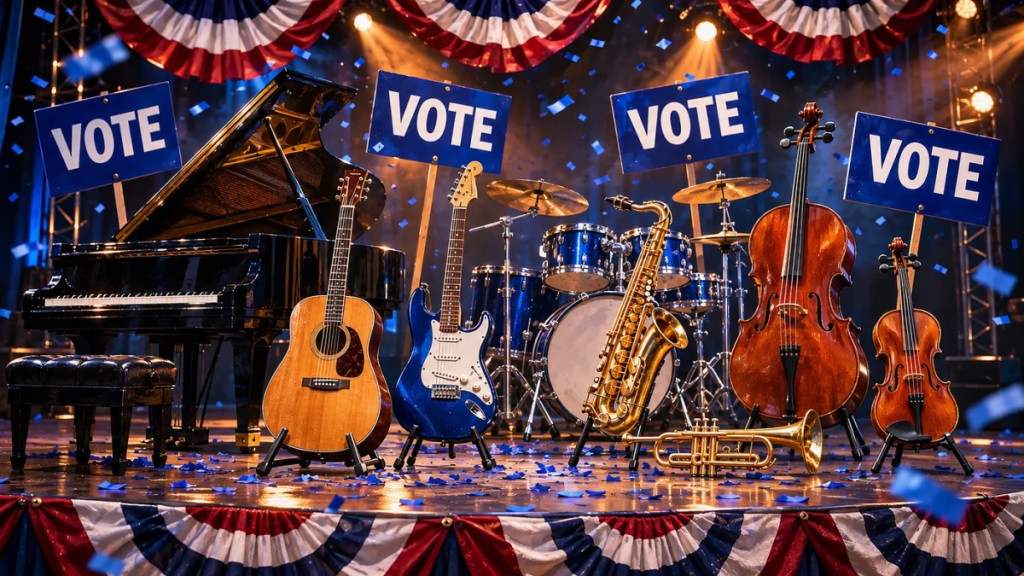
"A historic blue wave has broken across the United States. Is there an opportunity for musicians?" Image: Michael Whalen, via Digital Music News
Composer and producer Michael Whalen took that question to Digital Music News a week after the vote, calling himself "skeptical but hopeful." His essay lays out a ten-point wish list for music and AI — permission for commercial training, access to training records, a voice-and-likeness right, informed consent, a creator share of licensing money, collective bargaining, clear authorship rules, labeling, streaming-fraud accountability and affordable enforcement. It is a thoughtful agenda. But an agenda is not a map. Whether any of it reaches a musician's contract depends less on which party "won" than on a handful of specific people, committees and calendar dates.
This piece traces that map: what the election actually changed, where the music-relevant bills stand, and the reasons to keep expectations in check. Throughout, verifiable facts are linked to their sources; Whalen's views are attributed to him; and where we draw our own conclusions, we say so.
What the Election Actually Changed
The facts first. Democrats will control both chambers of the 120th Congress when it convenes in January 2027. In the Senate, they hold roughly 54 seats, with races in Alaska and Mississippi still being counted as of the latest reports (TechTimes, CNBC).
Three structural limits survive the wave, and Whalen names two of them himself:
- The veto. President Trump remains in office through January 2029. Overriding a veto takes two-thirds of both chambers — numbers Democrats do not have.
- The filibuster. Most legislation still needs 60 votes to end debate in the Senate. A 54-seat majority needs at least six Republicans on any contested bill.
- The calendar. Committee chairs for the new Congress have not been finalized. Until they are, nobody can schedule a markup.
The most consequential change for AI policy may be a gavel rather than a headcount. With Democrats in the majority, Senator Maria Cantwell (D-Wash.), the top Democrat on the Commerce Committee, is in line to replace Senator Ted Cruz (R-Texas) as chair of the panel with the broadest AI jurisdiction, TechTimes reports. The two have opposite instincts on the question that will shape music protections most: whether a federal AI law should override the states. Cruz has argued that any national standard must deal with the "patchwork" of state laws; Cantwell has opposed efforts to override them.
The Lame-Duck Window: One Last Run for NO FAKES
Before the new Congress arrives, the old one still sits until January 3, 2027 — and the music industry's most advanced bill lives or dies in that gap.
The NO FAKES Act of 2026 (S.4591) would create a federal right over AI-generated replicas of a person's voice and likeness. (We have broken down its mechanics in earlier coverage of Sony Music's mass takedowns of AI fakes and of the ELVIS Act suits against Suno; here the question is purely political.) The bill cleared the Senate Judiciary Committee on June 18 and sits on the Senate calendar. On September 30, Senator Marsha Blackburn (R-Tenn.) asked to pass it by unanimous consent. Cruz objected (Deadline).
Cruz's stated reason was not opposition to the idea. According to an account of the Congressional Record by The AI Musicpreneur, he said he had voted for the bill in committee but that its parody exception "leaves it to Big Tech to make the decision," and asked for more time to tighten free-speech language. Lead sponsor Chris Coons (D-Del.) closed the exchange: "We should not let the perfect be the enemy of the good."
A week later, RIAA chief Mitch Glazier told Billboard the bill had "a real shot" in the lame-duck session — while conceding that reintroduction in 2027 was the more likely outcome, per the same report. Even a lame-duck Senate passage would not finish the job: the House companion, H.R. 8915, has not moved since it was referred to the House Judiciary Committee in May.
Here the election matters less than it seems. Unanimous consent requires no majority at all — just the absence of an objector. A Democratic wave does nothing to remove a single senator's objection in December. Our read: the lame-duck odds depend almost entirely on whether Cruz's staff and the sponsors settle the parody language, not on November's results.
The Blackburn Paradox
One result from election night matters more to music AI than any Senate flip, and it went the other way.
Marsha Blackburn won the Tennessee governorship with about 45.5% of the vote (WPLN), becoming the state's first female governor. She is the Republican lead on NO FAKES. She was the Senate's most visible champion of Nashville's interests. And she is the author of the TRUMP AMERICA AI Act discussion draft that Whalen cites approvingly — the March 2026 proposal that would declare unauthorized AI training not to be fair use.
When she takes office in January, she leaves the Senate. Her seat will go to an interim appointee — whom she will name as governor — serving until the 2028 election. Glazier flagged this before the vote, according to The AI Musicpreneur: Blackburn's departure would take the bill's Republican lead out of the chamber.
Our inference: this cuts both ways. In Washington, the music industry loses a senior, bill-writing ally exactly when it needs Republican votes to clear 60. In Nashville, the governor who now runs the home state of the ELVIS Act is someone with every reason to defend it against federal override. Neither shift is a function of the blue wave; both may matter more than it does.
Preemption: The Fight That Decides What States Keep
For musicians, the most practical question is not whether Congress passes a federal law but whether that law wipes out the state laws they already have. Tennessee's ELVIS Act and California's 2024 digital-replica statutes are today's real protections; federal bills are still promises.
The record on this question is unusually clear:
- July 2025: The Senate voted 99–1 to strip a proposed ten-year moratorium on state AI laws out of the reconciliation bill (TechTimes).
- December 2025: President Trump signed an executive order directing the Attorney General to stand up an AI Litigation Task Force to challenge state AI laws, and ordering a legislative proposal to preempt them. The order's carve-outs cover child safety, compute and data-center infrastructure, and state procurement, plus "other topics as shall be determined." Likeness and voice are not on the list — though the same order says a national framework should ensure "copyrights are respected."
- March 20, 2026: The White House released its National Policy Framework. Per the National Governors Association's summary, it urges broad preemption, asks Congress not to disrupt the courts on whether AI training is fair use, and endorses collective licensing and a federal approach to unauthorized digital replicas.
NO FAKES itself contains a preemption clause. As reported to the Senate, it would generally displace state digital-replica claims but preserve state laws on the books as of January 2, 2025, according to analyses by Byte Back and Reed Smith. That likely protects early movers like Tennessee and California — and freezes out states that have not legislated yet. (We have not independently confirmed how each state statute would fare under the final text.)
Here the election matters in a concrete way. Democrats now hold a majority of governorships for the first time since 2010, plus newly flipped legislatures in Texas, Wisconsin, Pennsylvania and elsewhere (CNBC). In California, Xavier Becerra, who won the governor's race, has said he supports regulating AI, though he has not detailed positions on specific statutes. In Texas, governor-elect Gina Hinojosa ran mainly on education and affordability, not AI. Our inference: a Senate in which the likely Commerce chair opposes broad preemption, plus more Democratic statehouses, makes a sweeping federal override harder in 2027 — and makes state-level AI bills, including music-relevant ones, more likely to keep coming. For artists, that means more protection in some states and a more fragmented map overall.
Training Data: Where the Party Lines Blur
Whalen's top priority — permission rules for commercial training, backed by transparency — is also where the "blue wave equals music protection" story is weakest. On this issue, the dividing line runs through both parties.
On one side sits the Trump administration. Its March framework asks Congress to leave fair use to the courts, and its Justice Department went further: in a Statement of Interest filed in the OpenAI copyright litigation in New York, the government urged the court to treat training on copyrighted text as a highly transformative fair use, according to Lowenstein Sandler. That filing came after the Copyright Office's more cautious Part 3 report, which remains a pre-publication draft from May 2025; the same alert notes that on June 30, 2026 the Supreme Court declined to let the administration remove Register Shira Perlmutter while litigation continues.
On the other side sits a Republican: Blackburn's draft, which would bar unauthorized training from fair use altogether (CMU). The transparency bills are bipartisan too. The CLEAR Act, introduced in February by Senators Adam Schiff (D-Calif.) and John Curtis (R-Utah), would require developers to file notices summarizing copyrighted training data with the Copyright Office; Billboard reported backing from the RIAA, NMPA, Recording Academy and SoundExchange. The TRAIN Act (S.2455) would let rights holders subpoena training records. Neither has moved out of committee.
Our read: a Democratic Senate improves the odds of a hearing for CLEAR and TRAIN, and Whalen's suggestion to prioritize disclosure over liability is politically realistic. But a bill that requires training permission would run into the administration's stated position in court — and a veto. Expect transparency to move before liability, if anything moves at all.
Reasons for Caution
The optimistic reading deserves several checks.
Party is a weak proxy for AI policy. NO FAKES was blocked by a Republican and is led by a Republican; the strongest anti-fair-use proposal came from a Republican; the most sweeping preemption push came from a Republican White House, yet the Senate rejected the moratorium 99–1. Tech-friendly Democrats exist too — Leading the Future, the AI industry's largest super PAC network, backed 16 Democrats alongside 34 Republicans this cycle, per Fast Company. "Blue" does not map cleanly onto "pro-musician."
AI money did not simply lose. The post-election picture of industry spending is mixed. Fast Company concluded the midterms were not the rebuke of AI money many expected, and Semafor tracked where it did work. Groups on the pro-regulation side, such as the Anthropic-funded Public First network, have claimed victory — a characterization from an interested party. The lobbying capacity that shaped the 119th Congress will be present in the 120th.
Voters were not voting on AI. An October AP-NORC poll found cost of living and the Iran war dominated voters' priorities for the next Congress, TechTimes notes. A mandate on groceries is not a mandate on training data.
A selloff is not a statute. The November 5 market drop tells us what investors fear, not what Congress will pass. Whalen himself cautions that markets "can change direction quickly."
The source is an advocacy essay. Whalen's piece is a commentary from a working composer, and it says so. His ten protections are proposals, several of which — a statutory creator share of licensing revenue, a training permission requirement — have no bill text behind them. That is a strength as an agenda and a limit as a forecast.
What Musicians Should Actually Watch
Translating the election into anyone's royalty statement will take years. These are the dates and decisions that will show whether it is happening:
- Now through January 3, 2027: whether NO FAKES clears the Senate by unanimous consent and gets a House vote. If not, the clock resets.
- January 2027: committee assignments — who chairs Senate Commerce and Judiciary — and who Tennessee's new governor sends to fill Blackburn's Senate seat.
- Early 2027: reintroduction of NO FAKES, CLEAR and TRAIN in the new Congress, and whether any comprehensive AI bill carries a preemption clause that reaches state likeness laws.
- Through 2027: state legislative sessions in newly Democratic statehouses, and any action by the federal AI Litigation Task Force against state laws.
- Ongoing: the courts. The fair-use question for training is being decided in litigation, with the federal government now arguing for the AI developers.
Whalen proposes judging progress on Election Day, November 7, 2028, by asking whether working musicians can point to a contract, a performance or a payment the new rules changed. That is the right test. The blue wave changed who holds the pen in Congress. It did not change the 60-vote threshold, the veto, the courts, or the fact that the single most important ally music had in the Senate is moving to Nashville.
Sources
- Original article: Michael Whalen, "The 'Blue Wave' Could Change the Rules for Music AI", Digital Music News, November 10, 2026
- CNBC — Democrats sweep 2026 midterms; Republicans fail to flip a single seat
- TechTimes — Democrats Win Senate but Lack 60 Votes for AI Regulation
- UPI — Nasdaq plunges 5.5% as AI concerns erase post-midterm gains
- Fox Business — Nasdaq tumbles 5%, Dow plunges more than 1,800 points
- Congress.gov — S.4591, NO FAKES Act of 2026
- Deadline — Ted Cruz Blocks Senators' Effort To Pass No Fakes Act
- The AI Musicpreneur — NO FAKES Act Status: RIAA Chief Eyes Lame Duck After Cruz
- WPLN — Tennessee election results: Blackburn wins governor's seat
- CMU — Copyright Alliance welcomes separate AI documents published by White House and Congress
- The White House — Ensuring a National Policy Framework for Artificial Intelligence (executive order, December 2025)
- National Governors Association — In Summary: The White House National Legislative Policy Framework for AI
- Byte Back — A Federal Shift in AI and the Right of Publicity? NO FAKES Act Advances in Congress
- Reed Smith — AI and publicity rights: The No Fakes Act strikes a chord
- NBC News — Xavier Becerra wins California governor's race
- KUT — Gina Hinojosa defeats Gov. Greg Abbott
- Lowenstein Sandler — U.S. Government Backs Fair Use for AI Training in OpenAI Copyright Litigation
- IPWatchdog — CLEAR Act Would Establish Notice Requirements for Copyrighted Works in AI Training Data
- Billboard — New Federal Bill Could Require Disclosure of Songs Used in AI Training
- Congress.gov — S.2455, TRAIN Act
- Fast Company — The midterms weren't the rebuke of AI money many expected
- Semafor — Where AI money worked in the midterms