
Signed at 14, Licensed After 2029: NewJeans' Contracts and the AI Rights That Outlive the Deal
Updated:
In April 2022, five girls aged between 14 and 17 signed exclusive contracts with ADOR, a label inside HYBE, the company behind BTS. Within two years they were NewJeans, one of the most commercially successful K-pop acts of the decade. On November 5, 2026, The New York Times published those contracts' terms after obtaining copies. One detail went further than the rest: according to the report, after the deal expires in 2029 the label could keep using and licensing the members' names, faces and voices, including through AI voice clones and chatbots.
The Times article is behind a paywall. This piece relies on what Korean and international outlets reported about it, and on statements from the companies and people involved. Where those accounts disagree, the disagreement is noted.
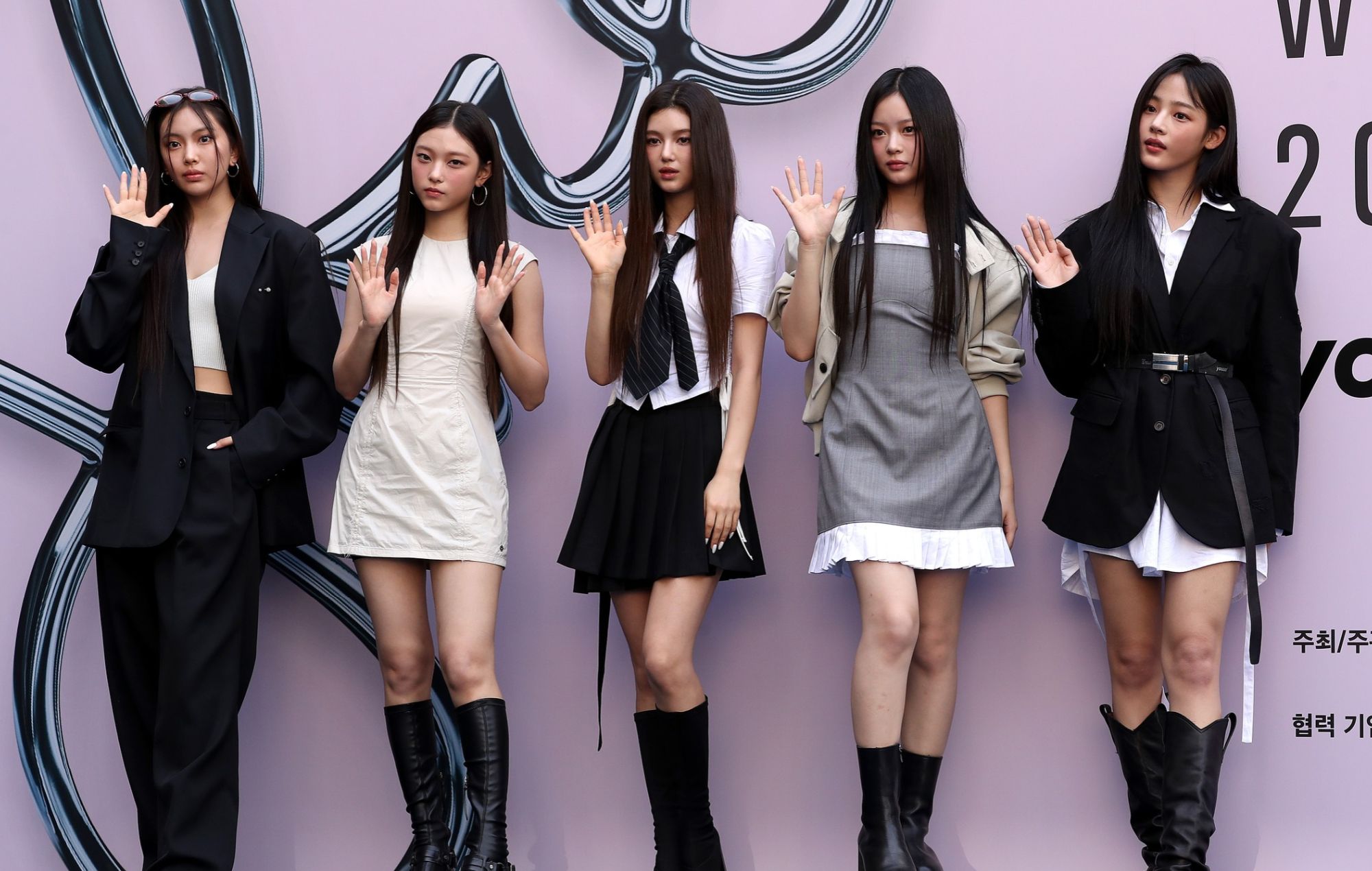
NewJeans in 2025. Credit: Han Myung-Gu/WireImage/Getty
Fights over K-pop contracts are old news: long terms, heavy penalties, strict rules on behaviour. This report raised a newer question. If a minor signs a clause about identity rights, can it reach beyond the contract's own end date? And can it cover a technology that barely existed as a business when the signatures went down?
What Korea's government templates actually ask for
South Korea has no single law that dictates what an entertainment contract must say. The system runs mainly on government-issued standard contracts: model agreements that companies are encouraged to use, which are then reinforced by sector laws.
The first layer dates to July 2009. That year the Fair Trade Commission issued standard exclusive contracts for actors and singers, partly in response to the death of actress Jang Ja-yeon and the debate over "slave contracts" that followed. YTN's report at the time set out the core terms. Actors' deals were capped at seven years. Singers could ask to terminate once seven years had passed. Clauses forcing artists to report their whereabouts or clear their private lives with the agency were to come out. Penalties were limited, and for singers they were tied to the months left on the contract. The seven-year benchmark still shapes the industry. NewJeans' contracts run from 2022 to 2029, exactly seven years.
The second layer is aimed at minors. In March 2019 the Ministry of Culture, Sports and Tourism issued a standard supplementary agreement for minor pop-culture artists, meant to be attached to the main contract whenever an artist or trainee is a minor ("youth" under Korean law, meaning under 19). According to the ministry, it:
- states that agencies "must endeavour to" guarantee minors' rights to free choice, education, personality and sleep;
- bans assault, coercion and threats, and requires agencies to shield minors from acts classed as harmful under the Juvenile Protection Act;
- lets the minor terminate the contract if the agency or its staff commit violence, sexual violence or abuse;
- spells out working-hour limits. Under-15s may work up to 35 hours a week; those 15 and over up to 40, with limited extensions by agreement. Work between 10 p.m. and 6 a.m. is barred.
The ministry itself described the hour limits in the underlying statute, the Popular Culture and Arts Industry Development Act, as "declaratory" in character, and said the supplementary agreement was meant to give them practical force (Korea.kr policy briefing).
A revised version took effect on January 1, 2026, after the 2022 NewJeans contracts were signed. It explicitly prohibits pressuring minors to skip or drop out of school. It extends the list of banned conduct to verbal abuse, harassment and sexual harassment. It forbids forcing a minor to film or perform when there are health or safety risks. And it requires agencies to name a youth-protection officer and inform the minor and their guardians (Star News, January 2, 2026).
Two facts frame the rest of this story. First, these documents are guidelines: the ministry's own 2019 release calls the supplementary agreement a "guideline" for protecting minors' rights, and companies are not legally required to sign the templates word for word. Second, much of their protective language is phrased as effort ("must endeavour to") rather than as an enforceable rule. Whether a contract that leaves them out is illegal, or simply worse for the artist, is a separate question.
Where the NewJeans contracts reportedly diverge
Pieced together from NME, The Kyunghyang Shinmun, Seoul Economic Daily and The Korea Herald, the Times reported the following:
- Missing minor-protection language. The contracts reportedly lacked the template's guarantee of minors' "physical and mental health, right to education, personality rights, and rights to sleep, rest, and free choice." They also reportedly lacked a clause stating the label would not demand that a minor "engage in excessive physical exposure or overly sexually suggestive expression."
- Broad conduct clauses. The contracts banned "inappropriate romantic relationships," an "insincere attitude" and "neglect of self-management." Kyunghyang also reported a clause barring public statements that could damage the company's reputation, whether or not they were true.
- Trainee costs. Members were to repay a substantial share of costs from their trainee years, including cosmetic procedures and skin care.
- The penalty formula. The standard template multiplies average monthly revenue by the months left on the contract. The NewJeans contracts reportedly averaged only over months in which revenue was actually earned, which the Times said could inflate the figure.
- Identity rights after the contract. The template generally ends the label's right to use an artist's name, likeness and voice when the contract ends. The NewJeans contracts reportedly let ADOR keep using them, or license them to third parties, after 2029. Per the reports, that includes AI voice cloning and chatbots. NME's account adds that the members would still be paid but could not control how their faces and voices were used.
The Times had five legal experts review the agreements. One of them, Seoul entertainment lawyer Noh Jong-eon, called it "an unusually aggressive contract," according to Kyunghyang and The Korea Herald. The paper also reported on the negotiations. When a member's mother asked for changes in January 2022, an ADOR vice president reportedly replied that if she did not agree with the revisions, it might be better to reconsider the contract altogether (wording as rendered in Kyunghyang's English edition). The parents of all five members signed.
The Times also reported on the trainee years: practice sometimes running until 2 a.m., cameras in practice rooms, and four of the five members leaving school. These claims come from unnamed sources cited by the paper, and HYBE disputes parts of them. This article does not treat them as established.
The companies' answer, and an argument over who wrote the contract
ADOR responded on November 6 with a point-by-point statement (full text in English via Cineplay). Its main claims:
- On minor protections: every HYBE label signs the government's standard supplementary agreement for minors with all trainees. That agreement covers personality rights, sleep, education and rest, and stays in force until adulthood. NewJeans' main contract also contains its own basic-rights provisions.
- On negotiation: a draft was shared on January 7, 2022 and the contract was signed in April. In between came three months of questions, emails, and revisions after review by the artists' lawyer. ADOR cites a Seoul High Court decision (case 2025Ra2421) as finding that the contract was signed after sufficient discussion.
- On the penalty clause: the wording differs from the template but the economic effect is identical, because NewJeans earned money in every month after debut.
- On AI and identity rights: the contract protects personality rights. AI content can be used only with each artist's individual consent. Using a former artist's identity without authorisation after the contract ends could also breach other Korean laws, including the Unfair Competition Prevention Act. The company says it has "neither reason nor intention" to do so.
- On responsibility: the contract's wording was negotiated by then-CEO Min Hee-jin, a vice president she appointed, each member and their parents, and lawyers for some members. ADOR says it asked the Times to identify Min as the party responsible and the paper declined.
Min, who now runs OK Records, rejected that framing the same day (Star News). Her side says ADOR had no legal team of its own at the time and that HYBE's legal team drafted and revised the contract. ADOR only relayed parents' questions. Final approval, her side says, required sign-off from HYBE's legal team, its CFO and its CEO, plus a board on which HYBE held two of three seats. Kyunghyang separately reported confirming that HYBE's legal team handled the drafting. Neither account can be independently verified from public records, and the supplementary agreement ADOR mentions has not been published.
On November 9 the Korea Popmusic Industry Association, whose members include HYBE, SM, JYP and YG, criticised the report as a "one-sided" verdict on an entire industry (The Korea Herald). It argued that a contract's fairness should be judged together with its supplementary agreements, applicable law, and how it was actually carried out, not clause by clause. It said the K-pop trainee system "cannot be judged solely through a Western perspective." It also objected to contract details from a live legal dispute being disclosed abroad.
Those objections deserve weight. The Times report shows that the main contract departs from the government template. It does not show that the arrangement as a whole broke Korean law. No court has ruled on that question, and the minors' supplementary agreement, which could change the picture, is not public.
Why the AI clause is a different kind of problem
Post-term rights are not new. Labels have long kept the right to sell recordings made during a contract and to use archival photos to promote them. Those rights cover work the artist already did.
An AI voice model works differently. Licence a voice clone and it can produce new performances: songs the singer never recorded, lines a chatbot speaks in her voice to fans she never met. In practice, a clause covering AI use after the contract ends lets the label keep producing "work" in the artist's name after she has stopped working for it. That is why Kyunghyang's report that the standard template ends name, likeness and voice rights at termination matters so much here.
The timing makes it harder still. When the members signed in early 2022, commercial voice cloning had not yet gone mainstream. Asking a 14-year-old's parent to approve, on her behalf, a use of her voice that the market had barely tried means asking for consent to something nobody could fully picture. That is this article's inference, not something the reporting establishes. ADOR's answer is that individual consent is still required before any AI use. If so, the clause's practical reach depends on what the contract says about that consent, and on whether a company assurance given in 2026 binds a licensee in 2030. The experts cited by Kyunghyang said it is unclear how far such a clause would hold up in court.
Lawmakers elsewhere have already started on this, as this site's earlier coverage of Tennessee's ELVIS Act and the federal NO FAKES Act described. Tennessee's ELVIS Act, in force since July 1, 2024, added "voice," including simulated voice, to the state's publicity-rights law. The federal NO FAKES Act (S. 4591) cleared the Senate Judiciary Committee unanimously in June 2026. On September 30 Sen. Ted Cruz blocked an attempt to pass it by unanimous consent (Forbes), and it has not been enacted.
California's approach comes closest to the NewJeans problem. AB 2602, in effect since January 1, 2025, makes a contract clause allowing a digital replica of a person's voice or likeness unenforceable in specific circumstances. All three conditions must hold: the replica would do work the person could otherwise have done in person, the clause lacks a reasonably specific description of the intended uses, and the person was not represented by a lawyer or by a union whose agreement expressly covers digital replicas. Only the offending clause falls; the rest of the contract stands. The law does not reach Korean contracts. It does show that one major jurisdiction has decided an open-ended AI likeness grant is not something a performer can sign away by default.
How other systems treat a child's signature
For a minor's entertainment contract, the US relies less on model templates and more on a judge.
In California, a minor can generally walk away from, or "disaffirm," a contract. Family Code §6751 provides that an entertainment contract signed during minority "cannot be disaffirmed" on that ground if a superior court has approved it. That approval "extends to the whole of the contract and all of its terms," including extension options. Under §6752, every such approval order must require the employer to set aside 15 percent of the minor's gross earnings in a trust (the "Coogan" account). The set-aside applies even when no approval is sought. New York's Arts and Cultural Affairs Law §35.03 likewise lets courts approve minors' performance contracts and appoint a guardian of savings. It also allows a court to revoke approval during the term if the minor's well-being is being harmed.
The two models fail in different places. In Korea a parent's signature carries the deal, the government template sets a benchmark that companies may or may not follow, and problems surface years later, in litigation or in a newspaper. In California and New York the company has a reason to put the contract in front of a judge before the child performs, because that is how it becomes binding. Court approval is no cure-all. In California it is optional, and approval makes a contract harder for the minor to escape, not easier. And nothing guarantees that a 2022 judge would have spotted the significance of an AI clause. But it puts a third party in the room at the moment that matters.
Where the legal fight stands
The contracts are not a new subject for the courts. They are the subject of an unfinished one.
- November 2024: after Hanni's testimony at a National Assembly audit in October, all five members announced they were terminating their contracts with ADOR. ADOR sued in December to confirm the contracts were valid (The Korea Herald).
- March 2025: a court granted ADOR an injunction blocking the members' independent activities, including under the name NJZ. The court later set a penalty of 1 billion won per member per violation.
- October 30, 2025: the Seoul Central District Court upheld the contracts. It found that Min's removal as CEO did not breach them. The members said at first they would appeal. According to The Korea Herald, they ultimately did not, and the ruling is final (Korea Herald, Nov. 12, 2026).
- November–December 2025: Haerin and Hyein returned to ADOR, then Hanni. Minji said she intended to return and, as of November 2026, remains in discussions (Korea Herald). ADOR ended Danielle's contract in December 2025.
- Damages suit: ADOR is suing Danielle, her mother and Min. The Korea Herald puts the claim at 33.1 billion won (about $24.8 million). NME and others earlier cited about $30 million. At the seventh hearing, on November 12, 2026, the court ordered ADOR to hand over advertising contracts needed to assess damages, and hearings are expected to end in January.
- Regulator: in June 2026 the Korea Fair Trade Commission opened a review of a complaint from Danielle. The complaint argues she was singled out among five members who took the same action, and it challenges penalty clauses that are common across K-pop (Complete Music Update). No decision has been reported.
The Korea Herald's assessment is a useful corrective. The clauses the Times highlighted "appear to have limited immediate legal significance" in the pending cases, which turn on who caused the group's months of inactivity and what that cost. The report could matter if the defendants show that particular terms affect the damages or the allocation of responsibility. Otherwise, its main effect has been to move the argument from the courtroom to public opinion.
What the case does and doesn't show
It does not show that HYBE or ADOR broke the law, that the members were coerced, or that anyone has made or plans to make an AI NewJeans. ADOR says AI use needs consent and that it has no intention of misusing the members' identities. The parents signed, some members had lawyers, and a court found the contracts valid.
What it does show is narrower and more structural. The templates protecting Korean minors are voluntary. Their key language asks for effort rather than imposing duties. And a contract can depart from them without anyone outside the deal knowing until it leaks. Over the same years, contracts started to cover a new kind of right: a licence not just to past work, but to the artist's voice as a raw material for future work.
In this article's view, three changes would follow from that. For contracts signed by minors, identity rights should end with the contract by default, as the government template already provides. AI replica rights should need a separate, specific consent, given or renewed once the artist is an adult. And some form of independent review, whether a court, a regulator or a mandatory independent lawyer, should happen before signing rather than years later. None of this would settle who was at fault in the NewJeans dispute. It would mean that whatever a teenager signs, her voice is hers again when the contract ends.
Sources
- Liberty Dunworth, "NewJeans' record label contract reportedly lacked protections for minors", NME, November 10, 2026 — original article.
- The New York Times, NewJeans contracts investigation, November 5, 2026 — paywalled; cited only via the secondary reporting listed here.
- The Kyunghyang Shinmun, "The 'Harsh Contract' for NewJeans obtained by the NYT", November 5, 2026 — contract terms, expert quote, negotiation account, HYBE legal-team drafting.
- Kim Jung-wook, "NYT Says NewJeans Contract Curbed Artist Rights; ADOR Points to Min Hee-jin", Seoul Economic Daily, November 6, 2026 — contract terms and ADOR rebuttal.
- Cineplay, "ADOR Says Reports of Unfair Terms Are 'Groundless' (Full Statement)", November 6, 2026 — ADOR's full statement.
- Star News, "Min Hee-jin's Side Rebuts Allegations of Responsibility for NewJeans Contract", November 6, 2026 — Min Hee-jin's response.
- The Korea Herald, "K-pop industry group pushes back on NYT report over artist contracts", November 9, 2026 — industry association position, member status.
- Kim Jae-heun, "NewJeans contract report shifts spotlight from courts to public opinion", The Korea Herald, November 12, 2026 — litigation status, finality of ruling, legal relevance of the report.
- The Korea Herald, "Court rules NewJeans must stay with Ador, upholding exclusive contract", October 30, 2025 — first-instance ruling, injunction history.
- Complete Music Update, "Korea's Fair Trade Commission puts K-pop deals in the spotlight", June 29, 2026 — KFTC review of Danielle's complaint.
- Ministry of Culture, Sports and Tourism, press release on the standard supplementary agreement for minor artists, March 2019 — template contents.
- Korea.kr policy briefing, "Standard supplementary agreement to protect minor entertainers", March 5, 2019 — working-hour limits, "declaratory" statutory duty.
- Star News, MCST revision of trainee and minor standard contracts, January 2, 2026 — 2026 revisions.
- YTN, "Entertainer exclusive contracts may not exceed seven years", July 8, 2009 — 2009 KFTC standard contract.
- California Family Code §6751 and §6752 — court approval and Coogan set-aside.
- New York Arts and Cultural Affairs Law §35.03 — judicial approval of minors' contracts.
- CalMatters Digital Democracy, AB 2602: digital replicas — California digital-replica contract rule.
- ELVIS Act — Tennessee voice protection, effective July 1, 2024.
- Congress.gov, S. 4591, NO FAKES Act of 2026; Forbes, "Ted Cruz Stops Senate Effort To Pass AI Deepfake Bill", September 30, 2026 — federal bill status.