
The Bridge and the Wall of Mandopop Touring: Inside the IMC Group Asia–CMC Live Alliance
Updated:
On August 21, 2026, at BPM Live Space in Chengdu's Eastern Suburb Memory park, a signing ceremony took place: IMC Group Asia, a Singapore-headquartered live entertainment company, and CMC Live (华人文化演艺) announced a deep strategic partnership. The plan is to connect CMC Live's Mandopop content with IMC's production and touring capabilities across Asia and beyond, jointly developing the overseas market for Chinese-language music (partnership release).
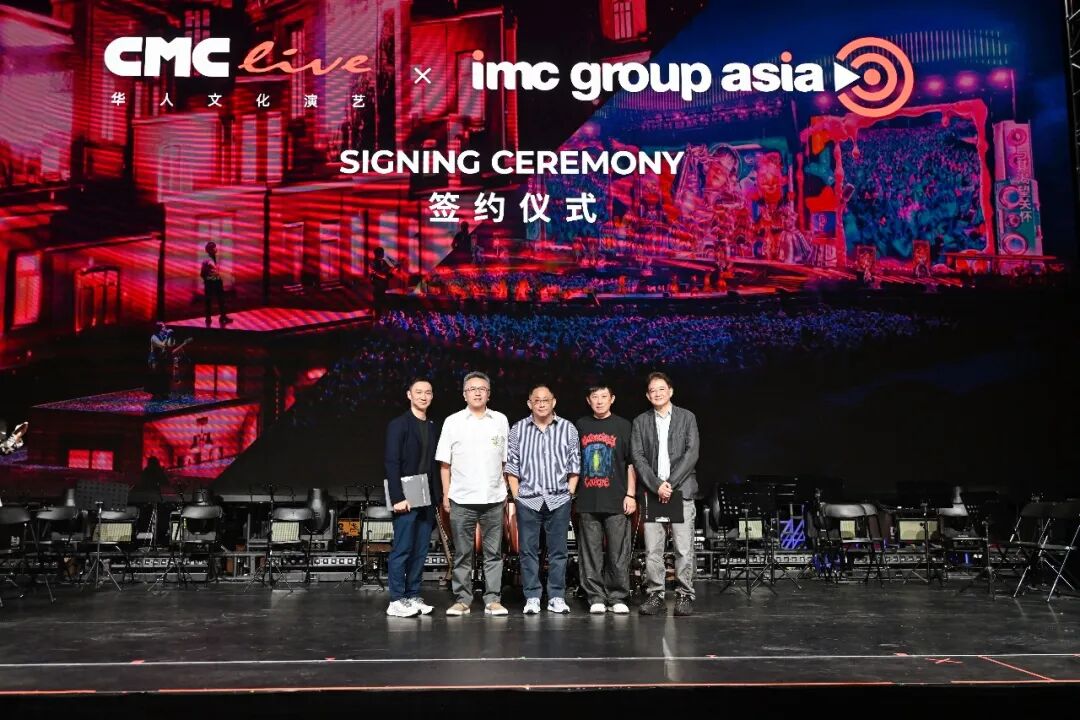
The press release's register is triumphal — "breakthrough cooperation," "a historic moment," "a new chapter." Strip away the rhetoric, though, and the alliance sits squarely between two realities of the Chinese live-music business: the domestic large-scale show market is still growing fast, while none of the old problems of exporting Mandopop has been solved. Whether the bridge gets built, and whether the wall comes down, is worth examining with both companies' cards — and the market data — laid on the table.
Two Companies, Two Capabilities
Start with CMC Live. Corporate records and public reporting show it was founded in January 2018 by Li Ruigang, chairman of CMC Inc. (华人文化), as a capital alliance integrating China's leading provincial concert promoters — over 20 local promoter companies at launch, 23 subsidiaries covering nearly 70 cities by the release's current count. Its exclusive or deep-partner artists include Mayday, Jonathan Lee, Richie Jen, G.E.M., and Li Ronghao; its in-house ticketing platform Fenwandao (纷玩岛) is also the official ticketing agent for tours by Mayday, Rene Liu, and Jackson Wang. In short: a nationwide on-the-ground network — permits, ticketing, tax compliance, local execution — is its core competence.
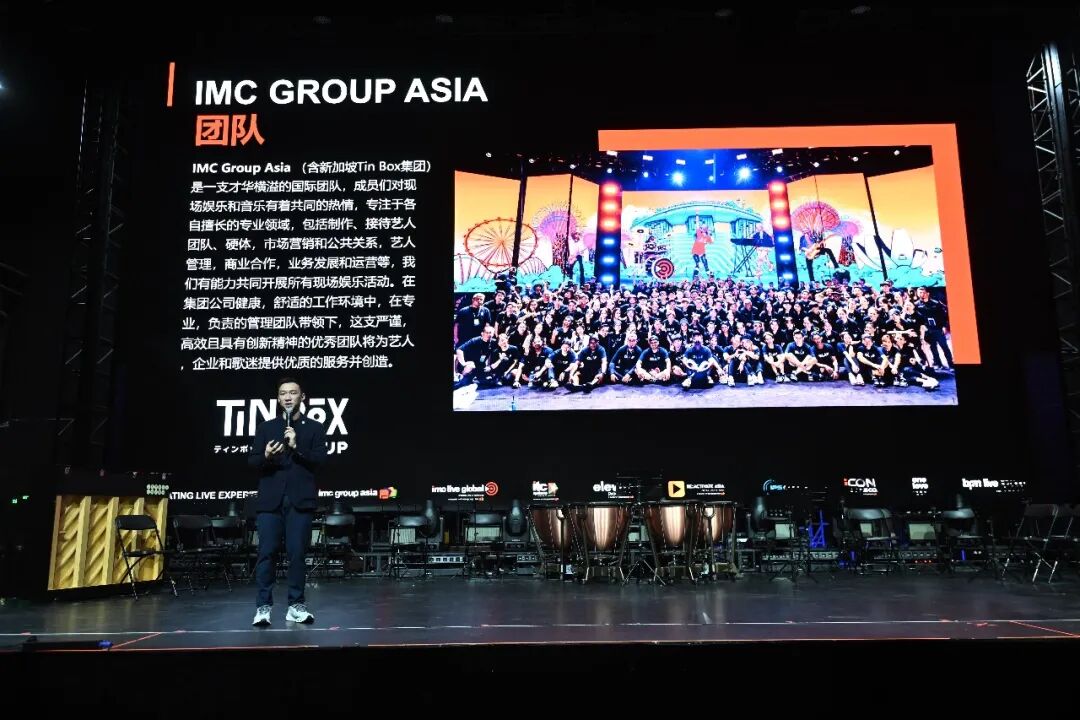
IMC Group Asia's public footprint is much thinner; most of what is known comes from its own account: headquartered in Singapore, with teams in Chengdu, Hong Kong, Kuala Lumpur, and Bangkok; touring reach extending to North America, Oceania, and Europe; claimed collaborations with Angela Chang, Jay Chou, Jolin Tsai, and Faye Wong; more than 800 shows staged and over 16 million tickets sold, in its own telling. It also operates BPM Live Space in Chengdu. All of these figures are company-reported, with no independent third-party statistics available for cross-checking — a caveat worth keeping in mind when reading the announcement.
Under the division of labor in the release, CMC Live becomes the primary promoter of IMC's shows in China, while IMC focuses on production and opening overseas channels. IMC's chief operating officer, Song Youshun, put it this way: "With CMC Live as the main promoter of our shows in China, IMC can focus more on concert production and work with more artists." (translated from Chinese)
Rising at Home, Rising Globally
The alliance was announced at a moment when the numbers look good.
According to the China Association of Performing Arts' 2025 national market brief, total box office for commercial performances reached ¥61.66 billion in 2025, up 6.39% year over year; within that, large-scale commercial shows of 5,000+ capacity numbered about 3,000, drawing 43.39 million attendees and ¥32.45 billion in box office, up 9.49% (People's Daily, January 14, 2026). The first half of 2026 accelerated further: 1,300 large shows, up 13.06%; 23.28 million attendees, up 20.37%; ¥17.11 billion in box office, up 17.7% — while the total number of commercial performances nationwide grew only 1.96%, a clear sign of revenue concentrating in large concerts and festivals.

On the international side, data from research firm Omdia's Global Live Music Forecast, as cited across trade media: global concert and festival ticket revenue exceeded $40 billion in 2025 and is projected to surpass $50 billion by 2030, with the United States remaining the largest single market. With the home market crowded and the global market expanding, "going overseas" has turned from sentiment into arithmetic.
The same datasets carry caveats, though. The association's brief and multiple outlets noted that spending is shifting from star-chasing toward diversified experiences, and show-count growth (1.96%) lagging far behind box-office growth (9.41%) means growth leans on per-show pricing and headliner projects — for a business model that exports headliners, that is both opportunity and ceiling.
The Wall: Cost, Execution, and Language
The three executives, to their credit, described the walls fairly candidly in the release.
The first wall is cost and execution. IMC chief executive Liang Shengjie said China's capability in large-scale production "has surpassed any overseas country," but that "taking a show of the same quality overseas creates major logistics problems — great difficulty in the build, and in the daily meter-running costs of venue rental." (translated from Chinese) High landing costs, hard-to-manage remote execution, scattered overseas resources, uncontrollable processes — these industry pain points have existed for years, and most artists touring abroad have done it alone.

The second wall is language and audience. CMC Live chief executive Hong Di used Jackson Wang as the template for success: first, he came out of a K-pop boy band, carrying a built-in international fanbase; second, most of his catalog is in English, lowering the barrier for overseas listeners. The reading matches Wang's résumé — he was the first Chinese solo artist to perform at Coachella (debuting in 2022 and returning in 2023), and his MAGICMAN tour series reached Barclays Center in Brooklyn, a major US arena.
Change is happening, too. Zhou Shen's 2025 "9.29Hz" world tour mapped a path that didn't rely on an English catalog: overseas stops included Las Vegas and Seattle in the US, Toronto in Canada, Melbourne and Sydney in Australia, and Kuala Lumpur in Malaysia — where he played two consecutive nights at Axiata Arena, each over three hours long (Wikipedia tour page; Lianhe Zaobao, April 2025). At the end of that year he became the first mainland Chinese singer to stage a solo concert at Hong Kong's Kai Tak Sports Park. As Hong Di put it, foreign audiences "may not understand Chinese, but they can still understand the music" (translated from Chinese) — though he conceded that, for now, this remains the exception.

The third wall is subtler: the structure of the audience. Three days after the signing, Song Youshun told China News Service's finance desk plainly that in Singapore, Malaysia, Auckland, Melbourne, and Vancouver — cities with concentrated Chinese audiences — Chinese artists find traction easily, but entering mainstream markets in other languages remains a serious challenge. In other words, most of today's "going overseas" still serves Chinese audiences distributed around the world, rather than genuinely breaking into local mainstreams.
On the Other End of the Bridge, Competitors
Placed in its industry context, the alliance was not signed in a vacuum.
The model for Mandopop export is shifting from artists "fighting alone" to institutionalized "team expeditions" — the same framing 21st Century Business Herald used when analyzing Chinese music platforms going overseas. The IMC–CMC division of labor — one opens global channels, the other supplies content — essentially converts the ad-hoc supply chains of past overseas tours into a standardized, replicable apparatus.

But in the same waters, the international giants' oars are drawing closer. Live Nation has kept adding weight in Asia: it acquired Hong Kong's major festival Clockenflap in 2023, and in October 2025 struck a strategic partnership with Trip.com Group to build "concert plus travel" products across Hong Kong and Macau, Singapore, Thailand, South Korea, and mainland China. For Chinese-language content owners, allying with a regional operator may speed the trip out — and may also mean meeting the international systems head-on in Asia later. The alliance is offense and defense at once (the author's inference).
Then there is the question the release does not answer: the deal's structure. The announcement discloses no capital arrangement or equity relationship, nor a first slate of projects, artists, or timelines. Numbers like "800 shows and 16 million attendees" are IMC's own account and cannot be verified. The test of this partnership is refreshingly simple: when the first jointly staged overseas concert happens, where it happens, and how the tickets sell.
Conclusion: The Bridge Is Under Construction; the Wall Stands Where It Was
Back to the release's line that "this is a historic moment for Chinese music" — candidly, a press announcement cannot carry the words "historic moment." But once the rhetoric is removed, the direction is not hollow: a hot domestic large-show market supplies the content, overseas Chinese and nearby Southeast Asian markets supply the first tier of audiences, and the old model of fighting alone genuinely deserves an institutional replacement.
What only time can test is the wall. Logistics costs, daily venue billing, and remote execution do not vanish because two companies signed; the distance of language and mainstream markets is something even the partners admit is "still rather difficult" for now. How long the bridge runs will be decided by the execution quality of the first landed projects — not by the adjectives at the signing ceremony. For the Chinese live industry, this day is worth recording; it is far too early for a verdict.
Sources
- 音乐先声 (Music First): "IMC Group Asia × CMC Live join forces to open a new era of Mandopop going global" (2026-08-22) — source press release: partnership content, three executive quotes, company profiles, market data
- Tencent News reprint of the partnership release (2026-08-22) — cross-check of the signing venue, BPM Live Space in Chengdu's Eastern Suburb Memory
- People's Daily: "National commercial performance box office topped ¥61.6 billion in 2025" (2026-01-14) — China Association of Performing Arts' 2025 national market brief (no direct link obtained)
- People's Daily: "First-half large-show box office up 17.7% year on year" (2026-08-03) — CAPA's H1 2026 market brief: 1,300 large shows, ¥17.11 billion, etc. (no direct link obtained)
- Omdia, Global Live Music Forecast (as cited by The Future Media, TelecomLead, Cyprus Mail) — global ticket revenue above $40 billion in 2025, projected $50 billion+ by 2030 (no direct link obtained)
- Chinese Wikipedia: Zhou Shen 9.29Hz World Tour — overseas stops, venues, and the cancelled London date
- Lianhe Zaobao: report on Zhou Shen's Kuala Lumpur shows (2025-04-17) — two consecutive nights at Axiata Arena (no direct link obtained)
- China News Service / Zhongxin Jingwei: "What opportunities and challenges do Chinese artists face holding concerts overseas?" (2026-08-24) — Song Youshun's follow-up interview on diaspora vs. mainstream-language markets (no direct link obtained)
- Chinese Wikipedia: CMC Live entry — founded January 2018 by Li Ruigang; alliance structure (cross-checked across multiple sources; not linked inline)
- South China Morning Post and Billboard reporting — Jackson Wang's Coachella firsts and the MAGICMAN tour reaching Barclays Center (no direct link obtained)
- PR Newswire (2025-10-13): Trip.com Group × Live Nation Asia strategic partnership — "concert + travel" push across Asia (no direct link obtained)
- Taiwan Creative Content Agency (TAICCA) industry research (2023-12) — Live Nation's acquisition of Hong Kong's Clockenflap festival (no direct link obtained)
- 21st Century Business Herald: on Chinese music going global — the "fighting alone" to "team expedition" framing (no direct link obtained)