
From North America to the World: How the Beatles' Merchandise Business Came Home to Universal
Updated:
London, August 19, 2026. Apple Corps Ltd, the company that manages the creative and commercial interests of the Beatles, announced an exclusive, long-term, global partnership with Universal Music Group (UMG): UMG will handle the band's physical and digital merchandise, licensing business, and e-commerce worldwide. The official announcement calls the deal "landmark" — but if you know the thirteen-year history of Beatles merchandise licensing, you will see it less as a brand-new relationship than as the completion of a long consolidation.
The backstory of a "new" deal: thirteen years of shifting North American rights
The Beatles' merchandise business has been entrusted to UMG before.
In 2013, Bravado, UMG's merchandise and brand-management arm, won the Beatles' North American merchandising rights. In December 2019, those North American rights passed to The Thread Shop, Sony Music's merchandising division. Barely three years later, in September 2022, Apple Corps handed them back to Bravado — a move Music Business Worldwide described at the time as reuniting the band's merchandise business with its recorded-music catalog "under one roof."
Seen against that history, the real increments in the August 2026 announcement are two. First, geography: the deal stretches from North America to the entire world. Second, scope: it grows from merchandising alone into end-to-end management of licensing, e-commerce, and digital merchandise. In other words, Apple Corps has, for the first time, gathered its long-scattered retail touchpoints and entrusted them collectively to UMG, the guardian of its catalog. The original Chinese report by 音乐先声 summarized the deal as a wholly new exclusive, long-term global partnership — accurate as to its scope, though the "new" rests on thirteen years of experimentation, breakups, and reconciliation.
Why now: the super-activation window of 2026–2028
Every licensing contract is about timing, and the Beatles stand in front of a once-in-several-decades window of activity.
In 2027, "The Beatles at 3 Savile Row" will open in London — the first official fan experience project in Apple Corps' history, spanning seven floors of never-publicly-shown material from the Apple Corps archive, a recreation of the studio where the band recorded Let It Be, and the actual rooftop where the 1969 concert took place.
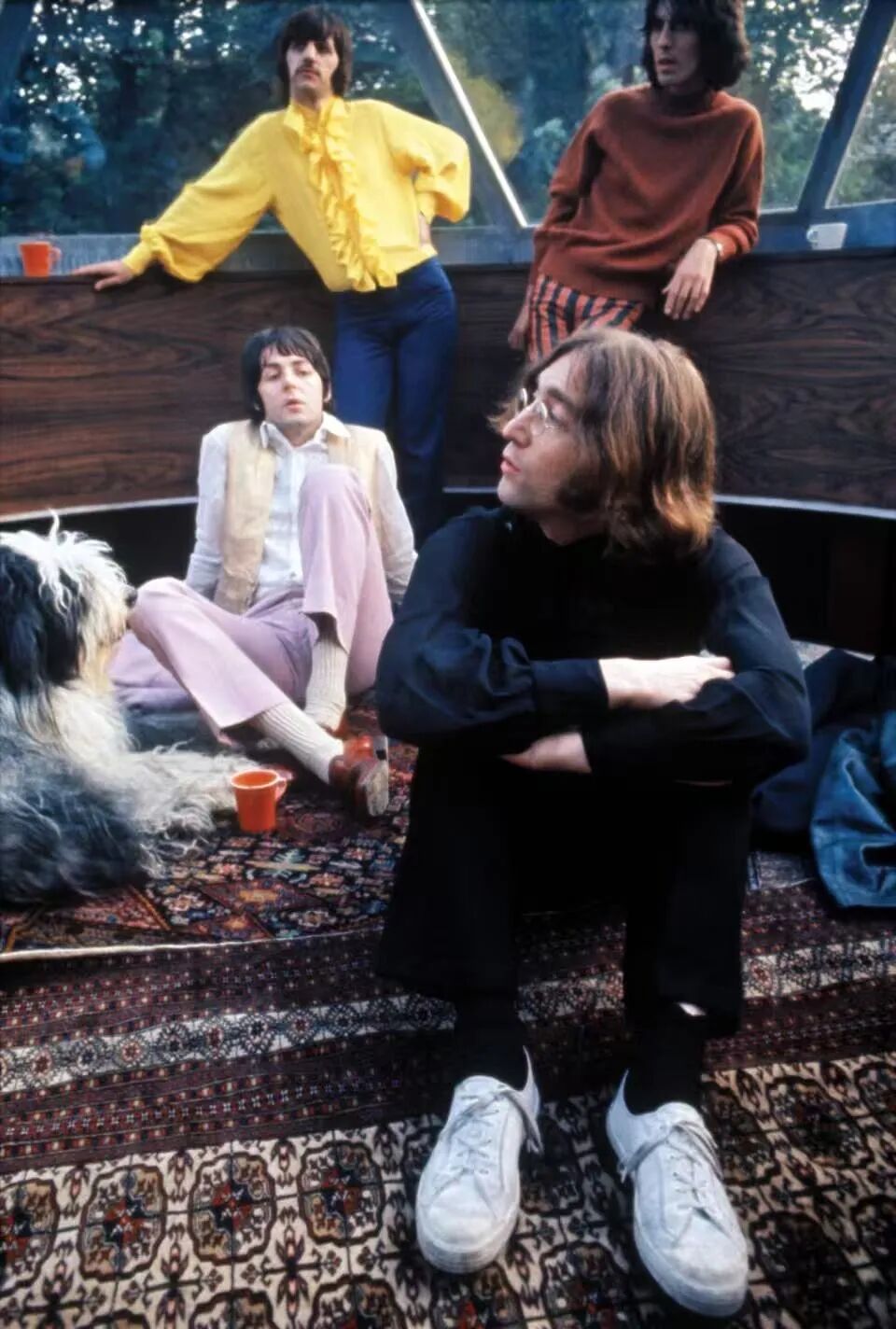
Promotional photo for the 1968 White Album (originally titled The Beatles), ©Apple Corps Ltd
In 2028, the four Beatles biopics directed by Sam Mendes will reach theaters. The official announcement stresses that this is the first time Apple Corps and the Beatles have granted a scripted film full life-story and music rights — before this, the band had never allowed anyone to dramatize their lives on screen.
In between falls the newly official Global Beatles Day. The fan-initiated observance, held every June 25 to mark the 1967 global satellite broadcast of "All You Need Is Love," began in 2009 (see the Global Beatles Day site) and has now, for the first time, received Apple Corps' official endorsement.
Apple Corps CEO Tom Greene made the timing explicit in the announcement: with the 2027 fan experience and the 2028 biopics approaching, there has never been a more exciting moment to be involved in Beatles projects. The merchandise and e-commerce infrastructure had to be in place before those super-events refocus the world's attention on the band — the timing of this contract is itself a marketing plan worth billions.
"The past 14 years": where the guardian role came from
In the announcement, UMG Chairman and CEO Sir Lucian Grainge called the 14-year relationship one of the highlights of his career. That "14 years" is worth unpacking: it points to UMG's September 2012 acquisition of EMI's recorded-music business, after which the Beatles' catalog came under UMG and the storied Abbey Road Studios passed to UMG through Virgin Records. The Beatles recorded 190 of their 211 released songs at Abbey Road — a physical and historical bond that underwrites Grainge's claim to be the catalog's guardian.
The other new variable in this announcement is Greene himself. Apple Corps' new CEO was appointed in July 2025, succeeding longtime chief Jeff Jones, after years running franchise businesses at Warner Bros. — including Harry Potter, an IP synonymous with merchandise, themed experiences, and cross-media licensing. Putting a franchise veteran in charge, then licensing out global merchandise and e-commerce rights wholesale: Apple Corps' intent is written into the personnel decision itself.
Dickon Stainer, Chairman and CEO of Universal Music UK, supplied the British perspective: the new agreement, he said, will ensure audiences worldwide can continue to encounter the band's unique talent.
The counter-view: why would music's most conservative rights holder go all-in on merchandising now?
The weight of this contract lies precisely in what it reverses.
In the music industry, Apple Corps has long been known as its most conservative rights holder. It fought Apple Computer over the Apple trademark for nearly three decades — suits filed in 1978, 1989, and 2003, settled in 2007. The Beatles' catalog reached iTunes only in November 2010, seven years after the store launched, and did not arrive on streaming services until December 2015 (see Wikipedia's Apple Corps entry). For a long time, scarcity itself was part of how the Beatles brand was managed.
That is exactly why handing over worldwide merchandise, licensing, and e-commerce — exclusively, long-term, to one commercial group — marks a clear turn in that philosophy. The supporters' logic is clear: the next generation of fans will not discover the Beatles through vinyl and record stores but through films, physical experiences, merchandise, and algorithmic recommendations; better to manage the brand proactively than let it be diluted by counterfeit and unlicensed goods. After Bravado reclaimed the North American rights in 2022, it had already begun expanding the official store and retail partnerships.
The risks are just as real. Over-commercialize a legacy IP and the scarcity premium erodes — licensing glut, brand dilution, and eventual retrenchment is a recurring risk pattern in classic music-IP management (the author's synthesis, not a single-source conclusion). The announcement disclosed no financial terms; how long "long-term" runs, how exclusive the exclusivity is, and what the exit mechanisms look like remain unknown. And concentrating every retail touchpoint with a single partner means Apple Corps has staked its brand's flexibility along with the rest. Whether this deal proves a shrewd consolidation or an irreversible cash-out will only begin to become clear after the twin tests of 2027 and 2028.
Conclusion
From the 2013 North American rights deal to global representation in 2026, the Beatles' merchandise business completed a thirteen-year cycle of experimentation, outsourcing, repossession, and consolidation. What drove it was not a single contract negotiation but a more fundamental shift: the band's custodians are turning from guardians of an estate into operators of a super-IP. When the four films premiere in 2028, the world will talk about the Beatles again — and by then, everything from the seven floors at 3 Savile Row to every T-shirt on a global e-commerce page will be waiting for that moment inside UMG's system.
Sources
- 音乐先声: Apple Corps Ltd and Universal Music Group reach global merchandise development and e-commerce strategic partnership (Chinese) (2026-08-19) — original article, announcement text, executive quotes
- UMG press release: Apple Corps Ltd and Universal Music Group Announce Landmark Global E-Commerce and Merchandise Partnership for The Beatles (2026-08-19) — deal scope, Savile Row project, four films, Global Beatles Day, executive quotes
- Music Business Worldwide: The Beatles return North American merchandise rights to Universal's Bravado (2022-09-01) — timeline of the 2013 Bravado deal, the 2019 handoff to Sony's The Thread Shop, and the 2022 return
- The Beatles official site, news page — Tom Greene appointed Apple Corps CEO in July 2025
- Global Beatles Day official site — fan-initiated observance since 2009, held annually on June 25
- Wikipedia: Abbey Road Studios — studios passed to UMG via Virgin Records after the September 2012 EMI acquisition
- Wikipedia: Apple Corps — Apple trademark suits (1978/1989/2003, settled 2007), iTunes arrival (2010), streaming arrival (2015)