
Restrained, and Able to Breathe: Has AI Music Reached Its "Eureka Moment"?
Updated:
You may have noticed something similar: a lot of AI music today is genuinely impressive on first listen, yet rarely makes you want to play it a second time.
The problem is not that these tracks lack complexity. Quite the opposite — many AI systems are in too much of a hurry to fill every inch of the music, and the result sounds more like a demonstration of capability than a piece of writing. The drums have to be dense, the harmonies thick, the emotional intensity pinned at the top throughout. Almost every layer is straining to justify its own presence, and the whole thing ends up sounding like it is trying too hard. One of the things that matters most in human songwriting is knowing when not to play — setting things up, leaving room to breathe, so that the climax actually holds when it arrives.
Take the AI "remix" of Bubble (《泡沫》) that stirred controversy a while back, which was pulled down and followed by an apology from its creator. Beyond the copyright question, a large part of the backlash came down to the fact that the AI arrangement had stripped out nearly all of the original's emotional shape, and with it the song's layering and tension. The copyright boundaries themselves are still being redrawn: on January 29, 2025, the U.S. Copyright Office published a report stating that output from generative AI can be protected by copyright only where a human author has determined sufficient expressive elements, and that merely supplying prompts is not enough to create copyright protection. U.S. Copyright Office
In fairness, AI music has spent these past few years working hard to sound more human. Early vocal models tended to sing an entire song in what felt like one unbroken breath; today they can simulate breathing and pauses, and even carry a degree of emotional variation. The technical progress is real and visible. Even so, there is still not much AI music that people willingly return to, because the models have barely learned genuine restraint, and the rise and fall of emotion across a song still does not compare with human work.
Once AI music broadly clears the "can it write a song" threshold, competition in the industry naturally shifts from generation to composition. And "composition" here points in two directions: whether the model can produce work that approaches the standard of human production, and whether the product can hand musicians tools they can actually use — rather than simply delivering a finished track that sounds complete.
Mureka's recently released V9.5 model, from a Chinese AI music platform, is the first thing in a while that has shown me both of those directions moving forward at once. On Mureka's official product page, V9.5 is summarized as making melody, harmony, and arrangement more natural while improving vocal performance and stylistic coverage. Mureka V9.5 official page
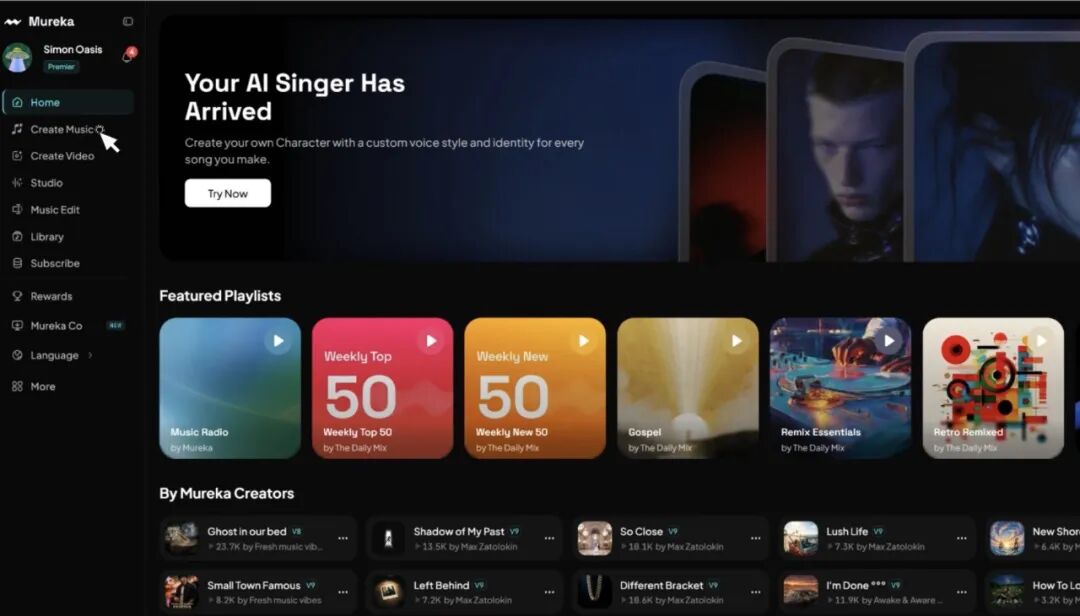
Its tagline is "True to music. Open to every idea." — no longer chasing "fuller and more complex" for its own sake, but emphasizing restraint, negative space, emotion, and the creator's control over the music. That thinking echoes Mureka's brand slogan: "Eureka Flows, Music Grows."
So: as AI music moves from able to generate to understands composition, is it arriving at a eureka moment of its own?

AI music is starting to learn restraint
Over the past two years, the most important advance in AI music was settling the question of whether a complete song could be generated at all.
But as large-model capabilities converge, that on its own no longer surprises anyone. Users today are no longer satisfied by the novelty of "AI wrote a song"; they have started judging AI tracks the way they would judge any other piece of music. Does it have feeling? Does it have a hook? Is it worth a second listen? The shift on the supply side is stark. According to figures Deezer published in July 2026, at peak in June 2026 the platform was receiving close to 90,000 fully AI-generated tracks per day — more than half of all new music uploaded that day. Yet those tracks accounted for only 1 to 3 percent of actual streams on the platform. Being able to generate music and getting people to listen repeatedly remain two very different things. Deezer Newsroom
This also exposes the increasingly obvious weakness in current AI music: a grab bag of instruments, elaborate arrangements, saturated mixes, and vocals pushed past human limits — nearly every element working to prove that it exists.

With those questions in mind, we spent time with Mureka's newly released Mureka V9.5 model.
After hands-on testing, the biggest surprise about Mureka V9.5 is that it appears to have started genuinely understanding composition. It no longer treats "fuller and more complex" as the only goal; instead it lets the music expand and pull back, which tracks much more closely with how real writing works, and the relationship between prompt and finished result has become noticeably more controllable.
Take Give Me a Little More Time (《再给我多一点时间》), which we had previously generated with the V9 model. Keeping the lyrics completely unchanged, we redesigned the prompt this time around:
"Ambient Lo-Fi atmosphere, 70 BPM slow tempo, built on Rhodes electric piano and analog synths with tape-saturation character, supported by delicate urban folk guitar, a minimal kick, and rain samples — aiming for a slow, restrained electronic ballad mood carrying the loneliness of late night."
What came back was more interesting than expected.
Start with timbre and texture. Mureka V9.5 has a more complete grasp of retro Lo-Fi: the warm grain of the Rhodes, the slight distortion and analog character that tape saturation brings — these fold into the overall sound fairly naturally, rather than stacking a few style-tagged elements on top of each other.
The practical upshot is that the correspondence between prompt and output has become considerably clearer. When a creator describes a particular atmosphere, tempo, and mood in a prompt, the model is beginning to land those abstract intentions on concrete musical decisions with reasonable consistency — instead of latching onto a couple of genre tags and calling it done.
You can hear the same thing in the arrangement logic: even where the prompt does not explicitly ask for it, Mureka V9.5 no longer chases density for its own sake, and has started actively managing how full the arrangement gets.
In our test demo Eureka (《尤里卡》), this is most audible where the vocal enters and at bridge transitions, where more space is ceded to the lead melody. The backing does not occupy the full frequency range continuously, and the parts leave each other the breathing room they need, so the emotion can build as the song progresses instead of sitting at one level of tension from the opening bar.
The changes on the vocal side are worth attention too.
Take the demo The Life We Make. Where a good many AI music models default to a vocal treatment with overwhelming presence — heavy timbre and a relentlessly full delivery used to signal polish — Mureka V9.5 opts instead for something more restrained and more believable.
Listening closely, the delivery is looser, and the articulation is not forced for emphasis. That kind of change may not land as a strong first impression, but it lets soft passages, breathiness, consonants, and tone of voice actually participate in conveying emotion, which gives the whole track a more natural emotional arc.
Mureka V9.5's more restrained arrangements, more faithful delivery on creative intent, and more natural vocals all point back to the same question: how exactly has AI begun to understand the compositional logic of a song as a whole?
Answering that means digging into the technical approach underneath.
Many AI music models still compose step by step, generating as they go while predicting what comes next. That gets a full track finished quickly, but because there is no unified plan for the global structure, you tend to get abrupt transitions between sections, uneven emotional pacing, and sometimes arrangement and vocal delivery drifting apart entirely.
Mureka V9.5 instead continues and further refines the MusiCoT (Music Chain of Thought) approach, which sits closer to a real music production workflow. Before generating any specific melody, instrumentation, or vocal, it first plans the structural framework of the whole piece — section organization, the emotional curve, dynamic swells, and where to leave space versus where to push — then works through the rest of the generation around that overall framework. The public MusiCoT research page also notes that the researchers drew ten random sample groups from a set of 100 songs and compared them against a base model, Suno V4, Udio V1.5, and Mureka V5.5. MusiCoT research page

Judging by results, the improvement this brings is not that one perceptual dimension got better in isolation — it is that the song's overall completeness sits closer to the logic of real composition. Arrangement, vocals, and prompt are no longer three things taking their chances against each other during generation; they have started serving a single, more coherent musical narrative.
So as the industry begins discussing negative space, emotional pacing, prompt fidelity, and repeat-listening value, the criteria by which AI music is judged are drawing steadily closer to the criteria for music itself.

AI music's "eureka moment"
For creators, most AI music tools have historically followed a very recognizable generation pattern — at bottom, a kind of gacha-pull composition.
This is where the most notable shift in Mureka's understanding of creators shows up. As the product moves from one-shot generation toward versioned creation, the hands-on experience makes something clear: Mureka has the model take responsibility for reducing the uncertainty of the output, while the product takes responsibility for widening the creator's decision space — handing more control back to the person making the music.
In a sense, Mureka is moving AI from generating content to cultivating ideas — and that is AI music's eureka moment.

The phrase "eureka moment" comes from the Greek heurēka, "I have found it." It usually describes the instant when, after a long stretch of searching, someone lands on the key answer and the idea lights up. Which is a fair description of composition itself. The hard part is usually not writing a song down; it is finding, among countless vague feelings, melodies, and half-ideas, the moment of that's it, that's the one.
On the model side, Mureka is trying to turn "sounds good" into a system capability that is controllable, reproducible, and able to keep improving. Section-level lyric semantics, the match between vocal delivery and emotion, and the relationship between musical structure and semantic progression have all been folded into one optimization framework.
Once the model gets strong enough, though, the genuinely interesting problems move up to the product layer. More important than generating more good songs is whether a creator can choose effectively between different versions. That is why Mureka's subsequent product capabilities deserve to be read as a single line of thinking.
Character & MV, for instance, lets a creator supply one photo and a short vocal sample, after which a virtual character composed of "appearance + voice" can be reused across later work, building into a more complete digital identity.
Soundtrack addresses a different kind of seam in the creative process. Video creators used to finish the visuals first, then go hunting for a piece of background music that was close enough; now AI participates in scoring based on the scene, the motion, and the mood on screen.
In the score we tested for Growing Up (《长大》), the generated music serves the image's narrative entirely, following the visuals as they progress rather than simply retrieving a stylistically similar bed of background music.
Mureka Co, by contrast, is closer to a key step in a professional music workflow. It moves directly into DAW environments such as Ableton Live, where natural language can create tracks, set BPM, load effects, generate complete pieces or individual stems, and handle stem separation and beat alignment.
For professional creators, this matters in particular. AI handles execution while the creator continues to handle judgment, and generation and production stop being two separate worlds.
Viewed from here, the change is increasingly hard to miss. Mureka is building a complete AI-native creation platform.
Beginners can produce lyrics, melody, vocals, and finished songs through a conversational agent or a custom mode. Content creators can score images and video and produce AI music videos. Professional producers can go deep into a DAW workflow using Studio, multitrack editing, stem export, and Mureka Co.
The whole pipeline covers the full chain from initial inspiration through generation, refinement, video production, and professional finishing. A single idea can be explored quickly on the platform, then controlled and executed across different versions — and what the creator actually retains is the part that is hardest to automate: aesthetic judgment, choices about what to keep and what to cut, and the final expression.
Which is why you cannot assess what makes Mureka different by asking only whether V9.5's demos are more impressive than some other model's.

Closing thoughts
Seen this way, Mureka is growing past being a pure AI music generation tool and moving closer to creative infrastructure for the AI music era: what it connects is not just models and finished works, but the whole chain of inspiration, generation, editing, and eventual release.
The difference is that the creators it serves, the ways they produce, and the forms their content takes are all more AI-native.
That also means the next phase of competition in AI music probably will not be a contest between models alone, but a contest over the entry point to creation.
What is really up for grabs in the future is not just who generates the better-sounding track, but who becomes the tool a creator habitually opens — the place where an idea can go from first appearance through generation, revision, and refinement, all the way to a finished work.
Model capability still matters, of course; it sets the ceiling on what an AI music product can do. But as the capability gap between models narrows, what actually determines whether users stay may come down to whether the workflow feels right in the hand, whether there is enough creative freedom, and whether the platform can keep absorbing the increasingly complex demands creators bring to it.
The model sets the ceiling on capability, the workflow determines the experience of creating, and what the platform is ultimately competing for is the creator's habits.
Sources
- Original article: "懂克制、会呼吸,AI音乐的'尤里卡时刻'到了?" (Restrained, and Able to Breathe: Has AI Music Reached Its "Eureka Moment"?) — local manuscript supplied by the user; original URL not provided
- U.S. Copyright Office, NewsNet Issue 1060 (January 29, 2025) — announcement of the report Copyright and Artificial Intelligence, Part 2: Copyrightability
- Deezer Newsroom (July 21, 2026) — fully AI-generated tracks exceeded half of daily uploads at peak in June 2026
- Mureka V9.5 official product page
- MusiCoT (Music Chain of Thought) public research page