
Suno Loses the Top Spot on AI Music's Vocal Leaderboard. Here's What ACE Music v1's Win Does—and Doesn't—Mean
Updated:
On November 11, 2026, Artificial Analysis posted on X that a new model had "debuted at #1" on AA-Music-Vocal v1.1, its blind-listening benchmark for AI songs with vocals. The model was ACE Music v1, from ACE Studio. The model it pushed down was Suno v6, which had led both of Artificial Analysis's music boards when their v1.1 versions launched on October 8, barely five weeks earlier.
The same day, Decrypt published a hands-on review headlined "This New AI Music Model Is Already Better Than Suno". That claim deserves a closer look. The data shows a real result, but a narrow one, and it covers one category only. The company behind it also came into song generation from an unusual direction.

A vocal-synthesis company reaches full songs
Most of the well-known AI music generators started from the prompt. Type a description, get a finished track back. Suno built its product around that idea and has only recently started letting musicians bring their own material: on November 4, 2026 it added MIDI input to its Create page, so a song can start from a user's notes as well as from a sentence.
ACE Studio started at the other end. According to Artificial Analysis, the company was founded in 2018 and "began in AI singing voice synthesis." Its flagship desktop app is a workstation that turns MIDI notes and lyrics into sung vocals for producers. The developer behind it, Timedomain, describes ACE Studio as a tool that "creates studio-quality vocals from MIDI and lyrics" and says it has raised $20 million to date. (Third-party coverage, including AlphaSignal, dates the workstation's closed beta to April 2022. The 2018 founding year comes from Artificial Analysis and Decrypt, and the company's own pages don't confirm it.)
So the company spent years on the hardest part of a song for a machine to fake: a believable human voice that pronounces the lyrics. Only after that did it build a model that writes and performs whole tracks. On its official model page, ACE Music v1 accepts a text description, the user's own lyrics, or both. It also takes performance cues in parentheses, such as "hum softly" or "sing with a raspy voice," placed before a verse or a single line.
It is reasonable to suspect a link between that history and the result. A model from a vocal-synthesis specialist topped a benchmark that rewards vocal songs specifically. AlphaSignal draws the same conclusion. The causal link is still an inference, because ACE has not published the architecture or training details of ACE Music v1.
Reading the scoreboard
Here is what the live AA-Music-Vocal v1.1 leaderboard showed on November 12, 2026:
| Rank | Range | Model | Elo | 95% interval | Samples |
|---|---|---|---|---|---|
| 1 | 1–2 | ACE Music v1 | 1160 | 1139–1181 | 2,119 |
| 2 | 1–3 | Suno v6 | 1144 | 1126–1162 | 3,063 |
| 3 | 2–3 | Suno v6-mini | 1132 | 1114–1150 | 3,175 |
| 4 | 4 | Mureka V9.5 | 1101 | 1083–1119 | 3,141 |
| 5 | 5–6 | Mureka V9 | 1063 | 1045–1081 | 3,121 |
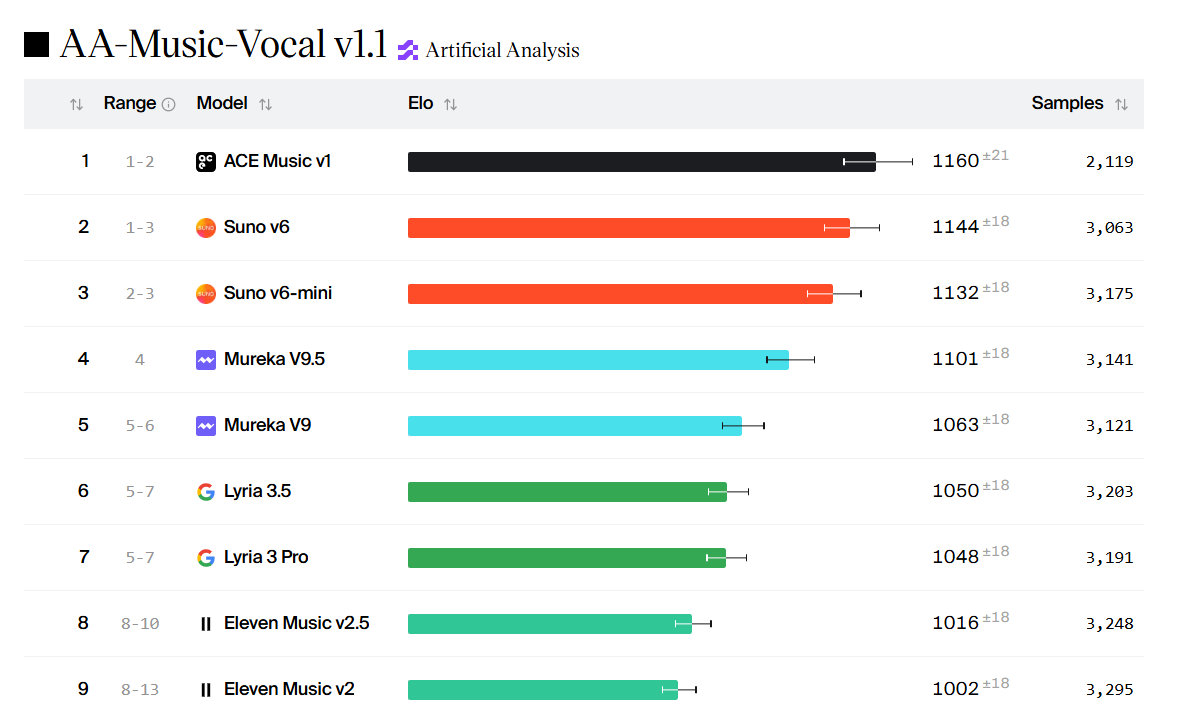
To read these numbers, you need to know how they are produced. Artificial Analysis's published methodology says each rating comes only from blind, pairwise votes by a validated private panel. Public votes in its Music Arena are collected but do not count. Evaluators hear two tracks made from the same prompt and must listen to at least 10 seconds of each before they can vote. Model names stay hidden until after the vote.
Every track is normalized to −16 LUFS and re-encoded to 320 kbps MP3, so loudness can't sway a listener. Ratings are calculated with Bradley-Terry maximum-likelihood estimation and rescaled to an Elo-like range, with MiniMax Music 3.0 fixed at 1000 as the anchor. For the vocal board, the model writes its own lyrics from the prompt. That makes this a test of end-to-end songwriting, not of how well a model sings lyrics a person supplies. The v1.1 prompt set has 1,000 prompts across 17 genres, according to the launch announcement.
Three points follow from this.
The lead is within the margin of error. ACE's interval (1139–1181) overlaps Suno v6's (1126–1162) substantially. The leaderboard's own "Range" column, which Artificial Analysis says it gets by simulating the whole board, puts ACE anywhere from first to second and Suno v6 anywhere from first to third. Decrypt and Artificial Analysis both acknowledge the overlap. The headline "#1" is the most likely ordering, not a settled one.
Sixteen Elo points is a small gap in head-to-head terms. On a standard Elo scale, a 16-point difference means the higher-rated model is preferred about 52% of the time. That is close to a coin flip. ACE's 59-point margin over Mureka V9.5 works out to about 58%, and its 160-point margin over the 1000 anchor to about 72%. (This is the author's calculation, which assumes Artificial Analysis's rescaling follows the conventional 400-point Elo curve. The company describes its scale as "Elo-like.")
ACE has fewer votes than its rivals. ACE Music v1 has 2,119 samples, compared with more than 3,000 for every other model on the board. That is why its interval is ±21 while the others are ±18. As votes come in, the score can still move in either direction.
Artificial Analysis also says that in its testing, ACE Music v1 did best on Reggae/Dancehall and Classical/Orchestral prompts. A single overall Elo number hides that kind of variation by genre. ACE's own FAQ says as much: the #1 claim "reflects blind listening preferences for vocal music, not separate rankings for every genre or feature."
The missing half: instrumentals
Artificial Analysis runs a second board, AA-Music-Instrumental v1.1, and ACE Music v1 does not appear on it. Suno v6 leads that board at 1148 (±22), followed by Suno v6-mini at 1114.
The gap is notable because Artificial Analysis's own announcement says ACE Music v1 "generates full tracks with vocals or instrumentals." The benchmarker has not said why ACE is missing. Its methodology says a model appears on a board only after receiving a minimum number of votes, and that the instrumental board only includes models with a reliable way to suppress vocals. Either rule could be the reason, but neither has been confirmed for this model. For now, the accurate statement is that ACE leads the vocal board and has no instrumental ranking. It is not that ACE "beats Suno" at music overall.
What a hands-on test adds, and where it falls short
Decrypt's testing fills in the qualitative picture. In mainstream styles, the reviewer found ACE's melodies more coherent and its singing more natural, with fewer of the familiar AI-vocal problems: garbled words, heavy auto-tune, filler syllables. They also found ACE better at finishing a song. Suno sometimes added odd sounds, repetitions, or sudden shifts near the end, while ACE usually held its structure through to a clean ending. Writing a good chorus is relatively easy. Keeping a musical idea going for three minutes is much harder.
The review also found clear failures. When asked for melodic death metal, ACE kept producing a clean, pleasant female vocal instead of the harsh delivery the genre requires, and it "confuses metal genres all over." Suno handled heavy styles with more creativity and more consistency.
A single outlet's listening session has limits, and Decrypt says so itself, calling its results "subjective rather than a controlled benchmark." The showcase track it links is a song about Decrypt's own corporate announcement, so it demonstrates the model but is not a neutral test. Taken together, the review and the leaderboard support a modest conclusion. ACE appears very strong on mainstream, vocal-led material, and its edge narrows or reverses at the genre extremes.
From prompt box to score: the MIDI connection
The most interesting part of ACE's launch may be the workflow around the model, not the ranking. After generating a song with ACE Music v1, users can convert it to MIDI and split it into stems to keep working in a DAW. The ACE Music v1.1 Preview goes further. It first writes a score in ABC notation, a text format for pitch, rhythm and chords, and generates audio from that score.
Users can hum a melody, play it on a keyboard, or upload a MIDI file as a starting point. They can then edit the melody and chords and regenerate. ACE notes that "each generation is a new performance, so the sound may differ even when the score stays the same."
Suno's November 4 MIDI input works in the other direction: the user's notes go into a prompt-first generator. ACE's v1.1 Preview treats a score as something the model plans internally and the user can edit. Both companies are moving toward the same goal from opposite ends: a tool that lets musicians take over the composition at the note level, not just the prompt. (This is the author's reading of the two product pages.) For working producers, this convergence may matter more than a 16-point Elo gap.
Closed, app-only, and what that means for creators
The flagship has real practical limits. Artificial Analysis states directly that "ACE Music v1 has no API." The model runs only in the ACE Music web app. That means three things:
- No pipelines. Developers can't build ACE Music v1 into their own products or batch workflows. Artificial Analysis's methodology says it usually benchmarks models "delivered via serverless API endpoints," so ACE is an unusual entry: anyone who wants to check its results has to do so by hand in the app.
- Rights depend on the plan. According to ACE's pricing page, the free tier gives 20 credits a day, and an ACE Music v1 generation costs 4 credits for two songs. Free-tier songs carry no commercial-use rights, and upgrading later does not grant them retroactively. Paid plans start at $7.90 a month, billed yearly, for 1,000 credits a month. That works out to roughly 500 v1 songs, matching Artificial Analysis's "up to 500 songs a month."
- The open-source option is a different model. ACE Studio and the Chinese AI lab StepFun co-lead ACE-Step 1.5, an MIT-licensed open-weights model that runs locally on less than 4 GB of VRAM. Its own technical report places its human-rated quality between Suno v4.5 and Suno v5, which is a generation or more behind the model now ranked #1. ACE says it "plans to open-source ACE Music v1 Flash in late 2026," a lighter variant that trades some quality for speed and lower hardware requirements. That is a stated plan with no release yet.
The training-data question
Every AI music leaderboard now operates against ongoing litigation. Suno is still being sued. Most recently, Elvis Presley's music owners and Eminem's publisher filed new suits in November 2026, although it has also signed a licensing partnership with Warner Music Group. In that climate, it matters where a new model's training data came from.
ACE's public record is incomplete. The ACE-Step 1.5 model card says the open model was trained on "a massive, legally compliant dataset" of "professionally licensed music tracks," public-domain and royalty-free music, and synthetic audio made through MIDI-to-audio conversion. The accompanying technical report describes annotating a "27-million-sample corpus" but does not list where that audio came from or who licensed it. For ACE Music v1, the closed model that actually topped the leaderboard, we found no training-data statement on its model page, its pricing page, or ACE Music's homepage as of November 12, 2026. A claim made for the open model shouldn't automatically be applied to the flagship. Creators who care about provenance should ask ACE directly.
The case for skepticism
Three caveats apply beyond this single result.
Benchmarks reflect the people who vote. A recruited panel's taste is not every listener's taste. The prompt mix (1,000 prompts, 17 genres, model-written lyrics, roughly three-minute tracks) favors certain styles over others. A metal producer, a film composer and a pop topliner would each weight the genres differently.
Arena-style rankings have known distortions. In "The Leaderboard Illusion", researchers studying the chatbot arena that popularized this format documented how private pre-release testing and uneven sampling can skew ratings. Artificial Analysis uses a closed, validated panel and standardized generation settings, which addresses some of those problems. It still cannot control which model variants providers choose to submit.
First place doesn't last long here. Suno v6 held this spot for about five weeks. At the v1.1 launch, Artificial Analysis singled out Mureka V9.5's 51-point jump over its predecessor as the largest gain within one model family. The leaderboard is a snapshot of a fast-moving field, not a final verdict.
What the result actually shows
It shows that in a blind test where listeners judge complete, model-written songs with vocals, a company that spent years building synthetic singers now produces tracks the panel slightly prefers to Suno's flagship, by a margin the benchmark itself can't call significant. It also shows that ACE's model handles song structure and endings well, and that this strength doesn't extend to every genre.
It doesn't show that ACE is better than Suno overall. There is no instrumental ranking, the vocal lead is within the margin of error, there is no API, the flagship's training data has no public disclosure, and Decrypt's own testing found genres where Suno is clearly stronger.
For creators, the practical takeaway is simple: test both models on your own material, at the plan tier that gives you commercial rights. The broader takeaway for the industry is that AI music competition is shifting from who has the best prompt box to who gives musicians the most control over the notes.
Sources
- Decrypt — "This New AI Music Model Is Already Better Than Suno—We Put ACE to the Test" (original article, Jose Antonio Lanz, Nov 11, 2026)
- Artificial Analysis on X — ACE Music v1 debuts at #1 on AA-Music-Vocal v1.1 (Nov 11, 2026)
- Artificial Analysis on X — launch of AA-Music-Vocal v1.1 and AA-Music-Instrumental v1.1 (Oct 8, 2026)
- Artificial Analysis — AA-Music-Vocal v1.1 Leaderboard (figures as of Nov 12, 2026)
- Artificial Analysis — AA-Music-Instrumental v1.1 Leaderboard (figures as of Nov 12, 2026)
- Artificial Analysis — Music Generation Benchmarking Methodology
- ACE Music — ACE Music v1 model page
- ACE Music — ACE Music v1.1 Preview model page
- ACE Music — Pricing
- Timedomain — company site
- AlphaSignal — ACE Studio's ACE Music v1 Beats Suno to Top AI Music Leaderboard
- GitHub — ace-step/ACE-Step-1.5
- Hugging Face — ACE-Step/Ace-Step1.5 model card
- Gong et al., "ACE-Step 1.5: Pushing the Boundaries of Open-Source Music Generation," arXiv:2602.00744
- Suno — Start Songs with MIDI (Nov 4, 2026)
- Variety — Elvis Music Owners, Eminem Publisher File Sprawling New Lawsuits Against AI Music Generator Suno
- Warner Music Group — WMG and Suno Forge Groundbreaking Partnership
- Singh et al., "The Leaderboard Illusion," arXiv:2504.20879