
Sheet Music in Plain Text: What Claude's Pirate-Harbor Jukebox Shows About LLM Composition
Updated:
Six short tunes of adventure-game music now play in a browser tab. There are no recorded samples behind them. Each tune is a plain-text file that a small Web Audio synthesizer reads note by note. A language model wrote both the files and the synthesizer.
The experiment comes from developer Simon Willison. On 6 October 2026 he asked Claude Opus 5.5 to do three things: invent a simple text format for computer-game music, build a player for it, and include example tracks. He named the standard he wanted: the music of the original The Secret of Monkey Island. The result is Scrimshaw Jukebox. He wrote that it "leaned a lot harder into the Monkey Island theme" than he had intended, but called the output "surprisingly good."
A single demo proves little, and Willison doesn't claim otherwise. Still, the way the demo is built says something useful about how text models handle music, and about what is not yet known.
What the model actually built
Most of the interesting work went into the format, which the tool page documents in full.
- Rhythm is counting. Every bar is cut into the same number of steps. A note such as
D5lasts one step, and each dash after it adds one more, soD5---lasts four. A dot is a step of silence. - Meter comes from two numbers.
beats 4withsteps 4gives 4/4 in sixteenth notes.beats 2withsteps 3gives a 6/8 jig, andbeats 3withsteps 2gives a waltz. Aswingvalue delays every other step. - Harmony can be named. Chord symbols such as
[Dm7]or[C/E]are voiced automatically around a pitch set for each voice. - Drums are grids. A drum lane uses one character per step, such as
x... ..x., wherexis a hit andois a ghost note. - Form is explicit. A score lists patterns (blocks of bars), then a
playline for the intro and aloopline for the section that repeats "as game music does."B*2repeats a pattern, andA+2transposes it up a whole tone.
The player provides 65 synthesized instruments, from steel drum and marimba to harpsichord, tuba, choir and hand percussion. It shows each score as a piano roll, and you can mute any voice. Listeners can also edit the text and replay it.
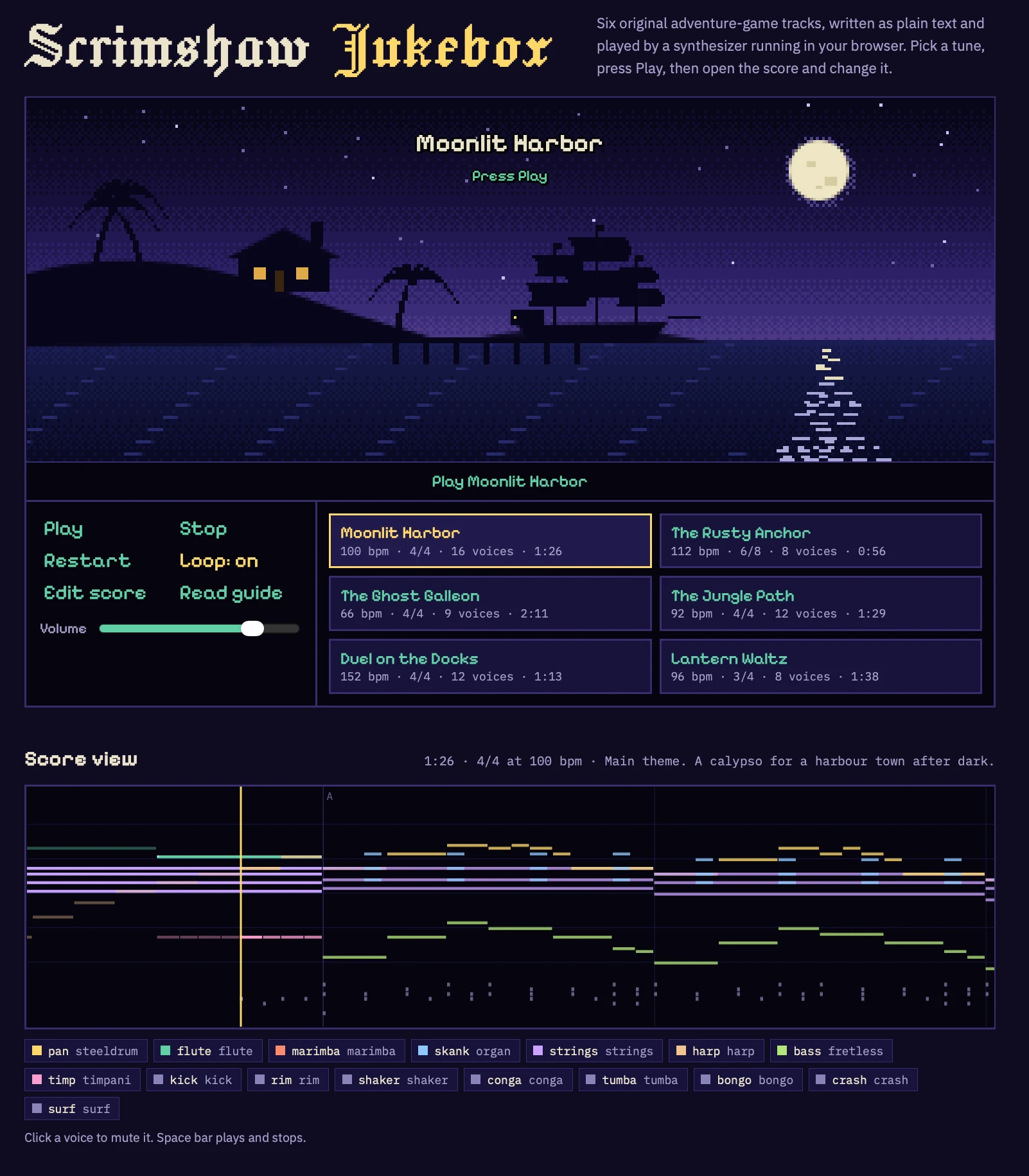
The Scrimshaw Jukebox player. The open track, "Moonlit Harbor," is described as "a calypso for a harbour town after dark," with 16 voices at 100 bpm. Screenshot: Simon Willison.
The six tracks cover a range of tempos and meters. "Moonlit Harbor" runs at 100 bpm in 4/4, "The Rusty Anchor" is in 6/8, "The Ghost Galleon" crawls at 66 bpm, "Duel on the Docks" races at 152 bpm, and "Lantern Waltz" is in 3/4.
The page also includes a ready-made prompt that teaches any LLM the format. It warns that "the most common mistake is a bar with the wrong number of steps, so count every bar." The editor flags any bar that doesn't add up, and you paste those errors back to the model for a fix. Composition becomes a compile-and-repair loop, much like coding with an assistant.
Why a text format suits a text model
Composing through notation rather than audio is not a new idea. In February 2024 a 35-author research team released ChatMusician. They took LLaMA2, then continued pre-training and fine-tuning it on ABC notation, a long-established text format for scores. They described music in this setup as "a second language." The authors reported that it wrote well-structured, full-length pieces that beat a GPT-4 baseline, and that adding musical ability didn't hurt its general language skills.
Scrimshaw follows the same logic, with one difference. ChatMusician needed a dedicated training corpus and fine-tuning. Here, a general-purpose model designed its own notation on request, wrote a player for it, and composed in it, all within one conversation. My reading, which is an inference and not a measured result: much of what a non-specialist model does well here is software design. It is choosing a representation where rhythm is arithmetic and structure is visible on the page.
That design echoes the music it imitates. The Monkey Island scores of 1990 were not recordings either. They were MIDI instructions played by whatever sound hardware the player owned. According to The International House of Mojo's history of the series, composer Michael Land found it "impossible to properly synchronize music with the player's actions" on the first game. After it shipped, he brought in Peter McConnell, and together they built the iMUSE interactive music system for Monkey Island 2. Scrimshaw's split between a one-time intro and a repeating loop is a small nod to that tradition of music written as instructions.
Is this a new capability?
Willison asks whether competent composition is "similar to the 3D graphics thing": a skill that text models have shown only in the last few months. The comparison has a record behind it on his blog. In September 2026 he described GPT-6 Astra, running in Codex, spending 17 minutes 51 seconds building a Blender model of a Fabergé-style egg from a single generated image. In November 2025, a test he covered had asked models for a POV-Ray scene of a pelican on a bicycle, and "most produced a script that failed to parse."
The evidence supports a narrower claim than "models can now compose":
- Symbolic composition by LLMs predates this demo. ChatMusician did it in 2024, though only after specialized training.
- What may be new is doing it unaided. A general model invented a workable format, a working synthesizer and stylistically consistent pieces with no fine-tuning. Whether older models could do the same is exactly the open question Willison raises. He notes it "would need some careful experiments with other recent and not-so-recent models."
The limits, and the case for caution
It is one prompt and one listener. "Surprisingly good" is an honest first impression, not a measurement. No public benchmark scores this kind of symbolic, text-to-score composition. The best-known music leaderboards, Artificial Analysis's AA-Music-Instrumental and AA-Music-Vocal v1.1, rank audio-generation models from blind pairwise votes by a recruited panel. They are not designed to compare a chat model writing synthesizer scores.
The model also leaned toward imitation. Asked to match the quality of Monkey Island, Claude pushed hard toward its style: pirates, harbors, calypso, a ghost ship. This is a toy project with original melodies, and nothing suggests it copied the game's actual themes. The tendency still matters, because the music industry is struggling with imitation at scale. Sony Music said it asked streaming platforms to remove more than 260,000 AI tracks impersonating its artists by the end of September, nearly double the 135,000 at the end of March. That figure comes from the Financial Times, as relayed by IT Home. Imitating a game soundtrack's genre is not the same as cloning a singer's voice. But "make it sound like X" is the prompt both start from.
Synthesis sets a ceiling. A browser synthesizer with 65 preset instruments can suggest a 1990 sound card, but it is not orchestration or production. Comparing this output with Suno-class audio models misses the point. Its value is that the score is editable, inspectable and small, not that it sounds realistic.
How the question could be settled
The test Willison proposes is easy to run. Give the published Scrimshaw prompt, unchanged, to models from different generations. Have the editor count the bars that fail to parse. Then play the surviving tracks to listeners blind, using the kind of pairwise preference voting that Artificial Analysis uses for audio. If older models produce valid but aimless scores and newer ones produce coherent themes with real structure, Willison's hunch about an emerging capability gains evidence. If not, the impressive part was mainly the format and the tooling, not a jump in musical ability.
For now, the Jukebox is best seen as a working example of composition as a programming task: plain text in, playable music out, with errors you can fix.
Sources
- Original article: Simon Willison, "Tool: Scrimshaw Jukebox", 6 October 2026
- Scrimshaw Jukebox tool page and score-format guide
- Willison's shared Claude conversation
- Ruibin Yuan et al., "ChatMusician: Understanding and Generating Music Intrinsically with LLM", arXiv 2402.16153, February 2024
- The International House of Mojo, "LucasArts' Secret History #6: The Music of LeChuck's Revenge"
- Simon Willison, posts tagged "3d" (Blender/GPT-6 Astra experiment, 9 September 2026; POV-Ray pelican test, 9 November 2025)
- Artificial Analysis, "Music Generation Benchmarking Methodology"
- IT Home, "Sony Music requests takedown of 260,000 AI deepfake songs" (citing the Financial Times), 6 October 2026