
The Human Premium, Stress-Tested: 44% AI Uploads, Deaf Ears, and Who Actually Pays
Updated:
Here is a paradox sitting inside the latest streaming numbers. On Deezer, 44% of all newly uploaded tracks — roughly 75,000 a day — are now fully AI-generated. Yet when the platform's research partner played listeners a blind test with two AI songs and one human-made song, 97% could not reliably tell which was which. And still: 80% of the 9,000 people surveyed across eight countries want AI music clearly labeled, 73% want to know when a recommendation is machine-made, and 52% think fully AI-generated songs should be kept out of the main charts.
Listeners can't hear the difference — and, when asked, they insist they care anyway. That gap is the subject of a BBC InDepth essay by Ros Atkins (published October 10, 2026), which asks whether AI is creating a "human premium" for art made by people — and whether that premium can hold. The piece ran hot on Hacker News, racking up more than a hundred comments of argument within a day.
The supply side of this story is already well documented: the flood of synthetic tracks, the fraud farms, the platforms playing whack-a-mole with royalty abuse. The genuinely open question is the demand side. If listeners demonstrably cannot distinguish AI music from human music, what exactly would they be paying a premium for — and is anyone building the machinery to collect it?
 (BBC's treated image of Garry Kasparov losing to a computer — the 1997 chess moment has become the standard analogy for what happens when machines match humans at a game. Credit: BBC)
First, what the data actually says
The core numbers come from Deezer itself, which is the only major streaming platform that detects, tags and excludes fully AI-generated music, and which publishes its figures. Per its April 2026 announcement: about 75,000 AI-generated tracks arrive daily — 44% of all uploads, more than two million a month — and 13.4 million such tracks were tagged across 2025. The growth curve is steep and unambiguous: about 10,000 AI tracks a day in January 2025, 30,000 by September, 50,000 by November, 60,000 by January 2026, 75,000 by April (TechCrunch).
Two numbers in the same release complicate the doom narrative, and they deserve equal billing. First, consumption of AI-generated music on Deezer is still only 1–3% of total streams — the flood is at the upload gate, not in people's headphones. Second, up to 85% of those AI-track streams were detected as fraudulent and demonetized. A large share of "AI music supply" is not art seeking an audience at all; it is manufactured noise seeking royalties.
The listener-attitude numbers come from a survey Deezer commissioned from Ipsos in November 2025 — 9,000 people across the US, Canada, Brazil, the UK, France, the Netherlands, Germany and Japan — described by the platform as the first focused on perceptions of AI-generated music. Those are the figures at the top of this article: 97% failing the blind test, 80% wanting labels, 73% wanting to know what their recommendations are made of, 52% wanting AI songs out of the charts. (BBC's rendering of the survey — "more than half of listeners said they did care" — maps most cleanly onto the 52% chart figure and the 73% recommendation figure.)
The premium is not in the sound. It's in the provenance
If 97% of listeners cannot tell the difference in a blind test, then the human premium cannot be a quality premium — or at least, not one detectable by ear. What people say they value is the origin: the knowledge that a human, as economist Daniel Susskind puts it in the BBC piece, "a mind like mine dreamt that up," looking up at the Sistine Chapel ceiling. Susskind's other example is chess: Garry Kasparov lost to Deep Blue in 1997, predictions of chess's death followed, and chess is instead more popular than ever. "It wasn't simply the moves on the board that people care about," he argues. "It's the fact that it's a human being sitting behind them."
Philosopher C Thi Nguyen's "why chain" framing in the same essay sharpens this: keep asking why you value something, and at the end of the chain you find what you actually value. The bet embedded in the "human premium" idea — articulated optimistically by author John Lanchester, who told the BBC "if you commodify one kind of thing, the things you can't commodify start to seem more important" — is that "a human was involved" sits at the end of that chain even after the music itself becomes indistinguishable.
 (The value isn't only the destination — it's the knowledge that a human got us there, says Daniel Susskind. Credit: Getty Images)
The counter-argument is that listeners have already proven they'll accept machine-made music when the quality is there. One Hacker News commenter, piro0919, recalls making music videos for a Vocaloid producer around 2010, when "people sometimes said Hatsune Miku songs were worth less because a machine was singing. In the end the songs were accepted because they were good." The distinction they concede: Vocaloid songs were still written by people, which is different from AI making the whole song. But the precedent stands as a real, if imperfect, historical data point (this is the commenter's opinion, not an established finding).
The premium is being institutionalized — as labeling, not certification
Here is where the story moves beyond survey answers. A stated preference only becomes an economy if someone builds a way to act on it at the moment of choice, and the industry is currently building three different kinds of machinery.
Deezer is running the interventionist model. Since June 2025 it has tagged AI-generated tracks at the platform level, excluded them from algorithmic recommendations and editorial playlists, demonetized detected fraud, stopped storing hi-res versions of AI tracks, and — since January 2026 — begun licensing its detection technology to the wider industry. In effect, Deezer is making "human-made" the default of everything its recommendation engine serves. Note the mechanism, though: it is exclusion of the flagged AI tail, not a positive certification of humanness. The platform decides what is synthetic; no artist gets a "made by humans" badge.
Spotify is running the disclosure model — and explicitly refusing to discriminate. Its September 2025 AI policy announcement introduced a strengthened impersonation policy for AI voice clones, a music spam filter (75 million spammy tracks had been removed in the previous 12 months), and support for a DDEX industry standard for AI disclosures in song credits — with a beta live since April 16, 2026, through which artists can disclose AI involvement in vocals, lyrics or production, already receiving "tens of thousands of AI credits submitted daily." Crucially, Spotify states that "all music is treated equally, regardless of the tools used to make it" — disclosure is transparency, not a ranking signal. The same company has also moved to protect artist identity at the profile level: Artist Profile Protection, in beta since March 2026, lets artists review and reject releases delivered under their name — a direct response to misattributed uploads, AI-generated or otherwise. French streamer Qobuz, meanwhile, announced plans in February to tag AI content as well.
A third track is the certification model — and it is the least mature. The BBC reports that academics are racing to develop a universally recognized "human made" symbol, akin to the Fairtrade label of the 1980s, and that "AI-free" labels are already appearing on some book, film and album covers. No music-industry equivalent has yet reached critical adoption, and there's a structural weakness any such scheme inherits: as Spotify itself notes, its credits depend on artist self-disclosure, so the absence of an AI credit doesn't mean the absence of AI. Labeling tells you what artists admit; certification would have to prove what they did. (This distinction between the three models is the author's synthesis of the platforms' own policy documents.)
Does stated caring convert into spending? The evidence cuts both ways
The demand-side evidence is where the human premium gets stress-tested, and it currently refuses to collapse in either direction.
Evidence that behavior follows attitude. The clearest case is live music. Alex Mahon, chief executive of festival giant Superstruct Entertainment, tells the BBC that "people want to go to more live things… They want to have things that are unforeseeable… unpredictable. The special moment is live." In-person events — the one format where humanness is the product — are booming. A second case is the art market: Hacker News commenter olalonde points out that people have paid a large premium for originals over identical copies "for over a century" — provenance economics long predates AI. Another commenter, freecodeio, reports that commissions from a local painter jumped from about $500 to about $3,000 on average as AI images spread — a striking data point, though a single, unverified anecdote.
Evidence that attitude and behavior diverge. Consumers are not just tolerating AI music — they are lining up to make it. In a16z's Top 100 Consumer AI Apps — Seventh Edition (October 2026), Suno ranks #19 by web traffic and #7 by spending, one of only seven companies to appear on all three of a16z's lists (web, mobile, spending) — and the firm's earlier State of Consumer AI named Suno among the consumer AI products that broke out to millions of users. People who tell pollsters they care about human-made art are, in large numbers, paying subscriptions to generate synthetic songs themselves. And per TechCrunch, an AI-generated track topped the iTunes charts in the US, UK, France, Canada and New Zealand in the same week as Deezer's April announcement — a single-source report of a single event, but a direct mainstream-demand signal nonetheless.
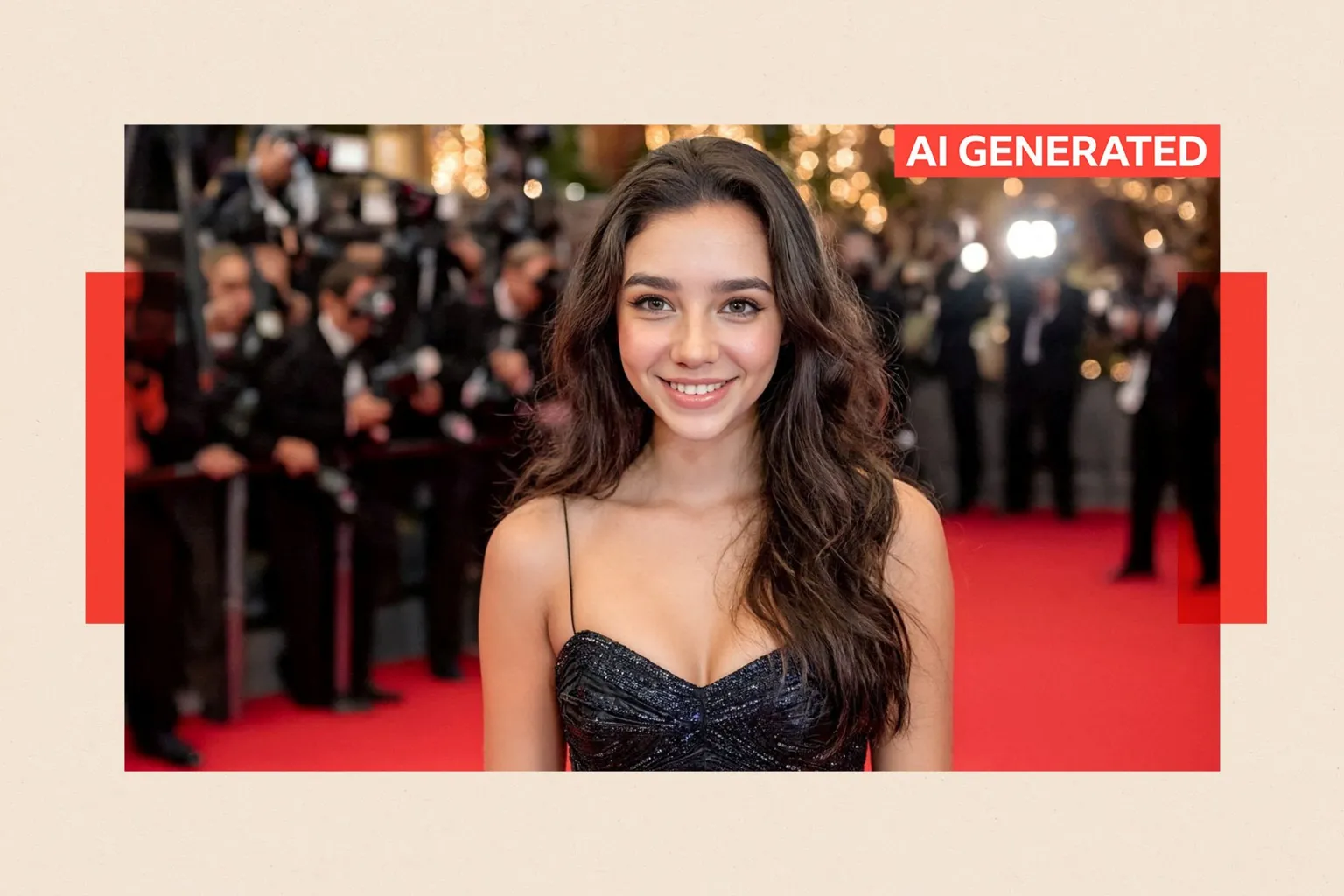 (The AI-generated "actor" Tilly Norwood — what feels untethered now may not feel that way for long. Credit: Getty)
The sharpest formulation of the gap comes from Hacker News commenter ahalay-mahalay: "While I agree that people want art by humans, they mostly buy the cheapest possible thing that fits their taste and intention." The question that decides the human premium is whether music behaves more like furniture or more like live experience. A related skeptic's jab in the same thread, from user prologic: why has no "Software made by Humans" premium ever appeared? One plausible answer (this is the author's inference): we never built our emotional relationships with software the way we do with songs — but the comparison is a useful reminder that provenance premiums are historically rare outside markets where the human is part of what's consumed.
Where the premium can hold — and where it almost certainly won't
Sorting the evidence suggests three zones rather than one verdict (this is the author's assessment, not a finding).
Zone one: functional music. Playlists for study, sleep, retail and content soundtracking, where music is a utility. Here price and volume win, provenance is invisible, and 75,000 uploads a day will keep arriving. If AI music has a durable market, it is here — and almost nobody defending "human art" will mourn this segment.
Zone two: music where the human is the product. Live shows, fandom-driven pop, the sweaty DJ night in Falmouth that opens the BBC essay — Ros Atkins' own example, 250 ravers in a converted bank in Cornwall. Here the human premium is not a hypothesis; it is the existing business model. Mahon's festivals sell out on exactly the "unforeseeable" quality algorithms can't manufacture. This zone is expanding, not shrinking.
Zone three: the recorded middle — charts, streaming, editorial. This is the contested ground, and it is being decided now, by policy rather than by consumer behavior. Deezer has effectively voted: AI out of recommendations and charts. Spotify has voted for neutrality-plus-disclosure. The 52% of surveyed listeners who want AI kept out of main charts have expressed a preference; whether platforms honor it is a business decision with billions in royalties attached — CISAC's study puts a quarter of creators' revenues at risk by 2028, up to €4 billion.
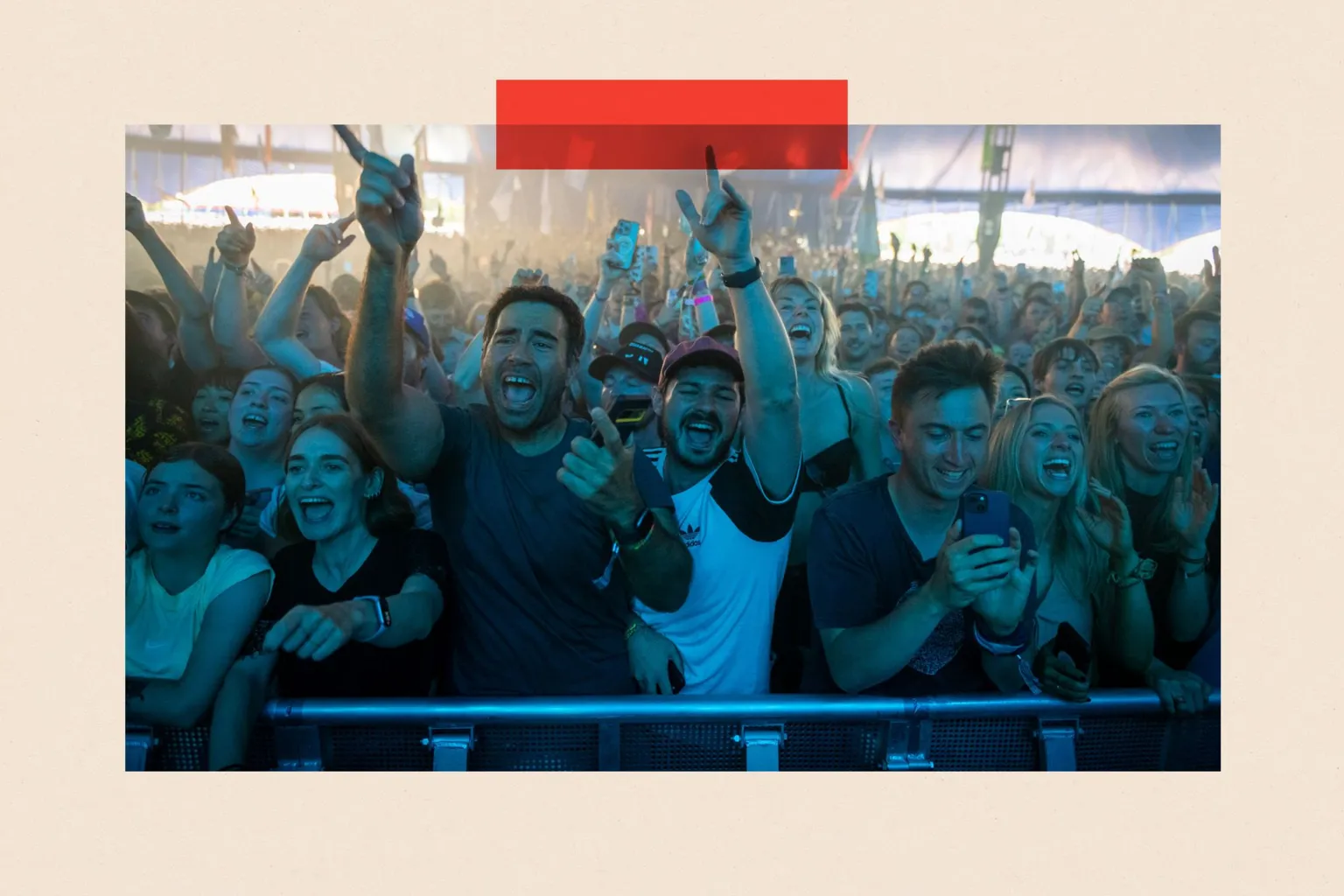 (In-person events — where humanness is the product — keep growing. Lorde at Glastonbury. Credit: Joseph Okpako/WireImage)
Atkins' essay closes with two warnings worth taking seriously. One is normalization: the AI "actor" Tilly Norwood drew a furious response from the Screen Actors Guild — "audiences aren't interested in watching computer-generated content untethered from the human experience" — but what feels untethered today may not in ten years; the calculator, which teachers marched against in 1986, won. The other is subtler: the algorithmic loop. As New Yorker writer Kyle Chayka (author of Filterworld) argues in the piece, we have already outsourced cultural discovery to recommendation engines, and the more the algorithm mediates what we hear, the less the question "was a human involved?" ever surfaces at the moment of choice. A human premium that listeners only get to act on when they already know the backstory is a premium that survives on Wikipedia pages, not in the royalty statements of working musicians.
The bottom line
"Will the human premium hold?" is really three questions wearing one coat. As a stated preference, it already exists — 80% want labels, 73% want to know, and this is before any certification scheme exists to serve them. As a purchasing behavior, it demonstrably holds in the markets where humanness is directly consumed — live events, originals, fandom — and is untested everywhere else, because AI music is still only 1–3% of streams and mostly fraudulent noise at that. As a policy regime, it is being built right now, and being built asymmetrically: AI labeling is arriving fast (Deezer's tags, Spotify's credits, Qobuz's plans), while positive "human-made" certification barely exists — meaning the industry can increasingly tell you what's synthetic, but cannot yet guarantee what's not.
The most honest reading of the evidence is that the human premium is real but narrow, and its future depends less on listeners' sincerity — which the data does not actually give us reason to doubt — than on whether provenance information survives the recommendation layer, and whether anyone can certify humanness in a way that an artist can cash. Lanchester's commodification line is elegant, but the chess analogy is the more useful one: Deep Blue didn't kill chess; it killed the assumption that the moves were the point. Music's Deep Blue moment is arriving one upload at a time — 75,000 a day, in fact. What survives it will be whatever listeners can still tell a story about.
Sources
- BBC InDepth — "AI is creating a 'human premium' for art made by people. But will it hold?" (Ros Atkins, October 10, 2026) — original article
- Deezer Newsroom — "AI-generated tracks now represent 44% of all new uploaded music" (April 20, 2026) — official upload, stream-share, fraud and Ipsos survey figures
- TechCrunch — "Deezer says 44% of songs uploaded to its platform daily are AI-generated" (Aisha Malik, April 20, 2026) — upload growth timeline, iTunes chart event, Qobuz tagging plans
- Spotify Newsroom — "Spotify Strengthens AI Protections for Artists, Songwriters, and Producers" (September 25, 2025) — impersonation policy, spam filter, DDEX AI-disclosure credits
- Spotify for Artists — "Introducing Artist Profile Protection" (March 15, 2026; updated September 9, 2026) — profile protection beta
- a16z — "Top 100 Consumer AI Apps – Seventh Edition" (Olivia Moore, October 5, 2026) — Suno traffic and spending rankings
- a16z — "State of Consumer AI 2025" (December 18, 2025) — Suno among breakout consumer AI products
- CISAC / PMP Strategy — AI and the music creator economy study — revenue-at-risk estimate
- Hacker News discussion of the BBC essay (October 11, 2026) — attributed individual opinions (piro0919, olalonde, ahalay-mahalay, prologic, freecodeio)