
Head Trip was billed as one-time-only. It was really a test of three ideas: scarcity, spectacle, and the ungated livestream
Updated:
Goldenvoice's Head Trip — a "one-time-only" dance music festival staged October 10-11 on the Coachella grounds in Indio, California — has wrapped, and the interesting question isn't whether it was good. By essentially every account, it was. The interesting question is what the festival business just learned from it.
Head Trip packed Calvin Harris, Skrillex, Swedish House Mafia, FISHER b2b Chris Lake's Under Construction, Peggy Gou b2b Four Tet, Dom Dolla b2b Kettama, The Blessed Madonna, Seth Troxler b2b Ben Sterling and DJ Harvey onto a single massive stage — zero conflicts, one stage, roughly where Coachella's main and outdoor stages sit — with Floating Points' Sunflower Sound System running all weekend (Digital Music News). Around 90,000 people gathered on the field for the Sunday show (Billboard).
Three ideas got tested. All three came back with results worth studying.
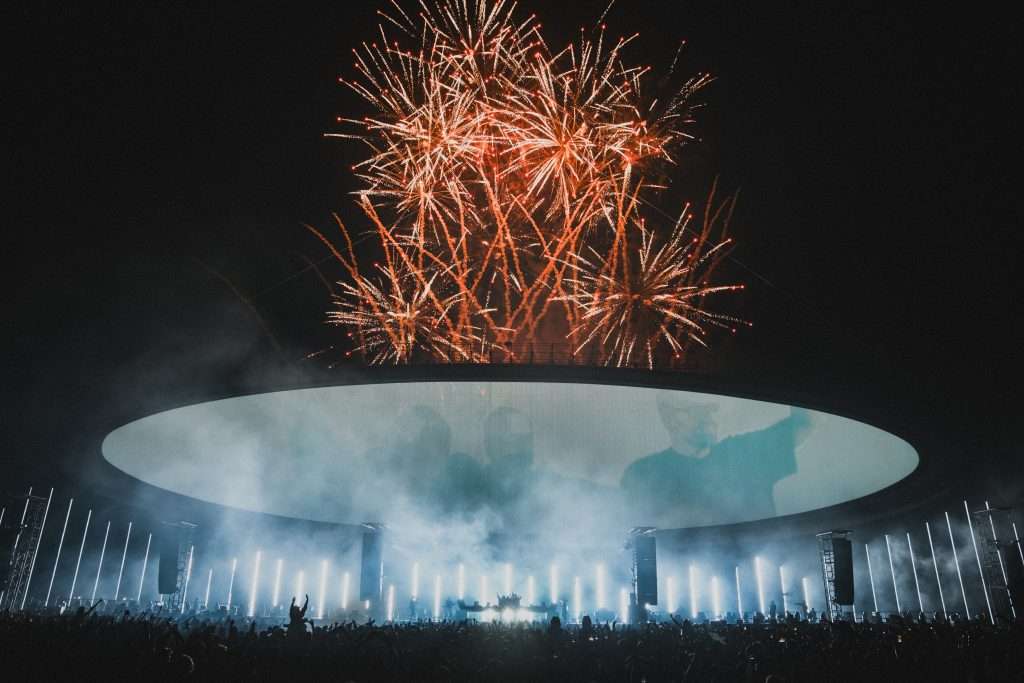
Photo Credit: Head Trip 2026
Idea one: scarcity as strategy — and its fragility
"One-time-only" is a dangerous promise: it sets a bar you can't underdeliver against, and it invites the audience to decide whether the lineup merited the framing. Goldenvoice has run this playbook before — Desert Trip and Power Trip, its one-off gatherings of classic rock and metal titans, were the templates (Billboard).
The format's weakness is the weather. Saturday, just after 9pm — mid-Under Construction, right after the drop in Chris Lake's "Turn Off the Lights" — production cut the lights and put a lightning warning on every screen, as the remnants of Tropical Storm Rachel hit the region. The crowd, some initially reading it as a production trick (the lyric, inconveniently, was "turn off the lights"), evacuated as asked. Saturday ended early; Calvin Harris never played his headlining set; the Apple Music livestream was cut short (Billboard).
What happened next is the scarcity story actually paying off. Dom Dolla posted that artists were reworking their sets so Calvin Harris could play Sunday; Harris was added to day two; and Sunday's bill — DJ Harvey, Peggy Gou, Kettama b2b Dom Dolla, Skrillex, Swedish House Mafia, plus Harris — read like what Billboard's recap called, accidentally, "the craziest one-night lineup in EDM history." A single-stage, one-time-only festival can't reroute a storm, but it can re-stack its only night — and the re-stack itself became the story. Chris Lake called the aborted Saturday "probably the best show I've ever played" and thanked the crowd; Skrillex, whose Sunday set drew criticism from livestream viewers for transition hiccups, publicly apologized: "No excuses, will take the L and make a lesson of it" (Digital Music News).
Idea two: the stage as headliner
The stage, designed by Romain Pissenem and his company High Scream, was widely described as a headliner in its own right — an orb motif in silver, orange, red and dark grey, mini orb screens giving every sightline the same view, lasers that residents reported spotting from miles away, and pyro used sparingly enough never to drown the music (Digital Music News).
Pissenem's credentials explain the ambition: theatre and TV director turned stage designer, with work stretching from Madison Square Garden to the closing ceremony of the Paris 2024 Olympic Games, the shows at Ushuaïa and Hï Ibiza, collaborations with David Guetta, Martin Garrix, DJ Snake and Black Coffee — and, per Billboard, France's 2026 Statue of Liberty birthday event and a knighthood from the French government earlier this year.
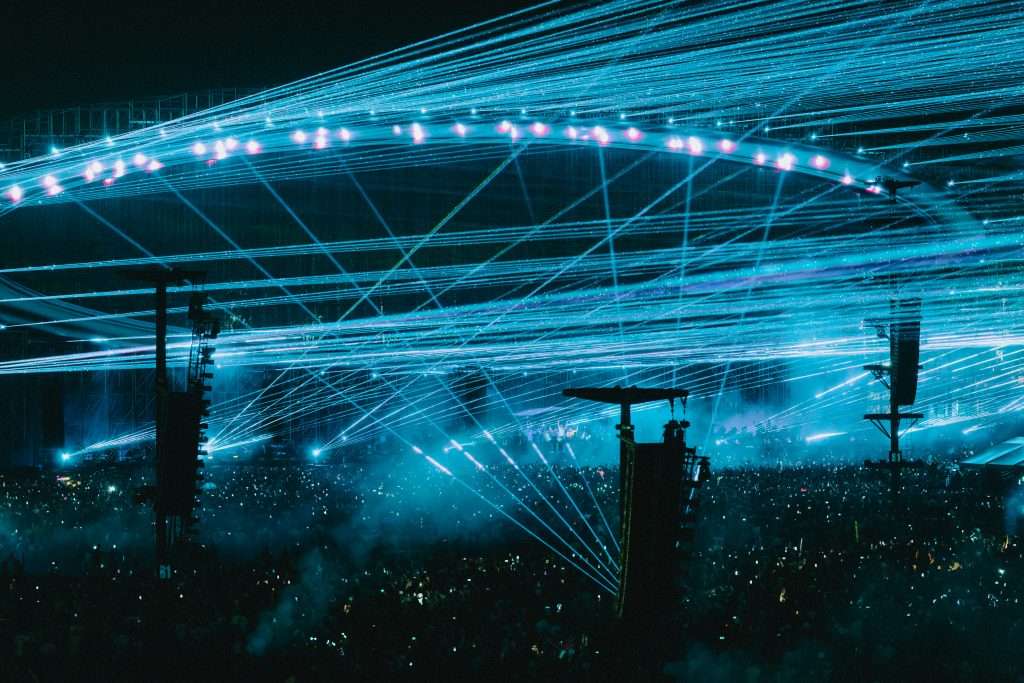
Photo Credit: Head Trip 2026
His design philosophy, as he put it to Billboard, is built for the person with the worst seat: "When you save much money to go to see something and sometimes have the worst seat at the end of the venue... I design so that anywhere you are, you can see and enjoy the show." The obvious question the DMN review poses to the rest of the festival business: EDC builds stages this immersive every year — why don't Coachella, Lollipalooza and other multi-genre festivals do it more often? The honest answer is probably that single-genre, single-stage festivals can spend the entire production budget on one structure. Multi-stage festivals can't.
The design language even ran to the drive in: each billboard on the way to the site, designed by Jiayi Li, showed a different DJ deck rendered as a piece of art, no taglines, the only branding a discreet Apple Music logo in the corner (Digital Music News).
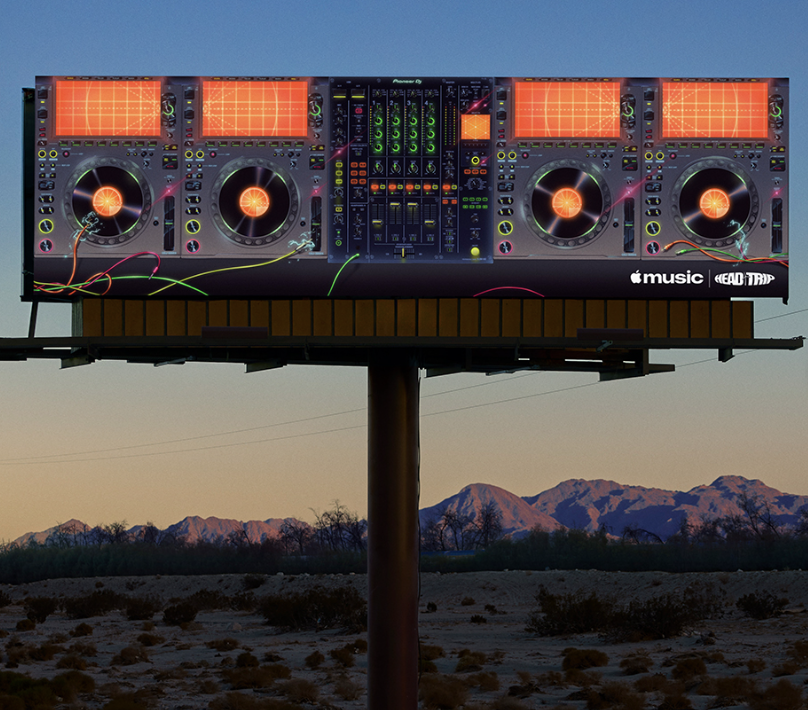
Photo Credit: Jiayi Li via Instagram
Idea three: the ungated livestream
The boldest experiment was the distribution. Head Trip was the first full festival video livestream in Apple Music's history, in any genre — free, and pushed as far as possible rather than held as an exclusive: the stream ran simultaneously on Apple Music's own accounts on YouTube, TikTok and Twitch, with an audio-only simulcast on Apple Music 1, Apple Music Club, TuneIn and SiriusXM. Performance videos are headed to each DJ's own YouTube channel; the audio sets live exclusively on Apple Music (Billboard).
Apple Music's global head of dance and electronic, Stephen Campbell, framed it as the opposite of gatekeeping: "We want the most amount of people around the world to experience this, so we're not gatekeeping it... Wherever you are in the world, you can watch this, listen to it, experience it." Goldenvoice's senior vp of talent Danny Bell said the one-and-done concept simply demanded it: "we just felt like it should be shared and captured. It's that simple" (Billboard).
There's real strategy under the generosity. A one-time-only festival has no next edition to protect ticket sales for — which makes maximal free distribution rational in a way it never is for Coachella itself. And the livestream was designed, not just switched on: Pissenem planned the stage for both audiences, telling Billboard that a show for social media, a livestream and a live crowd are "totally different" and that he designs for both. The DMN review confirms the stream "felt intentional, with real camera direction rather than a four-cam switch" — and the Sunflower Sound System stage, curated by Floating Points with sets from Ben UFO, Theo Parrish and Avalon Emerson, wasn't livestreamed at all but recorded in spatial audio for exclusive release on Apple Music. Some scarcity, it turns out, survives even the anti-gatekeeping strategy.
The verdict on the test case
The DMN review's bottom line is the one the industry will quote: Head Trip "plays like a test case for using festival grounds outside the main season." Coachella's Polo Fields sit mostly empty for ten months a year; a one-off that sells out with 90,000-strong crowds, deploys a purpose-built one-off stage, and hands a platform partner its first full-festival livestream is proof the asset can be monetized far beyond April.
Two open questions will decide whether the "one-time-only" framing holds. The first is whether Goldenvoice can resist running it back — the review's own condition is that "the lineup has to carry the same weight," and stacked one-offs that repeat become... a festival. The second is whether Apple Music archives the stream. For a weekend that will never happen again, the livestream is the only artifact — and the whole point of the anti-gatekeeping strategy would be undermined by locking the memory away. A festival business built on scarcity needs somewhere permanent to point people who missed it. Coachella, as the review notes, is right there.
Listen to the artists of Head Trip on Apple Music at apple.co/headtrip.
Sources
- Digital Music News — What Head Trip Taught the Music Festival Business About Scarcity, Stage Design, and Livestreaming (Nicole Haiimpoor), October 16-17, 2026
- Billboard — Head Trip Was a One-Time-Only Festival. Apple Music Made Sure the World Saw It (Katie Bain), October 16, 2026
- Billboard — Head Trip 2026 Was (Accidentally) the Craziest One-Night Lineup in EDM History: Seven Takeaways From the Historic Festival
- Billboard — Goldenvoice to Host New Head Trip Fest at Coachella Grounds With Skrillex, Calvin Harris & More